Skip to content
Briefings are running a touch slower this week while we rebuild the foundations.See roadmap
Iran Conflict 2026
1JUN

Senate war powers vote; unenforceable

3 min read
08:32UTC

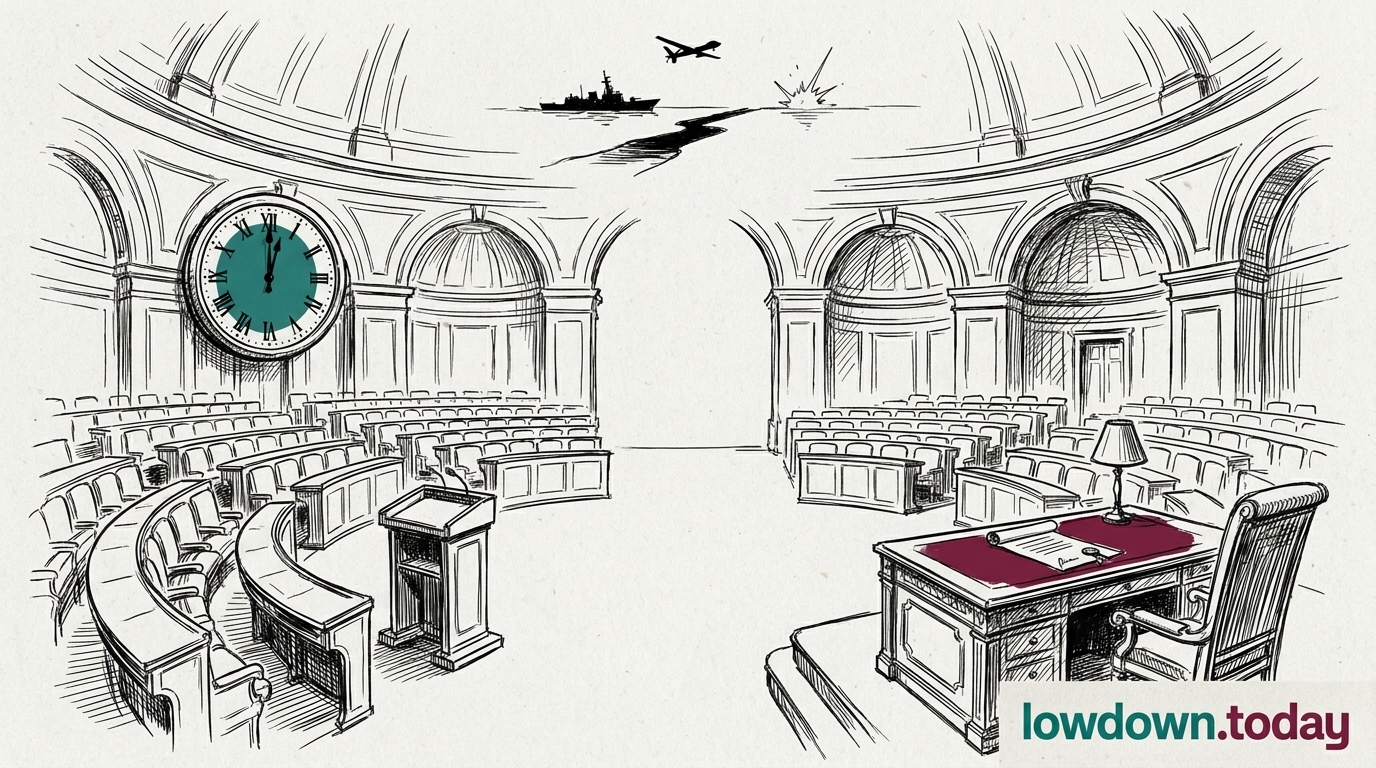
The Senate voted on the Kaine–Paul War Powers Resolution five days into an undeclared conflict. No tally was released, and the resolution faces certain defeat or presidential veto.

ConflictDeveloping
Key takeaway

The resolution's constitutional significance is archival rather than operational — it creates a formal legislative record that Congress asserted its war powers were bypassed, which may anchor future legal or historical accountability even as it fails to constrain current operations.

The Senate voted Wednesday on the KainePaul War Powers Resolution, which would require congressional approval for further military action against Iran. As of 11:29 UTC, no official tally had been released. Speaker Mike Johnson stated the House "has the votes to defeat the measure" when it takes up the resolution Thursday. A presidential veto is near-certain even if both chambers pass.

The resolution's path to restraining the campaign is closed, and the historical pattern explains why. Congress passed a War Powers Resolution on Yemen in 2019; President Trump vetoed it. Both chambers passed Iran-specific resolutions after the January 2020 killing of Quds Force commander Qassem Soleimani; neither constrained anything. No War Powers Resolution targeting a specific military operation has survived a presidential veto in the fifty-three years since the original 1973 act was passed over Nixon's objection.

The vote's function is documentary. Secretary Rubio told congressional leaders the US knew Israel would strike Iran, knew retaliation against American forces would follow, and launched pre-emptive strikes to reduce anticipated casualties . Senator Mark Warner, vice-chairman of the Senate Intelligence Committee, stated he saw "no intelligence" supporting the administration's imminent-threat claim . The resolution places Congress formally on record that the war's legal basis — self-defence under Article II — is contested by the senior Democrat on the intelligence oversight committee.

That record acquires weight if the conflict expands. President Trump declined to rule out ground troops on Monday , reversing his own statement from forty-eight hours earlier that the campaign would last "four weeks or less" . Congress will have registered its opposition to the war's legal foundation without taking any binding action to constrain its scope — the same constitutional deadlock that has defined American war-making since Vietnam.

Deep Analysis

In plain English

After the Vietnam War, Congress passed a law — the War Powers Resolution — saying the president can't keep troops in combat for more than 60 days without congressional approval. Every president since has argued the law is unconstitutional, used it as little as possible, and courts have refused to referee disputes about it. What Senators Kaine and Paul are doing is forcing a vote that goes on the official record: 'Congress did not authorise this war and objects to it.' Even if the vote fails in the Senate, is defeated in the House, or is vetoed by the president, the record exists. That matters for history, for any future court cases, and for the political accountability of everyone who voted.

Deep Analysis
Synthesis

The Kaine-Paul pairing recurs in every major post-2001 conflict debate — progressive Democrats opposed to military intervention and libertarian Republicans opposed to executive overreach form a coalition that documents objection but never achieves enforcement. The coalition's persistence across conflicts reveals a durable constitutional tension that the political system has chosen to leave unresolved: Congress retains the formal power to declare war but has structurally abdicated the practical power to stop one. Each failed WPR resolution extends that abdication and lowers the implicit threshold for future unilateral executive military action.

Root Causes

The WPR is structurally unenforceable for two reinforcing reasons: courts treat it as a non-justiciable political question (removing judicial enforcement), and Congress has never used its ultimate tool — cutting off military funding — because doing so during active combat is politically untenable for any legislator who could be accused of abandoning troops in the field. This structural trap means the executive branch can conduct sustained military operations with nominal WPR compliance indefinitely, and both parties' leaderships have accepted this arrangement across administrations.

What could happen next?
  • Meaning

    A bipartisan but sub-threshold coalition opposing the war without enforcement capacity demonstrates that constitutional war-powers constraints are politically non-binding when a president acts decisively and rapidly.

    Immediate · Assessed
  • Consequence

    Failure of the resolution continues the post-1973 pattern of WPR being invoked symbolically but never enforced operationally, further hollowing the statute and making future challenges to executive war-making progressively less credible.

    Long term · Assessed
  • Risk

    If the WPR's 60-day clock has started — which the administration will likely dispute — a legal challenge could theoretically force the administration to make public its legal rationale for continuation, exposing the internal constitutional arguments to scrutiny even if courts decline to act.

    Short term · Suggested
  • Precedent

    A Trump veto of a Kaine-Paul resolution, added to his two Yemen vetoes, would establish a three-instance record of a single president vetoing congressional war-powers challenges — an unprecedented accumulation that future executives can cite as normalised practice.

    Medium term · Assessed
First Reported In

Update #18 · First Iranian warship sunk since 1988

Washington Post· 4 Mar 2026
Read original
Causes and effects
This Event
Senate war powers vote; unenforceable
Creates a formal congressional record of dissent on military action launched without legislative authorisation, establishing that the war's legal basis is contested at the highest levels of intelligence oversight — a record with legal and political implications if the conflict expands to ground operations.
Different Perspectives
Human rights monitors (Hengaw, Amnesty International, Iran HRM)
Monitors documented a second death sentence for Zahra Tabari, 68, reported cemetery record deletions at Behesht-e Zahra, and a poll showing 81.5% of medical residents want to emigrate, against a background of 200+ confirmed executions since February. Iran's security courts operate at uninterrupted wartime tempo regardless of the diplomatic track.
Pakistan (mediator)
Pakistan (mediator)
Islamabad carried Trump's revised MOU demanding HEU destruction to Iranian negotiators, formally inheriting the role of sole active mediator after Oman's forced withdrawal. Pakistan lacks Oman's banking infrastructure for frozen-asset routing and carries its own regional stakes, making it a less structurally neutral broker.
Kuwait
Kuwait
Kuwait intercepted Iranian missiles and drones for a second time in days on 1 June, with air-raid sirens sounding nationwide, after invoking Article 51 self-defence on 28 May following the Ali Al Salem ballistic-missile strike. The repeated interceptions test whether Kuwait's domestic politics can sustain hosting US forces as a de facto co-belligerent.
China (PRC)
China (PRC)
Beijing sent scholars to Shangri-La rather than its defence minister and addressed Taiwan without mentioning Iran, maintaining bilateral energy corridor protection with Tehran while refusing diplomatic exposure at multilateral forums. Trump barred China as an HEU custodian on 27 May, removing Beijing from the deal architecture while China continues supplying DPI hardware that caps Iran's internet.
Lloyd's of London / war-risk underwriters
Lloyd's held its Hormuz war-risk designation at $10-14 million per voyage while Brent recovered to $93.91, maintaining the structural divergence from futures pricing that has persisted since late May. Underwriters require a UN Security Council resolution or government certification letter, not diplomatic optimism.
Gulf Cooperation Council states (Saudi Arabia, UAE, Bahrain, Qatar)
Five Gulf states wrote to the IMO on 21 May rejecting Iran's PGSA transit authority over international waters; Saudi Arabia and the UAE have not confirmed participation in the European Hormuz mission. The GCC is navigating between US security guarantees and exposure to Iranian fire, with no Gulf state formally co-belligerent except Kuwait.