
Skip to content
Briefings are running a touch slower this week while we rebuild the foundations.See roadmap
Iran Conflict 2026
2MAR

Day 3: Qatar's LNG dark; Trump eyes ground troops

3 min read
19:29UTC

Iranian drone strikes shut down Qatar's Ras Laffan and Mesaieed LNG facilities — 20% of global production — and Saudi Aramco's Ras Tanura refinery, triggering the sharpest energy price shock of the conflict. Qatar shot down two Iranian Su-24 jets in the first Gulf state air-to-air engagement with Iran. Trump declined to rule out US ground troops, reversing his position from 72 hours earlier.

Key takeaway

Iran's strikes have shifted from military retaliation to economic warfare targeting the global energy system, and the acknowledged breakdown in Iranian command and control means diplomatic channels may not be able to halt the escalation they are trying to address.

This briefing mapped
Loading map…
Military
Economic
Legal

Iranian drones hit the energy infrastructure of a US treaty ally that took no offensive role in the conflict, testing whether Washington treats attacks on CENTCOM's host nation as attacks on its own forces.

Sources profile:This story draws on centre-left-leaning sources from United States and Qatar
United StatesQatar

Iranian drones struck Ras Laffan Industrial City and Mesaieed in Qatar on Monday evening, the first direct Iranian attack on Qatar's fixed energy infrastructure. Until Monday, Iran's retaliatory fire had targeted military installations and commercial shipping.

Iran's decision to strike the energy infrastructure of a non-belligerent US treaty ally transforms the conflict from a bilateral military exchange into an attack on the global energy system and tests whether Washington will extend its military response to cover attacks on allied economic targets. 

Briefing analysis

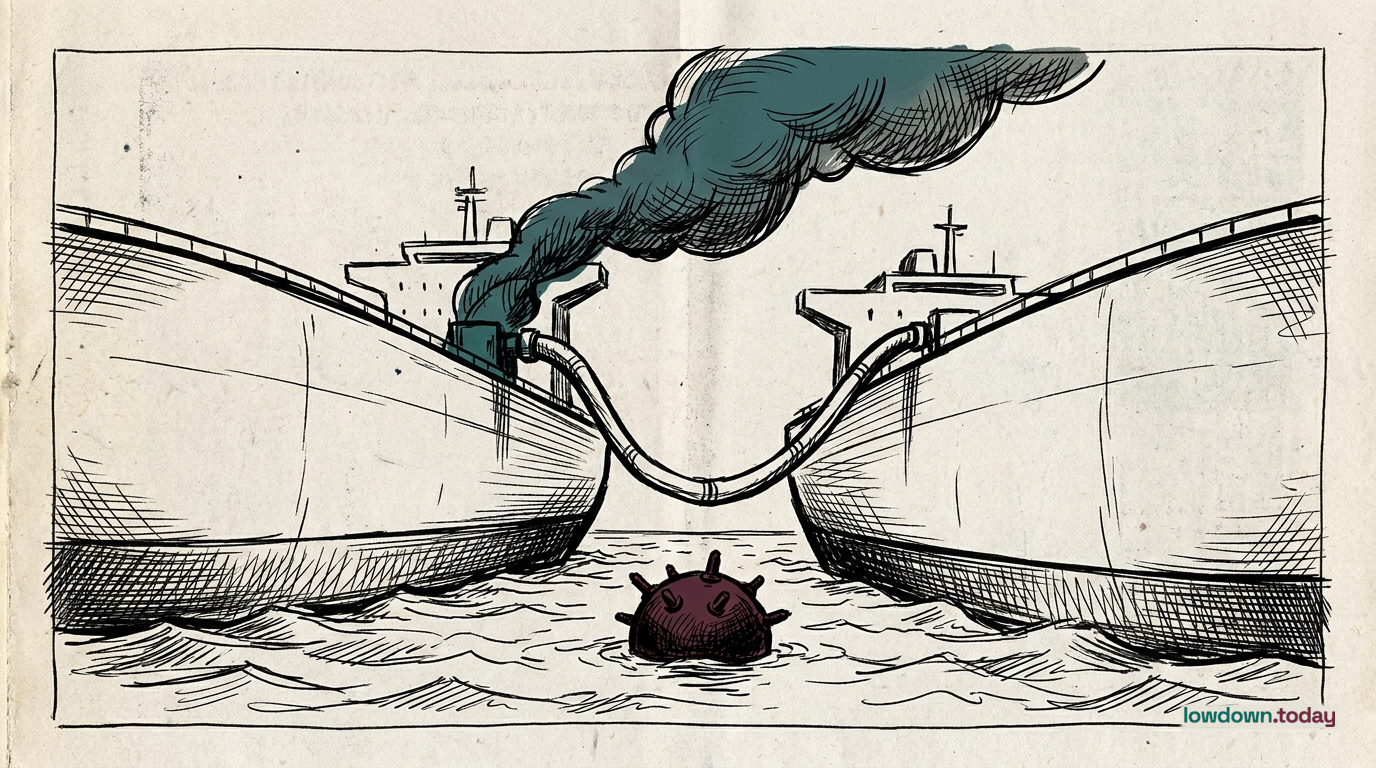
During the Iran–Iraq War, both sides attacked oil tankers and Gulf energy infrastructure to impose economic costs on the other's allies. Iran struck Kuwaiti oil facilities in 1987 to punish Kuwait for financing Iraq; the US responded with Operation Earnest Will, reflagging Kuwaiti tankers under the American flag, and eventually Operation Praying Mantis — the largest US naval engagement since the Second World War — after the frigate USS Samuel B. Roberts struck an Iranian mine.

The parallel is direct: Iran is again targeting the energy infrastructure of Gulf states it views as enabling an adversary's military campaign. The difference in scale is substantial — Ras Laffan's 77 million tonnes of annual LNG capacity dwarfs anything struck in the 1980s, and the EU's post-2022 dependence on Qatari LNG means the economic transmission is global rather than regional.

QatarEnergy shut all production at Ras Laffan and Mesaieed — 14 processing trains, 77 million tonnes of annual capacity, one-fifth of the world's LNG supply removed from global markets in a single evening.

Sources profile:This story draws on centre-left-leaning sources from Qatar and United States
United StatesQatar

QatarEnergy confirmed it had ceased all LNG production at Ras Laffan and Mesaieed following the Iranian drone strikes. Ras Laffan is the world's largest LNG export facility. Qatar produces 20% of the world's Liquefied Natural Gas.

The shutdown of the world's largest LNG export facility removes one-fifth of global LNG supply, completing Iran's degradation of all three pillars of Gulf energy exports — production at Ras Laffan, refining at Ras Tanura, and transit through the strait of Hormuz

European gas prices surged 45–54% within hours as the supply chain the EU spent four years building to replace Russian pipeline gas came under direct Iranian fire.

Sources profile:This story draws on centre-left-leaning sources from United States
United States

European gas prices surged 45–54% within hours of the Qatar strikes. Asian LNG spot prices rose 39%. Oil climbed 13% intraday above $82 per barrel. The EU had spent four years replacing Russian pipeline gas with Qatari LNG, and that supply line is now under direct fire.

The price surges expose a structural flaw in European energy security: four years of replacing Russian pipeline gas with Qatari LNG created a new single point of failure now under direct military threat, while simultaneously triggering a supply emergency for LNG-dependent Asian economies. 

Sources:Bloomberg·CNBC

An Iranian strike shut Saudi Aramco's 550,000-barrel-per-day Ras Tanura refinery. Iran has now degraded Gulf oil production, refining, and transit — all three pillars of the region's energy export architecture.

Sources profile:This story draws on centre-left-leaning sources from United States and United Arab Emirates
United StatesUnited Arab Emirates

A separate Iranian strike shut Saudi Aramco's Ras Tanura refinery, which has 550,000 barrels per day of refining capacity. Iran has now degraded all three pillars of The Gulf's energy export architecture: production at Ras Laffan, refining at Ras Tanura, and transit through Hormuz.

Iran's strike on Ras Tanura completes the systematic degradation of all three pillars of Gulf energy exports — production at Qatar's Ras Laffan, refining at Ras Tanura, and transit through the strait of Hormuz — within one week, transforming a bilateral military conflict into a structural global energy supply crisis that OPEC+'s emergency response cannot offset. 

Qatar's air force destroyed two Iranian Su-24 attack aircraft — believed to be the first time a Gulf state has shot down Iranian military jets — dragging a non-belligerent CENTCOM host into direct combat.

Sources profile:This story draws on centre-left-leaning sources from United States and Israel
United StatesIsrael
LeftRight

Qatar's air force shot down two Iranian Su-24 attack aircraft, along with seven ballistic missiles and five drones, during Monday's defensive operations. This is believed to be the first time a Gulf state has destroyed Iranian military aircraft in combat.

The first destruction of Iranian military aircraft by a Gulf state draws Qatar — a non-belligerent US treaty partner hosting CENTCOM's forward headquarters, which also shares the world's largest gas field with Iran — into direct hostilities, and tests whether Washington treats an attack on Al Udeid as an attack on US forces

The first Indian national killed in the conflict — a mariner on a tanker struck for the second time in 48 hours — pressures New Delhi to break its silence on a war that threatens nine million Indian workers in the Gulf.

Sources profile:This story draws on centre-leaning sources from India and France
IndiaFrance
LeftRight

An Indian mariner was killed when a bomb-laden surface drone detonated against the hull of the MKD Vyom (Marshall Islands-flagged tanker), 52 nautical miles northwest of Muscat. The same vessel had been struck by a projectile on Saturday. This is the first Indian national killed in the conflict.

The first Indian death in the conflict compresses New Delhi's space for non-alignment. India has nine million citizens in The Gulf states and imports roughly 85% of its crude oil, making it acutely exposed to both the humanitarian and economic fallout of a war it has so far refused to comment on. 

President Trump told CNN the largest wave of strikes on Iran 'has not yet happened' and refused to rule out ground forces — seventy-two hours after promising a bounded air campaign lasting 'four weeks or less.'

Sources profile:This story draws on centre-left-leaning sources from United States
United States

In a CNN interview, President Trump stated that the largest wave of strikes on Iran 'has not yet happened' and declined to rule out sending US ground troops 'if necessary.' Seventy-two hours earlier, Trump had explicitly rejected ground forces and described the operation as lasting 'four weeks or less.'

The rhetorical shift from a time-limited air campaign to an open-ended operation with ground troops as a stated option widens the gap between the administration's legal framework and its operational trajectory, arriving as Congress prepares war powers votes and with four US service members killed in 72 hours. 

Erdogan positioned Turkey as the only actor with relationships on all sides of the conflict — but Iran's acknowledgement that its own military units are operating beyond central control raises the question of who would enforce any agreement.

Sources profile:This story draws on centre-left-leaning sources from United States and France
United StatesFrance

Turkey's President Erdogan called for 'an end to the bloodbath' and offered Turkish mediation between the US, Israel, and Iran. Turkey — NATO's second-largest military, Iran's western neighbour, a continuing buyer of Iranian oil — has relationships with all parties. No formal mediation process has been announced.

Turkey is the only state that maintains diplomatic, economic, and security relationships with the US, Israel, and Iran simultaneously, making it the most credible potential mediator. But the fracture between Iran's interim governing council and autonomous IRGC units means any ceasefire commitment may be unenforceable. 

The United States declared the November 2024 ceasefire over and told Lebanon it will make no distinction between Hezbollah and the Lebanese state unless Beirut designates the group a terrorist organisation — a demand that requires Lebanon to confront a force its army cannot defeat.

Sources profile:This story draws on centre-left-leaning sources from United States, France and 1 more
United StatesFranceQatar

The United States told Lebanon that the November 2024 ceasefire is formally over and Washington will not intervene to stop Israeli operations unless Beirut designates Hezbollah a terrorist organisation. The ultimatum: comply or the US will make no distinction between Hezbollah and the Lebanese state.

The ultimatum collapses the diplomatic framework that ended the 2024 Lebanon war and demands Lebanon take an enforcement action — designating and confronting Hezbollah — that its 80,000-strong army has never been able to execute against a 30,000–50,000-strong militia with combat experience and an independent arsenal. 

Lebanon's Justice Minister ordered arrest warrants for those who fired at Israel — the most direct challenge to Hezbollah's armed status since the civil war ended in 1989. The Lebanese army has 80,000 troops; Hezbollah has up to 50,000.

Lebanon's Justice Minister ordered the public prosecutor to arrest those who fired at Israel, extending Prime Minister Salam's earlier ban on all Hezbollah military activities — the most direct governmental challenge to Hezbollah's armed status in Lebanon's post-civil-war history.

The arrest orders extend the Lebanese government's challenge to Hezbollah from political declaration to legal enforcement, but the state's military inferiority to Hezbollah — demonstrated when the group seized West Beirut in 2008 over a far lesser provocation — raises the question of whether the orders can be executed without triggering the internal conflict they are meant to prevent. 

Sources:Haberler
Closing comments

Three escalation vectors are open simultaneously. First, Trump's 72-hour shift from 'no ground troops' to 'if necessary' follows the pattern of stated-objective expansion that preceded ground deployments in Vietnam (advisory mission to combat troops, 1961–65) and Iraq (WMD elimination to regime change to nation-building, 2003–04). Second, the Lebanon front is reopening: the US has declared the ceasefire over and Lebanon's government is attempting to enforce sovereignty over Hezbollah for the first time, risking an internal confrontation it lacks the military capacity to win. Third, Iranian command fragmentation means escalation can occur without political authorisation — the interim council may want de-escalation but lack the mechanism to deliver it. Congressional war powers votes this week will not constrain the administration (two-thirds majority is unattainable) but will create a political record as the operation's scope expands beyond its original legal justification.

Emerging patterns

  • Escalation from military and shipping targets to fixed energy infrastructure of non-combatant states
  • Critical energy infrastructure shutdowns cascading into global supply disruption
  • Energy price shock widening from oil to gas markets as conflict hits LNG infrastructure directly
  • Systematic degradation of all three pillars of Gulf energy export architecture: production, refining, transit
  • Gulf states transitioning from passive targets to active combatants against Iran
  • Maritime attacks killing third-country nationals, compressing non-aligned states' space for neutrality
  • US mission creep: bounded air campaign shifting to open-ended operation with ground troop option within 72 hours
  • Regional actors with cross-party relationships positioning as mediators after Iran rejected direct US engagement
  • US leveraging conflict conditions to force structural changes in partner states' internal security arrangements
  • Lebanese government escalating from political bans to judicial action against Hezbollah military operations
Different Perspectives
Lebanon's Justice Minister
Ordered the public prosecutor to arrest those who fired at Israel, extending PM Salam's ban on all Hezbollah military activities — the most direct governmental challenge to Hezbollah's armed status in Lebanon's post-civil-war history.
Qatar Air Force
Qatar Air Force
Shot down two Iranian Su-24 attack aircraft, seven ballistic missiles, and five drones — believed to be the first time a Gulf state has destroyed Iranian military aircraft in combat.
President Trump
President Trump
Declined to rule out US ground troops in Iran, reversing his explicit rejection of ground forces stated 72 hours earlier, and stated the largest wave of strikes has not yet occurred.
United States (to Lebanon)
Declared the November 2024 ceasefire formally over and conditioned intervention against Israeli operations on Lebanon designating Hezbollah a terrorist organisation — abandoning a ceasefire the US itself brokered.
