Skip to content
You can now search across every topic, entity and event.What's new
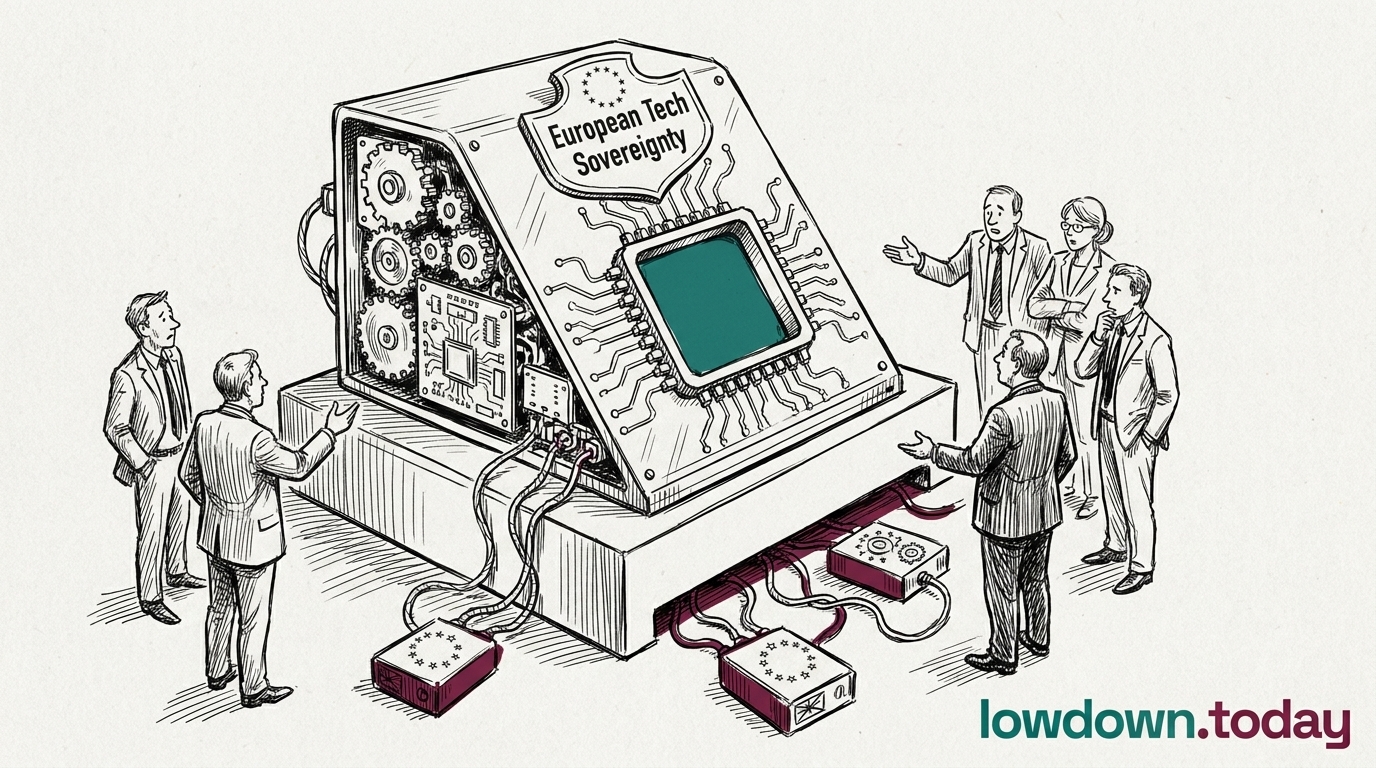
European Tech Sovereignty
23APR

Mojtaba speaks via proxy, unseen

3 min read
09:21UTC

The new Supreme Leader's first public statement was read by another person while a photograph was displayed. Mojtaba Khamenei has not been seen since taking office — raising the question of who actually commands Iran's war.

TechnologyDeveloping
Key takeaway

A Supreme Leader who cannot be seen cannot perform the arbitration function that holds Iran's parallel power structures together.

Iran's state media broadcast the first public statement from Supreme Leader Mojtaba Khamenei on Thursday. He did not appear on camera. Another person read his words. A photograph was displayed. The content confirmed existing policy — "The lever of blocking the strait of Hormuz must continue to be used" — and added an open-ended threat: "Studies have been conducted regarding the opening of other fronts in which the enemy has little experience and is highly vulnerable." He did not specify which fronts.

The statement's form matters more than its substance. Since the Assembly of Experts appointed him under IRGC pressure on 7 Marchwith eight members boycotting the voteMojtaba Khamenei has not been seen in public. Iran International reported it remains unclear whether Thursday's statement is genuinely his. Iran's constitutional architecture rests on velayat-e faqih, the guardianship of the Islamic jurist — a doctrine that presupposes personal clerical standing and visible public authority. Ali Khamenei governed through Friday sermons, military inspections, and televised audiences with officials over 35 years. His son is governing through unsigned text read aloud by someone else.

The practical consequence is a question of command. The IRGC pledged "complete obedience" within hours of the appointment , but the Council on Foreign Relations assessed that Mojtaba Khamenei holds only a "minimum viable legitimacy base" to sustain the war effort . If The Supreme Leader cannot appear — whether because of Israeli assassination threats , injury, or factional constraint — operational authority rests with the IRGC's 31 provincial commanders by default. Those commanders have already demonstrated they can sustain coordinated offensive operations without central command infrastructure, launching 109 drones and 9 ballistic missiles at UAE targets in a single day after Israel destroyed the IRGC's aerospace and drone headquarters in Tehran . Iran may be fighting a war in which the nominal commander-in-chief issues written directives no one can verify, while the military's decentralised structure makes the real decisions on the ground.

Deep Analysis

In plain English

Iran runs two overlapping power systems. The elected government — led by President Pezeshkian — handles diplomacy and day-to-day administration. The unelected Supreme Leader holds ultimate authority over the military, nuclear programme, and strategic direction. The Supreme Leader's power is personal: it rests on religious standing, physical presence, and the ability to arbitrate disputes between Iran's competing factions in real time. When Mojtaba Khamenei issues a written statement read aloud by someone else, it is the equivalent of a company's chief executive communicating only through anonymous press releases. No one can question him directly. Factions within Iran's security establishment — particularly the IRGC — can interpret any ambiguous order in whatever way suits their preferred course of action. The IRGC, which controls Iran's military and operates largely outside presidential authority, has every structural incentive to claim ambiguous directives support escalation.

Deep Analysis
Synthesis

The gap between Pezeshkian's ceasefire conditions and Khamenei's 'new fronts' language is not merely a policy disagreement — it is evidence that no single authority is co-ordinating Iranian strategy. In a state with this degree of internal fracture, de-escalation requires not just a ceasefire agreement but a domestic political settlement that does not currently exist. Any deal Pezeshkian signs could be immediately repudiated by IRGC commanders citing Khamenei's 'new fronts' directive as superseding it.

Root Causes

Mojtaba Khamenei's absence likely reflects two compounding factors. Physical security concerns following his father's death in the 28 February strikes are one element. The deeper issue is a legitimacy deficit inherent in his rapid elevation: he was appointed without the decades of public religious scholarship traditionally required before the Assembly of Experts validates a Supreme Leader. His authority has not been consolidated through the constitutional process in the manner his father's was, leaving it structurally contested from within the clerical establishment.

Escalation

The 'other fronts' language is operationally significant in a specific way. Given the same-day Stryker cyberattack and drone boat deployments documented in other events, the statement may be retrospective endorsement rather than forward direction — the Supreme Leader ratifying actions the IRGC has already taken, rather than ordering new ones. If so, the statement reveals a command structure in which the IRGC acts and the Supreme Leader follows, not the reverse.

What could happen next?
  • Risk

    If Mojtaba Khamenei's statements are not genuinely his, any ceasefire agreement concluded under his authority could be immediately contested by IRGC factions citing a different reading of his directives.

    Short term · Suggested
  • Meaning

    Governance by proxy text effectively transfers de facto operational authority to IRGC provincial commanders, who will interpret ambiguous directives according to their own strategic preferences.

    Immediate · Assessed
  • Risk

    The legitimacy vacuum at the top of Iran's system may attract internal challenges from senior clerics in Qom questioning Mojtaba's credentials and from political factions seeking to exploit his absence.

    Medium term · Suggested
  • Consequence

    The unspecified 'other fronts' language provides IRGC commanders with open-ended authorisation to escalate in any theatre, making Iranian action harder to predict or pre-empt diplomatically.

    Immediate · Assessed
First Reported In

Update #33 · Oil breaks $100; war reaches Iraqi waters

Al Jazeera· 13 Mar 2026
Read original
Causes and effects
This Event
Mojtaba speaks via proxy, unseen
In Iran's constitutional system, the Supreme Leader's authority rests on the doctrine of velayat-e faqih — personal clerical guardianship. Governing through unverified, proxied text without a single public appearance is without precedent in the Islamic Republic's 47-year history. If Mojtaba Khamenei cannot or will not appear, operational command defaults to the IRGC's 31 autonomous provincial commanders, who have already demonstrated the capacity to sustain fire without central direction.
Different Perspectives
United States (Google/Alphabet)
Alphabet lost its final Android appeal on 2 July with no further court to hear it, a result its Computer and Communications Industry Association allies frame as precedent, not deterrence, since the €4.1bn fine changed nothing about Google's Play Store terms across eight years of litigation.
UK Department for Science, Innovation and Technology
DSIT opened its £96m second Sovereign AI wave on 3 July, switching from April's equity stakes to fixed-price contracts because Britain has no domestic hyperscaler or Bpifrance-style lender to fund capacity another way. It is betting on buying outcomes it controls alone rather than joining an EU-wide framework.
German federal government
Berlin backed both German deliverables this week, Infineon's fab and Aleph Alpha's merger, but is finding one far harder to close than the other. It wants enforceable protective rights inside Cohere's cap table before the merger closes, a legal instrument the Bundeskartellamt has no filing to review yet.
European Commission
European Commission
The Commission banked a clean CJEU win on the eight-year Android case on 2 July, removing Google's last comparator argument before President von der Leyen rules on the far larger DMA self-preferencing fine due 27 July. Brussels treats Infineon's early Dresden delivery as proof the Chips Act mechanism works, at the node Europe already led.
Bruegel (EU industry sceptics)
Bruegel economist Mario Mariniello argued the EU sovereignty package mimics US and Chinese strategy while EU cloud providers hold roughly 15% of their home market; using nationality as a proxy for security without fixing the underlying capital and energy gaps that drive the dependency creates €86bn of migration cost without the security benefit it is sold as delivering.
France
France
France published a joint sovereignty definition with Germany at VivaTech and mobilised €13bn under Tibi Phase 3, placing SAP's partnership with Mistral as the working proof that a German enterprise-software giant running a French sovereign model inside public administration is what digital sovereignty looks like in practice.
