Skip to content
You can now search across every topic, entity and event.What's new
European Oil Markets
15JUN

Russia's wealth fund sheds $4.8bn

2 min read
11:33UTC

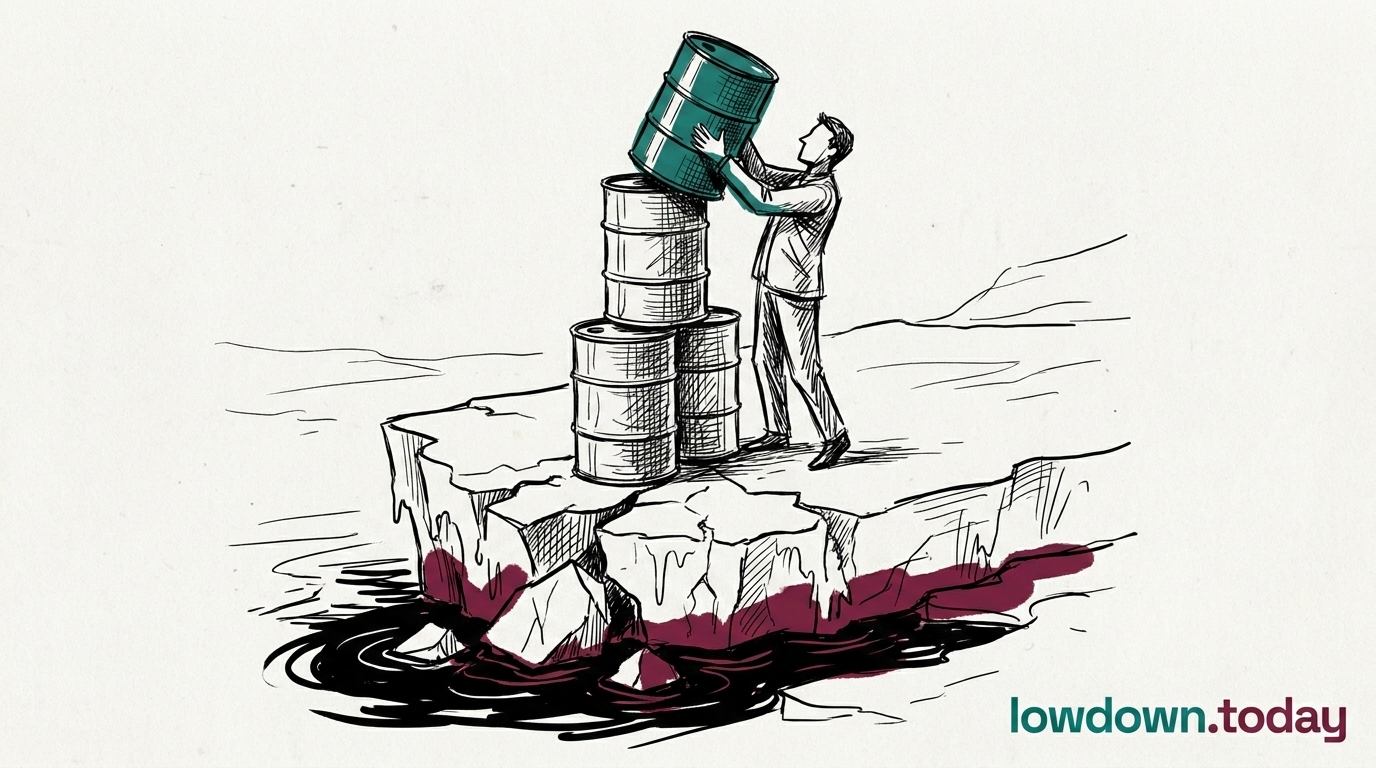
Rising oil prices could not prevent Russia's National Wealth Fund from haemorrhaging reserves as the business climate index turned negative for the first time in three years.

EconomicDeveloping
Key takeaway

Russia's financial buffers are shrinking despite oil prices above budget assumptions.

Russia's National Wealth Fund shed 400 billion roubles ($4.8 billion) in January and February 2026 1. The country's business climate index turned negative in March for the first time since October 2022. Fixed capital investment fell 2.3% in real terms during 2025.

The Urals benchmark has risen $11.30 to $73.24 per barrel, well above Russia's $59 budget assumption. Yet rising prices did not prevent the fund's decline. Russia is spending 38 to 40% of its federal budget on defence, the highest proportion since the Soviet era . Moscow dropped planned 10% cuts to non-military spending after the Iran-war oil price surge, only to face a revenue squeeze from the opposite direction: not low prices, but destroyed export capacity at Baltic ports.


Deep Analysis

In plain English

Russia has a 'rainy day fund' called the National Wealth Fund, similar to a national savings account. It lost $4.8 billion in just two months at the start of 2026, even while oil prices were high. Why? Russia is spending 38-40% of its entire government budget on the military, the highest proportion since the Soviet era. High oil prices were supposed to offset that. But Russia is spending the money faster than it earns it. Now the oil export damage from the Baltic port strikes compounds the problem: Russia has high oil prices but can't ship as much oil. The business climate index turned negative in March for the first time in years, suggesting the civilian economy is feeling the strain.

Deep Analysis
Root Causes

Russia's fiscal deterioration reflects the simultaneous pressure of three forces. First: record defence spending at 38-40% of the federal budget, consuming reserves faster than revenues replenish them.

Second: investment collapse, with fixed capital investment down 2.3% in 2025, meaning Russia is not building the productive capacity needed to sustain long-term revenue growth. Third: the Baltic port disruption now compressing both the volume and revenue sides of the oil export equation simultaneously.

The business climate index turning negative for the first time since October 2022 is the civilian economy signal. It precedes consumer confidence deterioration by two to three quarters. If sustained, it indicates Russian business investment is contracting under war conditions despite high nominal oil prices.

What could happen next?
  • Consequence

    At current NWF depletion rates, Russia may need to cut non-military spending or increase deficit financing within 12-18 months, creating domestic economic pressure on the war effort.

First Reported In

Update #9 · Ukraine halves Russia's Baltic oil exports

Moscow Times· 1 Apr 2026
Read original
Different Perspectives
Sanctions compliance officer reviewing a Lukoil International GmbH bid
OFAC's amended FAQ 1224 gives a compliance desk its first published standard: full severance from Lukoil and a US-jurisdiction blocked account for sale proceeds. The conditions name neither ISAB nor Italy, so a Priolo Gargallo-linked bid answers a different question than a Neftochim Burgas or Petrotel Ploiesti one.
Managed-money funds on Brent Last Day
CFTC data for the week to 21 July showed managed money flipping 74,400 contracts to a net long of 15,665 against 1,410 short on the Brent Last Day contract, code 06765T. A fund that held that short through July has now covered it, and the spent short base raises the bar for the next leg higher.
Saudi crude exporters
Saudi-linked tanker transits through Bab el-Mandeb fell to about 7.5 a day after the 24 July underwriting withdrawal, pushing more barrels onto the longer route round the Cape or through the Yanbu terminal. Every diverted barrel ties up a ship for longer, and a fleet that turns slower charges more.
Tanker owners on the Bab el-Mandeb route
Lloyd's-market syndicates withdrew war-risk cover from Saudi-linked hulls on 24 July, leaving owners of that class of vessel to sail Bab el-Mandeb uninsured or not at all. Tanker transits on the route fell to roughly 7.5 a day, and cover, once withdrawn, does not return on a shipowner's timetable.
Eni
Eni
Eni's board approved second-quarter results on 29 July, swinging refining EBIT to a EUR0.08bn profit from a year-earlier loss even as group profit doubled, and named Red Sea freight cost as a cap on that improvement. A refiner absorbing higher shipping costs on Saudi-linked crude while its numbers improve treats the freight line as a drag, not a crisis.
Asian buyers (India, Japan, China, South Korea)
Asian refiners are absorbing 62% of Yanbu's 3.75m b/d flow, the bulk of Saudi Arabia's rerouted crude now clearing east rather than into the Atlantic basin. That destination split leaves Asian buyers more exposed to any single Yanbu-specific disruption than under the kingdom's normal multi-terminal export pattern.



