Skip to content
You can now search across every topic, entity and event.What's new
European Oil Markets
31JUL

Oil surges past $103 on blockade

3 min read
09:33UTC

Brent crude jumped 8% past $103 on Monday, reversing the post-ceasefire drop and making Goldman Sachs's $120 Q3 severe scenario the operative frame.

EconomicDeveloping
Key takeaway

Goldman Sachs's $120 severe scenario is now the operative frame, not the tail risk.

Brent Crude surged 8% above $103 on the blockade announcement, reversing the post-ceasefire drop that had taken prices to $92.21 . Goldman Sachs had cut its Q2 Brent forecast to $90 after the ceasefire was announced. The blockade made that forecast obsolete within a day. Goldman's severe scenario, $120 by Q3, is now the operative frame rather than the tail risk .

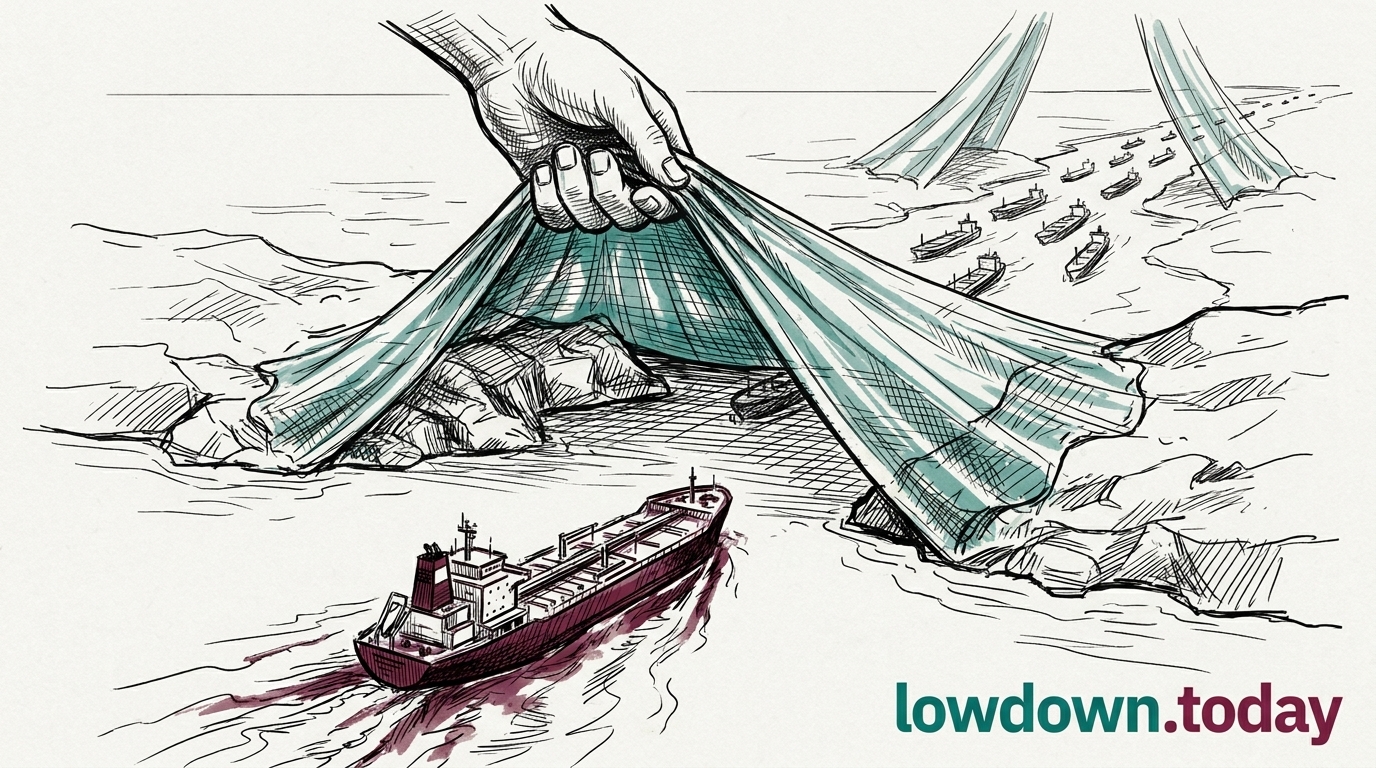
Approximately a dozen Iranian supertankers carrying an estimated $2.4 billion of crude sit stationary in the Gulf of Oman, caught between CENTCOM's blockade from one side and Iran's own mine and vetting regime from the other . The $2.4 billion figure derives from operational analysis rather than wire-service confirmation. 325 tankers remain stranded in the Gulf. Hormuz traffic, which had climbed to 17 transits by Saturday, dropped to near zero when enforcement started 1. 20,000 sailors aboard roughly 2,000 vessels are stranded.

Saudi Arabia has insulated itself: its Petroline pipeline, restored to full capacity, now routes all exports via the Red Sea, bypassing Hormuz. That protects Riyadh's revenue but does nothing for the 21 million bpd that normally transits the strait .


Deep Analysis

In plain English

Oil prices shot up sharply on Monday when the blockade was announced. Brent crude , the international benchmark for oil pricing , jumped 8% above $103 per barrel. For context, it had fallen to $92 after the ceasefire last week. Why does this matter to you? Oil prices feed into fuel prices at petrol stations, heating costs, and the cost of transporting goods. When oil goes up, almost everything gets slightly more expensive with a delay of a few weeks. Goldman Sachs, one of the world's largest banks, had previously predicted oil could reach $120 in the worst case. Before Monday, that seemed unlikely. Now analysts say it is possible without anything further going wrong.

What could happen next?
  • Consequence

    April CPI will layer blockade-driven fuel costs on top of March's 0.9% monthly rise , the largest since 1967 , creating a two-month compounding effect that central banks cannot offset without rate rises that would further damage consumer confidence.

    Short term · 0.85
  • Risk

    If Goldman's $120 scenario materialises, US Federal Reserve rate policy is constrained: cutting rates to support the economy while inflation is energy-driven would be politically untenable, forcing a stagflationary choice between growth and price stability.

    Medium term · 0.72
  • Opportunity

    Saudi Arabia, now exporting via Petroline and insulated from Hormuz disruption, benefits from elevated prices without the supply constraint , strengthening Riyadh's fiscal position and reducing its incentive to mediate a Hormuz resolution.

    Short term · 0.8
First Reported In

Update #67 · Trump blockades Iran on a tweet

CENTCOM / Al Jazeera· 13 Apr 2026
Read original
Different Perspectives
Sanctions compliance officer reviewing a Lukoil International GmbH bid
OFAC's amended FAQ 1224 gives a compliance desk its first published standard: full severance from Lukoil and a US-jurisdiction blocked account for sale proceeds. The conditions name neither ISAB nor Italy, so a Priolo Gargallo-linked bid answers a different question than a Neftochim Burgas or Petrotel Ploiesti one.
Managed-money funds on Brent Last Day
CFTC data for the week to 21 July showed managed money flipping 74,400 contracts to a net long of 15,665 against 1,410 short on the Brent Last Day contract, code 06765T. A fund that held that short through July has now covered it, and the spent short base raises the bar for the next leg higher.
Saudi crude exporters
Saudi-linked tanker transits through Bab el-Mandeb fell to about 7.5 a day after the 24 July underwriting withdrawal, pushing more barrels onto the longer route round the Cape or through the Yanbu terminal. Every diverted barrel ties up a ship for longer, and a fleet that turns slower charges more.
Tanker owners on the Bab el-Mandeb route
Lloyd's-market syndicates withdrew war-risk cover from Saudi-linked hulls on 24 July, leaving owners of that class of vessel to sail Bab el-Mandeb uninsured or not at all. Tanker transits on the route fell to roughly 7.5 a day, and cover, once withdrawn, does not return on a shipowner's timetable.
Eni
Eni
Eni's board approved second-quarter results on 29 July, swinging refining EBIT to a EUR0.08bn profit from a year-earlier loss even as group profit doubled, and named Red Sea freight cost as a cap on that improvement. A refiner absorbing higher shipping costs on Saudi-linked crude while its numbers improve treats the freight line as a drag, not a crisis.
Asian buyers (India, Japan, China, South Korea)
Asian refiners are absorbing 62% of Yanbu's 3.75m b/d flow, the bulk of Saudi Arabia's rerouted crude now clearing east rather than into the Atlantic basin. That destination split leaves Asian buyers more exposed to any single Yanbu-specific disruption than under the kingdom's normal multi-terminal export pattern.



