Skip to content
You can now search across every topic, entity and event.What's new
European Oil Markets
23JUL

The carriers that did not leave

2 min read
19:27UTC

The USS Abraham Lincoln and USS George H.W. Bush held station in the Gulf on 18 June with no drawdown order, as the blockade they backed came down.

EconomicDeveloping
Key takeaway

Trump opened the one lock that was free and kept the carriers that cost Iran.

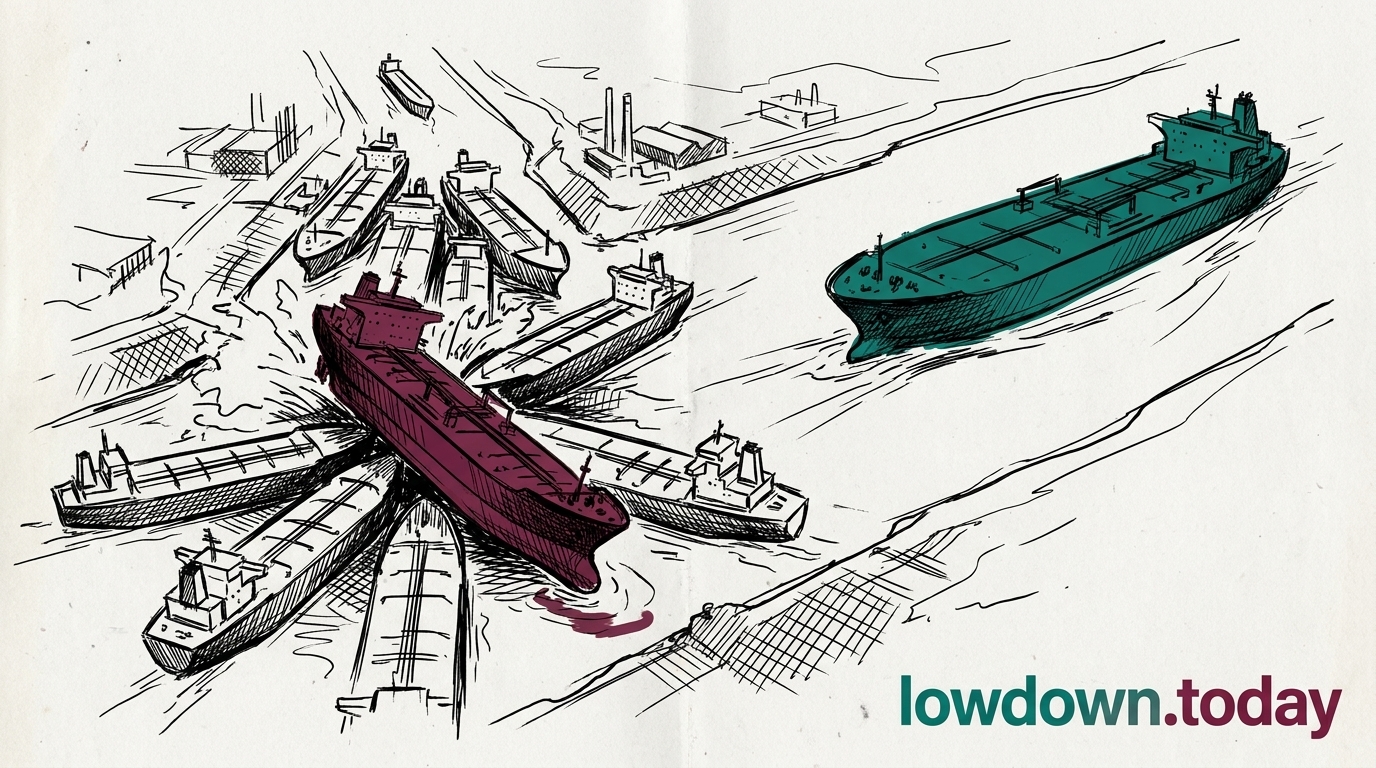
The USS Abraham Lincoln and USS George H.W. Bush held station in The Gulf on 18 June, with no CENTCOM drawdown order to accompany the blockade wind-down . The two carrier strike groups are the heaviest US naval presence in the region and the standing threat behind every clause of the deal.

The week's single instrument-level move was the blockade lift, and it was the cheapest one on the board: reversible, costless to the United States, and insufficient on its own to reopen a strait that insurers and minesweepers keep shut. Everything else the Memorandum of Understanding obligates, sanctions relief, weapons verification, reconstruction money and the strait's physical reopening, sits in a final agreement nobody has drafted.

Keeping the carriers on station makes the asymmetry literal. Trump gave up the lever that constrained Iran at no cost to America and retained the one that constrains Iran at a cost to Iran. Across every stage of this deal the pattern has held: the civilian side signs, the powers that matter, the Revolutionary Guard Corps, the carriers, the London underwriters, commit to nothing. The week the deal happened, the only lock that opened was the one Washington held the key to.


Deep Analysis

In plain English

The United States has two of its largest warships, aircraft carriers called the Abraham Lincoln and the George H.W. Bush, sitting in the Persian Gulf. On 18 June, the US said it was stopping its naval blockade of Iranian ports. But it did not order those two ships to leave. Think of it this way: the security guard stopped checking bags at the door, but stayed standing there. The threat of reimposing the blockade remains because the military machinery to do it is still in place. For Iran's government, two US carriers on its doorstep after a supposed peace deal is a constant reminder that the US can reimpose pressure immediately if negotiations go badly.

Deep Analysis
Root Causes

The carrier holdover reflects a structural feature of US power projection: carrier strike groups are the most expensive and visible form of American military presence, and withdrawing them signals strategic disengagement more clearly than almost any other action. Trump's administration made a deliberate decision that ending enforcement (cheap) and withdrawing carriers (expensive in signalling terms) were separate decisions, each with its own calculus.

CENTCOM issued no drawdown order by design. Two carriers on station can resume enforcement within hours if Iran defaults on Phase 2 commitments. That re-imposition option is the structural underpinning of US coercive leverage during the 60-day window.

Escalation

The carrier holdover is the single most important structural signal of US intent in the Phase 2 window. Its continued presence without drawdown order means the 60-day negotiating period runs under implicit threat of re-escalation, which is Washington's design but carries the risk that Tehran uses it as justification for its own maximum-resistance positions.

What could happen next?
  • Consequence

    The two carriers on station without a drawdown order maintain US re-imposition capability through the entire 60-day Phase 2 window, providing coercive leverage on nuclear and sanctions negotiations.

    Short term · Assessed
  • Risk

    Iran may read the carrier holdover as evidence that the US views the MOU as a tactical pause rather than a genuine settlement, potentially hardening its nuclear positions in Phase 2 on the grounds that the war has not actually ended.

    Short term · Assessed
  • Opportunity

    A partial carrier drawdown from two to one strike group would cost the US minimal operational capability while providing Iran a concrete de-escalation signal that could ease the Phase 2 nuclear access negotiations.

    Short term · Reported
First Reported In

Update #132 · Trump lifted the blockade, not the strait

Wikipedia (aggregated CENTCOM statement)· 19 Jun 2026
Read original
Different Perspectives
US money managers (CFTC-tracked)
US money managers had trimmed WTI net long positioning into July's rally, doubting the Hormuz premium would hold without freight or war-risk confirmation, and the crude stock build reported for the week to 17 July gives that scepticism a fundamentals basis. The 25 July CFTC data will show whether Brent's move above $100 changed their calculus.
Asian distillate buyers (Singapore)
Singapore's distillate holders kept retaining middle-distillate barrels as the East-West arbitrage window narrowed further this week, a pattern that sharpened as Fujairah light distillates hit a record low. Cargoes are being held rather than released west into the tightening Mediterranean market.
Bulgaria
Bulgaria
Bulgaria secured the removal of Lukoil founder Vagit Alekperov and Patriarch Kirill from the 21st package, with President Rumen Radev calling a personal listing 'shooting ourselves in the foot'. Sofia is protecting its position in Lukoil's EUR 3bn compensation claim over the 2023 Neftohim Burgas nationalisation.
Russia
Russia
Russia loses the roughly $14 a barrel of legal headroom the price-cap formula would have released toward $58, even as Urals continues trading below Moscow's $59 budget floor. The shadow-fleet insurance workaround that lets sanctioned crude clear above $44 in practice remains untouched by the freeze itself.
European Union
European Union
The EU adopted its 21st sanctions package on 23 July, freezing the $44 Russia oil cap for 12 months rather than letting the formula drift it toward $58, and listed shadow-fleet support vessels for the first time. The package cleared only after three failed Coreper votes.
Marine war-risk underwriters (Lloyd's-linked syndicates)
War-risk syndicates lifted southern Red Sea hull premiums 150% to about 0.75% of hull value after the 20 July blockade declaration, still a seventh of the roughly 5% Hormuz band. Underwriters reset on realised loss, not declared threat, so the 23 July Encelia and Layla strikes set up the next re-mark.