Skip to content
You can now search across every topic, entity and event.What's new
European Oil Markets
23JUL

Two US carriers stay, blockade runs on

3 min read
19:27UTC

The USS Abraham Lincoln and the USS George H.W. Bush remained on station in the Gulf as of 18 June, the blockade still redirecting vessels, despite the memorandum's clause that it be removed immediately.

EconomicDeveloping
Key takeaway

Two carriers on station are the proof the order to lift the blockade never reached the fleet.

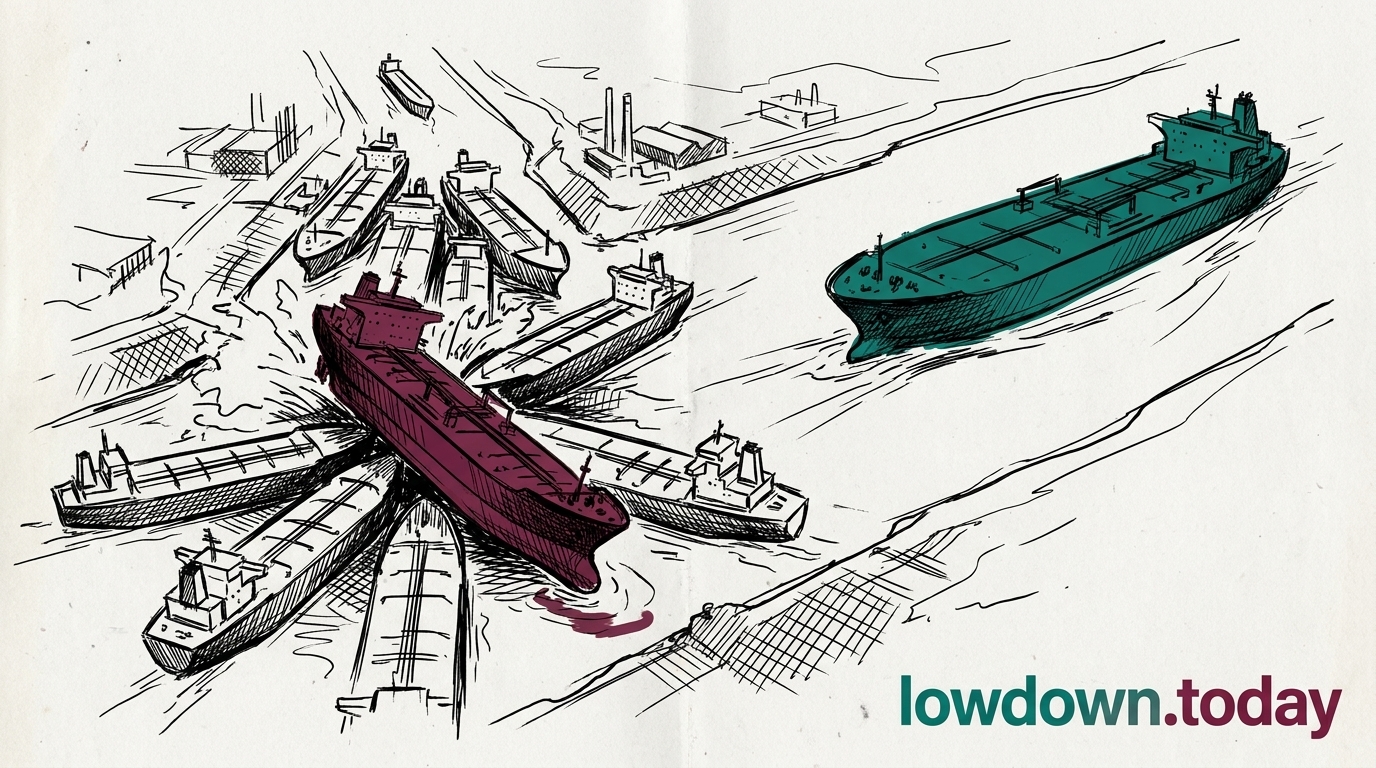
Two US carrier strike groups, built around the USS Abraham Lincoln and the USS George H.W. Bush, remained on station in the Gulf region as of 17-18 June 1. CENTCOM (US Central Command), the US military command for the Middle East, has issued no drawdown order, and the naval blockade continues to redirect vessels, despite the Islamabad Memorandum of Understanding (MoU) clause that the blockade be "removed immediately."

The blockade is the apparatus that has throttled Iranian seaborne trade through the war, turning the strait into a corridor ships transit only on US sufferance. Trump signed the MOU and ordered the blockade lifted on 16 June , but CENTCOM kept it running pending a signed instrument it has not received. The carriers on station are the physical evidence that the order has not reached the water.

The shipping industry reads operations, not press releases. Insurers, mine-clearance crews and tanker owners need an on-water change before commercial transits resume; a memorandum does not move a hull. Hormuz logged zero new tanker transits the day after Trump signed . The Geneva signing ceremony was scrapped, and Baghaei confirmed the text was finalised electronically, the presidents' signatures applied digitally rather than at any podium.


Deep Analysis

In plain English

Think of the naval blockade as a lock on a gate that is run by one department and the key as a different document held by another department. When the US President signed the Islamabad MOU, he was handing over a promise to unlock the gate. But the military commanders operating the lock need a separate written order from the Defence Department before they can actually turn the key. As of 18 June, that order had not arrived. So both aircraft carriers, the Abraham Lincoln and the George H.W. Bush, stayed in position, redirecting ships just as before. The gate remained locked. Separately, the sea still has live floating mines in it. Even if the lock were opened, no commercial ship would sail through a minefield without a guarantee that the mines had been removed.

Deep Analysis
Root Causes

The blockade-stays problem has a structural cause independent of politics: the CENTCOM enforcement mechanism runs on a separate chain of command from the diplomatic track that produced the MOU. Trump signed the MOU as the US executive; the blockade is operationalised by CENTCOM via the Secretary of Defense chain. Without a National Security Council decision memo, a SecDef order, and a CENTCOM operational directive, the blockade runs by default.

Mine-clearance progress also blocks the blockade lift. Hormuz was still seeded with active mines on 18 June. BIMCO and the International Chamber of Shipping have stated publicly that commercial vessels will not transit an uncleared minefield regardless of what a ceasefire agreement says. The operational prerequisite for the blockade lift, cleared lanes, does not yet exist.

What could happen next?
  • Risk

    An incident between an on-station carrier and an IRGC vessel, as happened on 15 June with the 'last warning' radio transmission, could escalate to an exchange of fire that voids the MOU before the 19 June ceremony.

    Immediate · Reported
  • Consequence

    The carrier stay gives Iran a public talking point: the US blockade continues despite the signed MOU, symmetrically matching Iran's own non-compliance on Lebanon.

    Short term · Assessed
  • Precedent

    If the blockade does not begin to lift within seven days of signing, insurers will treat the MOU as a rhetorical instrument rather than an operational change, maintaining war-risk exclusions and keeping effective transit near zero.

    Short term · Assessed
First Reported In

Update #131 · Iran deal's first death tests the text

Al Jazeera· 18 Jun 2026
Read original
Different Perspectives
US money managers (CFTC-tracked)
US money managers had trimmed WTI net long positioning into July's rally, doubting the Hormuz premium would hold without freight or war-risk confirmation, and the crude stock build reported for the week to 17 July gives that scepticism a fundamentals basis. The 25 July CFTC data will show whether Brent's move above $100 changed their calculus.
Asian distillate buyers (Singapore)
Singapore's distillate holders kept retaining middle-distillate barrels as the East-West arbitrage window narrowed further this week, a pattern that sharpened as Fujairah light distillates hit a record low. Cargoes are being held rather than released west into the tightening Mediterranean market.
Bulgaria
Bulgaria
Bulgaria secured the removal of Lukoil founder Vagit Alekperov and Patriarch Kirill from the 21st package, with President Rumen Radev calling a personal listing 'shooting ourselves in the foot'. Sofia is protecting its position in Lukoil's EUR 3bn compensation claim over the 2023 Neftohim Burgas nationalisation.
Russia
Russia
Russia loses the roughly $14 a barrel of legal headroom the price-cap formula would have released toward $58, even as Urals continues trading below Moscow's $59 budget floor. The shadow-fleet insurance workaround that lets sanctioned crude clear above $44 in practice remains untouched by the freeze itself.
European Union
European Union
The EU adopted its 21st sanctions package on 23 July, freezing the $44 Russia oil cap for 12 months rather than letting the formula drift it toward $58, and listed shadow-fleet support vessels for the first time. The package cleared only after three failed Coreper votes.
Marine war-risk underwriters (Lloyd's-linked syndicates)
War-risk syndicates lifted southern Red Sea hull premiums 150% to about 0.75% of hull value after the 20 July blockade declaration, still a seventh of the roughly 5% Hormuz band. Underwriters reset on realised loss, not declared threat, so the 23 July Encelia and Layla strikes set up the next re-mark.