Skip to content
You can now search across every topic, entity and event.What's new
European Oil Markets
16JUL

Hormuz logged two ships, not 94

3 min read
09:39UTC

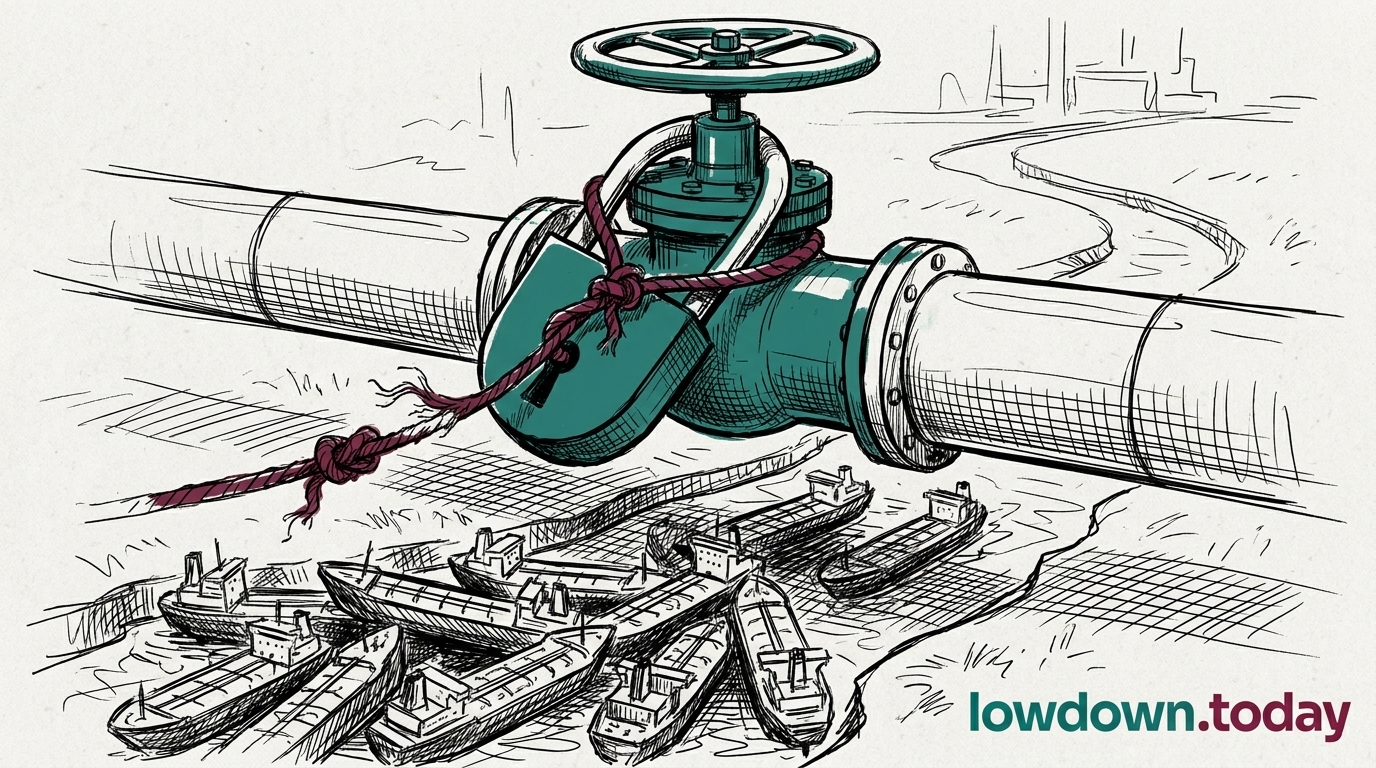
Two ships transited the Strait of Hormuz across 15-16 June, against a pre-war rate of 94 a day. The memorandum promises a full reopening on Friday, yet not one major operator has routed a tanker through on the strength of it.

EconomicDeveloping
Key takeaway

Markets are pricing the gap between the signed deal and a moving tanker, not the deal itself.

Two ships transited the Strait of Hormuz across 15-16 June, the 33-kilometre Gulf chokepoint that carries about a fifth of the world's seaborne oil. 1 Before the war the strait handled roughly 94 vessels a day. The newly signed memorandum promises a full reopening when the deal is formalised in Geneva on Friday, yet no major operator has sent a tanker through on the strength of it.

Underwriters, not nerves, keep the tankers in port. Protection-and-indemnity clubs, the mutual insurers that cover a vessel's third-party liability, will not underwrite a Hormuz crossing while the IRGC, Iran's Islamic Revolutionary Guard Corps, still runs the toll authority it set up on 5 May and has refused to dissolve. Iran reasserted its sovereignty over the strait and its right to charge for passage the day of the signing , so the clubs have no security grounds to reinstate cover. Without cover, no major charterer sails. Jotaro Tamura, a shipping executive quoted by the Financial Times, said operators will wait weeks until conditions change "on the water". 2

Brent Crude settled near $83.61, down a further 4.3 per cent and below the two-month low it had already reached when the deal first looked probable . That is not a peace dividend. Traders are pricing the distance between signed paper and a moving tanker, discounting the chance that Friday produces actual flows rather than a ceremony. Lower crude eases fuel costs for importers, but with the toll authority intact and the underwriting absent, the relief rests on cargoes no one will yet insure.


Deep Analysis

In plain English

The Strait of Hormuz is a narrow waterway between Iran and Oman through which roughly one-fifth of the world's oil travels. Before the war, about 94 ships passed through each day. On 15-16 June, only two did. Shipping companies cannot send a vessel worth hundreds of millions of pounds into the strait without insurance covering seizure or damage. Protection-and-indemnity clubs, which cover almost all large cargo ships, have refused to write that cover since March. The major insurance clubs, which together cover almost all big cargo ships, will not write that cover while Iran's military still controls the waterway and there is no written, legally binding safety framework. A signed-but-unpublished diplomatic document does not change that. Until the insurance question is resolved, oil tankers will wait outside regardless of what politicians announce.

Deep Analysis
Root Causes

P&I cover for Hormuz transits ceased because two separate legal conditions remain unmet. First, Lloyd's Joint Hull Committee guidance, circulated on 19 May 2026 , requires either a written rules-of-engagement document from the 26-nation coalition or a published PGSA (Persian Gulf Strait Authority) transit framework before the market will price the route.

Neither exists. Second, the IRGC's Persian Gulf Strait Authority, created 5 May, has registered zero commercial vessels; the MOU does not dissolve the PGSA, meaning the authority that P&I clubs treat as an extortion mechanism remains operational on the day of the signing.

The market's assessment is therefore that paper diplomacy has not changed the operational facts: the IRGC can still board, delay or seize vessels in Iranian territorial waters, and no insurer has indemnity protection against that outcome.

What could happen next?
  • Consequence

    P&I clubs will not restore cover until either a UN Security Council resolution or a published government certification of safe transit exists, conditions that neither the MOU nor the Geneva ceremony address.

    Short term · Assessed
  • Risk

    If a vessel transits without P&I cover and is seized or damaged, the resulting uninsured loss falls on the ship owner directly; no government indemnity mechanism currently exists.

    Immediate · Assessed
  • Opportunity

    Iranian crude re-entering the market at full pre-war volume would release approximately 1.5 million barrels per day, worth roughly $4-5 per barrel on the Brent price, if Hormuz fully reopens within a 60-day window.

    Medium term · Suggested
First Reported In

Update #129 · Iran deal signed, but no paper to show

Financial Times· 16 Jun 2026
Read original
Different Perspectives
Indian refiners
Indian refiners
Indian refiners kept lifting discounted Urals as the India/Baltic price split widened past $9-10 a barrel, a gap that only grows as GL X1's Iranian wind-down cuts an alternative discounted grade off the market by 17 July. Cheaper Russian feedstock is being locked in while it lasts.
Chinese refiners
Chinese refiners
Chinese refiners gain leverage as the Urals-Brent discount widens, since Beijing's state buyers already source discounted Russian barrels near the fiscal floor unaffected by Western insurance costs. A wider discount, if it holds past 23 July, lets them lock in cheaper term contracts regardless of the cap's outcome.
US money managers (CFTC-tracked)
Managed money trimmed WTI net length into the rally, positioning that reflects doubt the Hormuz premium survives without freight or war-risk confirmation. The Brent-WTI spread widening almost entirely on the Brent leg supports that scepticism about a broad-based repricing.
OPEC+ (Saudi-led subgroup)
Saudi Arabia is defending market share through a fourth straight 188kbd August hike even as OPEC's own July MOMR cut 2026 demand growth for the fourth consecutive month. At a $108-111 fiscal breakeven, every added barrel costs Riyadh revenue it cannot recoup, so the hike reads as a positioning signal, not a demand bet.
Greek shipping registries
Greece, backed by Cyprus and Malta, is pushing a three-month cap-freeze compromise against the Commission's freeze to January 2027 ahead of the 23 July vote. Athens' and Valletta's combined tanker registrations mean a shorter review gives their insurers more frequent chances to reprice risk on Russian cargoes.
Russia (Deputy PM Alexander Novak)
Novak extended the diesel export restriction to producers on 8 July, the first producer-binding curb of the war, protecting the domestic pump price ahead of any refinery repair timeline. Urals still trades below Russia's $59 budget floor even as Brent gained, so the ban trades export revenue for fiscal stability at home.