Skip to content
You can now search across every topic, entity and event.What's new
European Oil Markets
16JUL

Brent drops below $90 on ceasefire bet

3 min read
09:39UTC

Brent crude fell about 4 per cent to $89.25 on 12 June, below $90 for the first time in the conflict window, as traders priced the ceasefire as more likely than not.

EconomicDeveloping
Key takeaway

Oil fell on ceasefire odds, not new barrels, so a missed signing would snap it straight back.

Brent Crude fell about 4 per cent to $89.25 on 12 June, slipping below $90 for the first time in the conflict window "after Trump suspended planned attacks" 1. The drop reverses the prior session, when Brent had reached $96.34 on the US-Iran exchange repricing Hormuz risk and then settled at $94.71 on CENTCOM (US Central Command)'s strikes-complete call . The $5.46 fall completes a round-trip on the de-escalation signal.

Iran's exports have tightened to between 209,000 and 260,000 barrels a day, down roughly 86 per cent from the 1.84 million before the war, with the physical supply picture barely changed this week. That collapse is old news to the market. The move is sentiment, not supply: the price tracks no new barrels, it tracks the odds of a ceasefire.

The market read Trump's stand-down as the real turn and Esmail Baghaei's denial as noise, putting the futures desk on the opposite side of Iran's own foreign ministry. One of them is wrong, and a weekend signing or a missed one will settle which by the close.


Deep Analysis

In plain English

Oil prices dropped sharply on Thursday because investors around the world bet that the fighting between the US and Iran was winding down. When conflicts in oil-producing regions calm down, oil prices usually fall because traders stop charging a "risk premium", the extra money built into the price in case the situation gets worse. The catch is that very little oil has actually started flowing again through the Strait of Hormuz. Iran's oil exports have been cut to almost nothing by the blockade, and that had not changed this week. The price fell because of hope, not because of new supply. If the deal Trump announced is not signed by the end of the weekend, expect oil prices to bounce back up just as fast as they fell.

Deep Analysis
Root Causes

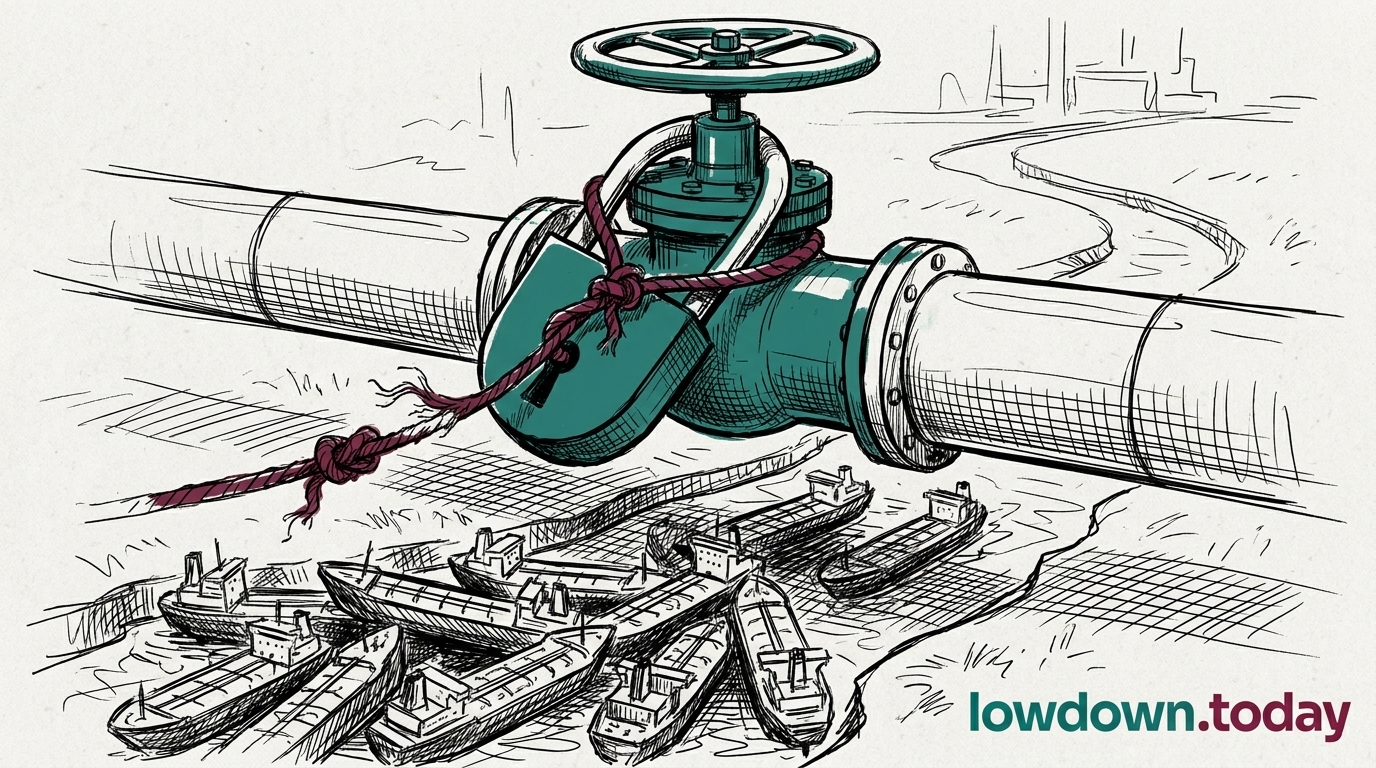
Oil markets price Hormuz risk via a conflict premium that has no direct supply-chain transmission mechanism: Brent can fall 4 per cent on a stand-down even when zero additional barrels clear the strait, because the premium reflects a probability-weighted expectation of future supply, not current flows.

Kpler and Vortexa data confirm Iran's exports at 209,000-260,000 barrels per day are unchanged from the prior week . Kpler and Vortexa data confirm Iran's exports at 209,000-260,000 barrels per day are unchanged from the prior week , so the $5.46 fall prices ceasefire probability, not new barrels.

Lloyd's of London has not repriced Hormuz war-risk cover because its trigger requires a UN Security Council resolution or government certification, not a presidential statement. Until Lloyd's reprices, tanker insurance costs remain elevated and the strait stays commercially inaccessible regardless of the Brent spot move. Spot price and shipping-market reality pointed in opposite directions on Thursday, with the divergence persisting until a formal legal resolution of the conflict is certified.

What could happen next?
  • Consequence

    A sustained sub-$90 Brent reduces the economic pressure on Iran that Washington has cited as the blockade's primary coercive leverage, creating a narrow window in which both sides have an incentive to close a deal before the price recovers.

    Immediate · Assessed
  • Risk

    Lloyd's of London's war-risk cover for Hormuz will not reprice until a UN Security Council resolution or government certification is issued. Until that threshold is met, tanker insurance costs remain elevated and the strait stays commercially inaccessible regardless of the spot Brent move.

    Short term · Reported
  • Opportunity

    South and Southeast Asian oil-importing economies, including India, Indonesia, Pakistan and Bangladesh, stand to gain approximately $1 billion per year per dollar of sustained Brent reduction at current consumption levels, partially offsetting the supply disruption costs they have absorbed since February.

    Medium term · Suggested
First Reported In

Update #125 · Trump halts strikes, touts deal Iran denies

Trading Economics· 12 Jun 2026
Read original
Different Perspectives
Indian refiners
Indian refiners
Indian refiners kept lifting discounted Urals as the India/Baltic price split widened past $9-10 a barrel, a gap that only grows as GL X1's Iranian wind-down cuts an alternative discounted grade off the market by 17 July. Cheaper Russian feedstock is being locked in while it lasts.
Chinese refiners
Chinese refiners
Chinese refiners gain leverage as the Urals-Brent discount widens, since Beijing's state buyers already source discounted Russian barrels near the fiscal floor unaffected by Western insurance costs. A wider discount, if it holds past 23 July, lets them lock in cheaper term contracts regardless of the cap's outcome.
US money managers (CFTC-tracked)
Managed money trimmed WTI net length into the rally, positioning that reflects doubt the Hormuz premium survives without freight or war-risk confirmation. The Brent-WTI spread widening almost entirely on the Brent leg supports that scepticism about a broad-based repricing.
OPEC+ (Saudi-led subgroup)
Saudi Arabia is defending market share through a fourth straight 188kbd August hike even as OPEC's own July MOMR cut 2026 demand growth for the fourth consecutive month. At a $108-111 fiscal breakeven, every added barrel costs Riyadh revenue it cannot recoup, so the hike reads as a positioning signal, not a demand bet.
Greek shipping registries
Greece, backed by Cyprus and Malta, is pushing a three-month cap-freeze compromise against the Commission's freeze to January 2027 ahead of the 23 July vote. Athens' and Valletta's combined tanker registrations mean a shorter review gives their insurers more frequent chances to reprice risk on Russian cargoes.
Russia (Deputy PM Alexander Novak)
Novak extended the diesel export restriction to producers on 8 July, the first producer-binding curb of the war, protecting the domestic pump price ahead of any refinery repair timeline. Urals still trades below Russia's $59 budget floor even as Brent gained, so the ban trades export revenue for fiscal stability at home.