Brent Crude opened Monday 18 May Asian trading at $110.30 a barrel, up $1.00 from the 16 May close of $109.30 and 6 per cent on the week, OilPrice.com reported. The breach is the first $110-plus print of the war. WTI (West Texas Intermediate) traded at $106.30. Brent now sits $9.09 above its $101.21 ceasefire-priced close of 11 May. Brent's tape carries two stacked premia at the Asian open. The first prices the weekend escalation: the Barakah strike, Trump's Truth Social threats, and the Haaretz assessment that the war's stated objective has not been achieved. The second prices a multi-year supply re-architecture. ADNOC (Abu Dhabi National Oil Company) announced plans on Sunday to double its oil-export capacity through Fujairah by 2027, building the Hormuz-bypass route through Khor Fakkan that the UAE has signalled in throughput terms since the 1.62 million bpd (barrels per day) reading of late March. Doubling implies a target near four million bpd inside twenty months. Read against Saudi Aramco CEO Amin Nasser's 12 May warning that global oil will not normalise until 2027 if the blockade persists, the ADNOC investment is The Gulf monarchies pricing a multi-year crisis as their planning baseline. The four-million-bpd target sits east of Hormuz, beyond any Iranian toll mechanism. For drivers in the UK, that translates to pump-price pressure compounding through 2027 even if a ceasefire instrument is signed tomorrow; the supply re-architecture is now structural rather than tactical. The accounting plumbing matters here. Fujairah-routed crude bypasses the VLCC (Very Large Crude Carrier) traffic that has paid up to two million dollars per ship to Iran's PGSA (Persian Gulf Strait Authority) in yuan tolls since March. ADNOC capacity built east of Hormuz is capacity the Iranian toll regime cannot price. Malaysia issued a maritime advisory warning of surging Iranian ship-to-ship transfers in its waters, evidence that informal-market evasion is intensifying as the formal benchmark reprices. The toll regime captures shrinking commercial volume even as Brent's open prints a fresh war-high.
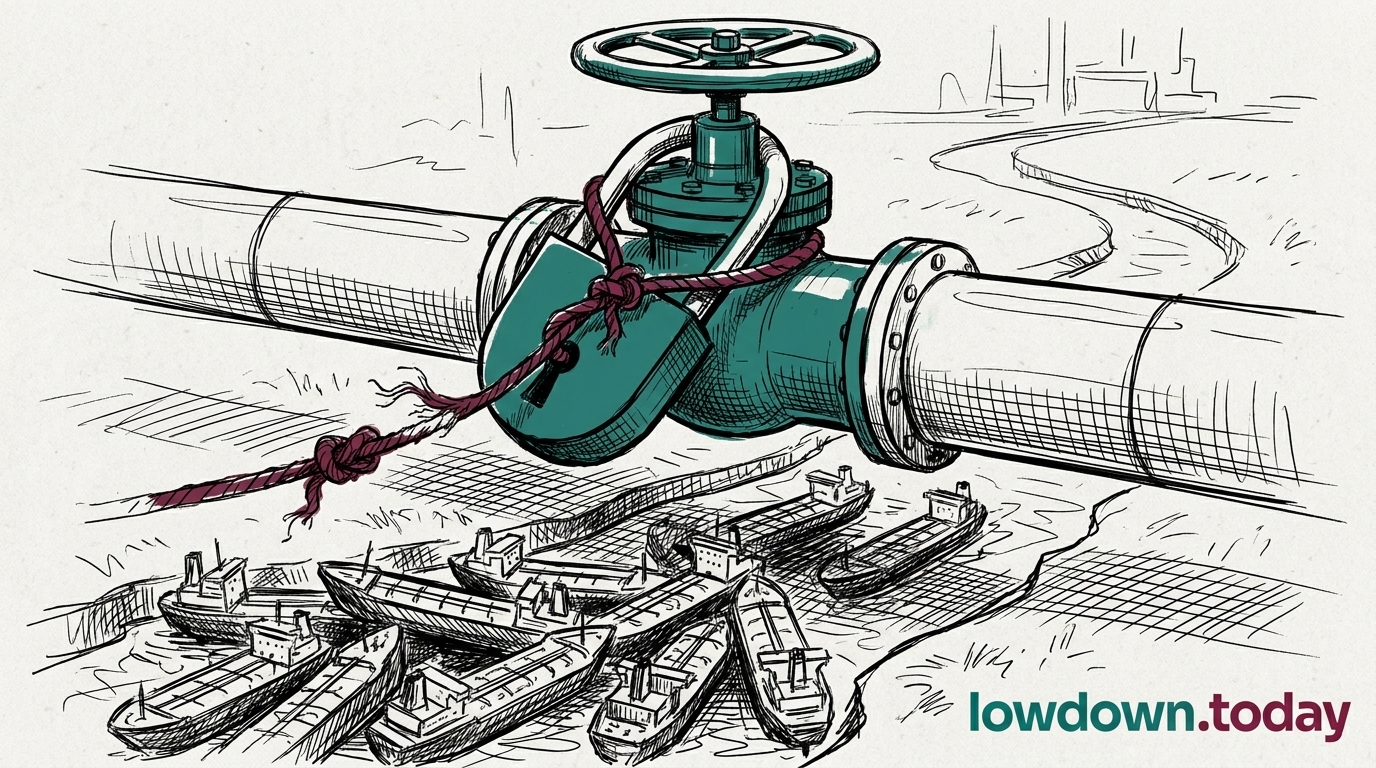
Brent breaks $110, ADNOC bypasses Hormuz
Brent crude opened Monday at $110.30 a barrel, the first $110-plus print of the war, as ADNOC announced doubling Fujairah export capacity by 2027 through Khor Fakkan.
Brent's $110.30 open carries a one-day escalation premium and a 2027 supply re-architecture premium that bypasses Iran's yuan toll regime.
Deep Analysis
Oil hit $110 a barrel for the first time since the war began. That is 6 per cent higher than the previous week. When oil prices go up, almost everything else follows: petrol, diesel, home heating, and eventually food prices, because farms and food factories run on fuel. The UAE's state oil company, ADNOC, announced it will double its ability to export oil through the Port of Fujairah, a route that avoids the strait of Hormuz entirely. That is reassuring for the long run, but the new port capacity will not be ready until 2027. Until then, **Brent** is pricing in the risk that the strait could be disrupted, which lifts every petrol forecourt and freight quote in Europe.
Three structural conditions converged to produce the $110 print. First, the Hormuz coalition's existence confirms global markets cannot assume free passage, the premium for 'Hormuz-bypass infrastructure' is now a permanent line item in capital allocation decisions. Second, ADNOC's Fujairah bypass announcement is itself a market signal: the UAE, which exports roughly 2.5 million barrels per day, is behaving as if Hormuz transit risk is chronic, not episodic.
Third, the Malaysia ship-to-ship transfer surge, documented in Kuala Lumpur's own maritime advisory, shows Iran has already adapted its export infrastructure to bypass Western interdiction, meaning the effective supply reduction is smaller than the formal closure implies.
The interaction between these three factors, elevated war premium, credible bypass investment, and shadow-fleet adaptation, produces a market where neither bulls nor bears can achieve a clean signal on fundamentals. That uncertainty itself sustains the premium.
- Consequence
UK petrol pump prices will rise approximately 4-5p per litre within three weeks if Brent holds above $110, adding to household cost pressures already elevated by the prior oil-price rise.
Immediate · 0.82 - Consequence
ADNOC's Fujairah bypass investment signals the UAE treats Hormuz disruption as a chronic condition, not a temporary war consequence, reshaping Gulf energy infrastructure investment for a generation.
Medium term · 0.75 - Opportunity
Sustained $110+ oil accelerates European renewable energy investment decisions: at this price level, offshore wind and nuclear new-build NPVs turn positive without subsidy in several member states.
Long term · 0.65
Update #101 · Barakah hit, Trump posts, Italy sends minesweepers




