Skip to content
You can now search across every topic, entity and event.What's new
European Oil Markets
22JUN

Treasury names a Hormuz insurance racket

3 min read
09:55UTC

OFAC designated the two bodies selling IRGC-approved transit cover in the Strait of Hormuz, payable in Bitcoin, alongside four shadow-fleet tankers and a front that crowdsourced targeting tips.

EconomicAssessed
Key takeaway

Tehran collects a Hormuz toll through insurance paperwork, with no gunboat and no signed agreement.

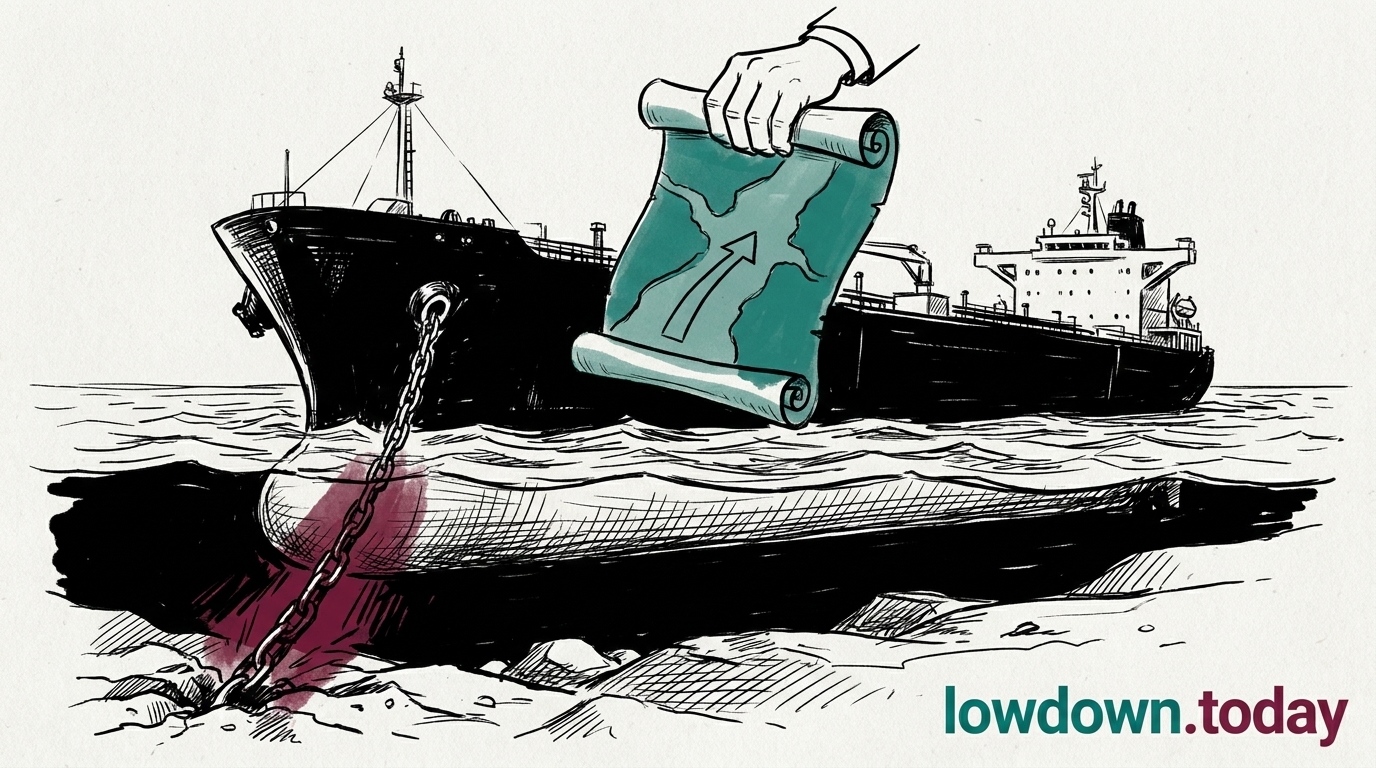
The Office of Foreign Assets Control (OFAC), the US Treasury unit that administers American sanctions, designated Persian Gulf Marine Insurance Company and HormuzSafe Marine Services Authority on Wednesday 29 July under Executive Order 13902 1. The scheme those two bodies run makes cover compulsory: a vessel transiting the Strait of Hormuz must buy IRGC-approved insurance against risks Iran itself creates. HormuzSafe accepts Bitcoin and other digital assets, and the sanctioned financier Babak Zanjani promoted it on social media.

HormuzSafe collects without putting a boarding party on a single deck. No port accepts an uninsured hull and no charterer books one; cargo owners, classification societies and flag states all demand valid cover before a ship moves. Forcing transits to buy Iranian-approved paper therefore extracts payment through the commercial liability chain, at the point where a refusal costs the shipowner the voyage rather than the ship. Washington's answer to a Hormuz toll has been that nobody may charge for passage at all, and this scheme collects without ever putting the question to a negotiator .

OFAC named eight shadow-fleet tankers in the same action, hulls that disguise Iranian crude through flag-of-convenience registration, opaque ownership and ship-to-ship transfers, among them WELL SAIL, LILY, AL SALMI and BREEZE V. That takes Treasury past 100 vessels designated this year 2. A separate release the following day, under Executive Order 13224, named six targets across China, India, Russia and Iran 3.

DadeNegar Startup Studio neither moves cargo nor sells tickets. The IRGC-affiliated front ran a public website soliciting crowdsourced locations of American and Israeli equipment and relayed strike requests to the Guard 4. Iran has used front companies to procure components for decades, and the Zanjani network drew its own designation on 24 July . Buying targeting information from passers-by is a different function from buying centrifuge parts, and it places anyone who photographed a convoy inside the kill chain.


Deep Analysis

In plain English

The US Treasury's sanctions arm, OFAC, added two Iranian shipping insurance companies and eight tankers to its blacklist on 29 July, and an Iranian tech investment firm called DadeNegar Startup Studio the following day. This is part of a long-running effort to stop Iran from selling oil by cutting off the insurance and financial services that let its ships keep operating despite sanctions. The tankers and companies named will struggle to get insurance, dock at most ports, or use the international banking system.

What could happen next?
  • Consequence

    The four newly sanctioned tankers will likely re-flag and seek alternative insurance within weeks, following the pattern of prior 2026 designation rounds.

  • Meaning

    Naming the insurance company directly, rather than only the tankers, targets the mechanism that has let sanctioned vessels keep operating.

First Reported In

Update #164 · The pause ends, and the map moves west

US Department of the Treasury· 31 Jul 2026
Read original
Different Perspectives
Gulf oil producer
Gulf oil producer
Secured OPEC's confirmed 188,000 b/d September increment with the next meeting set for 6 September, but the Secretariat's own 2 August release says nothing about the fourth quarter. Output guidance beyond September remains undisclosed even as delegate sourcing keeps filling that gap.
Money manager positioned in WTI
Added 21,402 lots to a 108,307 net long in NYMEX WTI in the week to 28 July, against just 1,485 added to Brent's 15,740, a roughly fourteen-to-one split. Conviction sits in the American benchmark even as the European diesel story sets the record.
Indian refiner buying Urals
Bought Russian crude at a discount that narrowed to $1-2 a barrel in the week to 29 July from over $10, as Hormuz risk pushed it toward Urals. If that risk eases with the strike now called off, the discount it is currently enjoying could re-widen just as fast.
Russian diesel exporter
Novak tied any lifting of the diesel export ban, due to lapse 31 July, to an unspecified market recovery with no date, and pushed the gasoline ban to end-2026. An open-ended constraint suits an exporter benefiting from the record European crack it feeds.
War-risk underwriter
Withdrew war-risk cover for Saudi-linked hulls on 24 July and has not reinstated it, holding Bab el-Mandeb tanker transits near 7.5 a day. A cancelled strike does not by itself trigger the committee review needed to re-accept the class.
Northwest European refiner
Sources only 17% of diesel imports from Saudi Red Sea ports against the Mediterranean's 24%, so the ARA crack at $85.86 trails the Med print by $5.81. Lower Red Sea exposure is cushioning it against the rerouting cost, not eliminating it.



