Skip to content
You can now search across every topic, entity and event.What's new
European Oil Markets
18MAY

Trump demands allied warships at Hormuz

4 min read
17:30UTC

Five nations named, zero committed. One Greek shipowner is running the blockade alone — at $440,000 a day with armed guards on deck.

EconomicDeveloping
Key takeaway

Trump's Hormuz coalition call has produced zero allied naval commitments in response.

Trump posted on Truth Social that he expects China, France, Japan, South Korea, and the United Kingdom to send warships to keep the strait of Hormuz "open and safe" 1. In the same post, he claimed the US had "already destroyed 100% of Iran's Military capability" — then acknowledged Tehran could still "send a drone or two, drop a mine, or deliver a close range missile." He pledged to be "bombing the hell out of the shoreline" in the meantime.

No named country has publicly committed forces, and each refusal has its own logic. China's special envoy Zhai Jun is touring the region pursuing mediation, not military deployment 2 — and Chinese-linked vessels already transit Hormuz under de facto IRGC protection, with 11.7 million barrels of Iranian oil shipped to China since 28 February . Beijing has no incentive to join a fleet that would disrupt an arrangement already working in its favour. France offered to host Lebanon talks in Paris and lost a soldier to a drone strike in Iraqi Kurdistan ; its posture is diplomatic, not naval. Japan and South Korea are the most exposed — both import the majority of their crude through Hormuz — but Japan's Article 9 constraints and South Korea's domestic political crisis limit what either can deploy without prolonged legislative action. The UK prepositioned Typhoons and F-35s across the region from January but has maintained deliberate distance from the offensive campaign.

Trump's demand also collides with contradictions inside his own administration. Energy Secretary Wright said the Navy is "simply not ready" for tanker escorts . Defence Secretary Hegseth told the public not to worry about Hormuz . Treasury Secretary Bessent promised escorts "as soon as militarily possible." Three officials, three positions, no escorts. The IRGC declared days earlier that "not a litre of oil" would pass through the strait . Since 28 February, at least 19 vessels have been attacked, daily transits have fallen from a historical average of 138 to single digits, and over 300 commercial ships remain stranded .

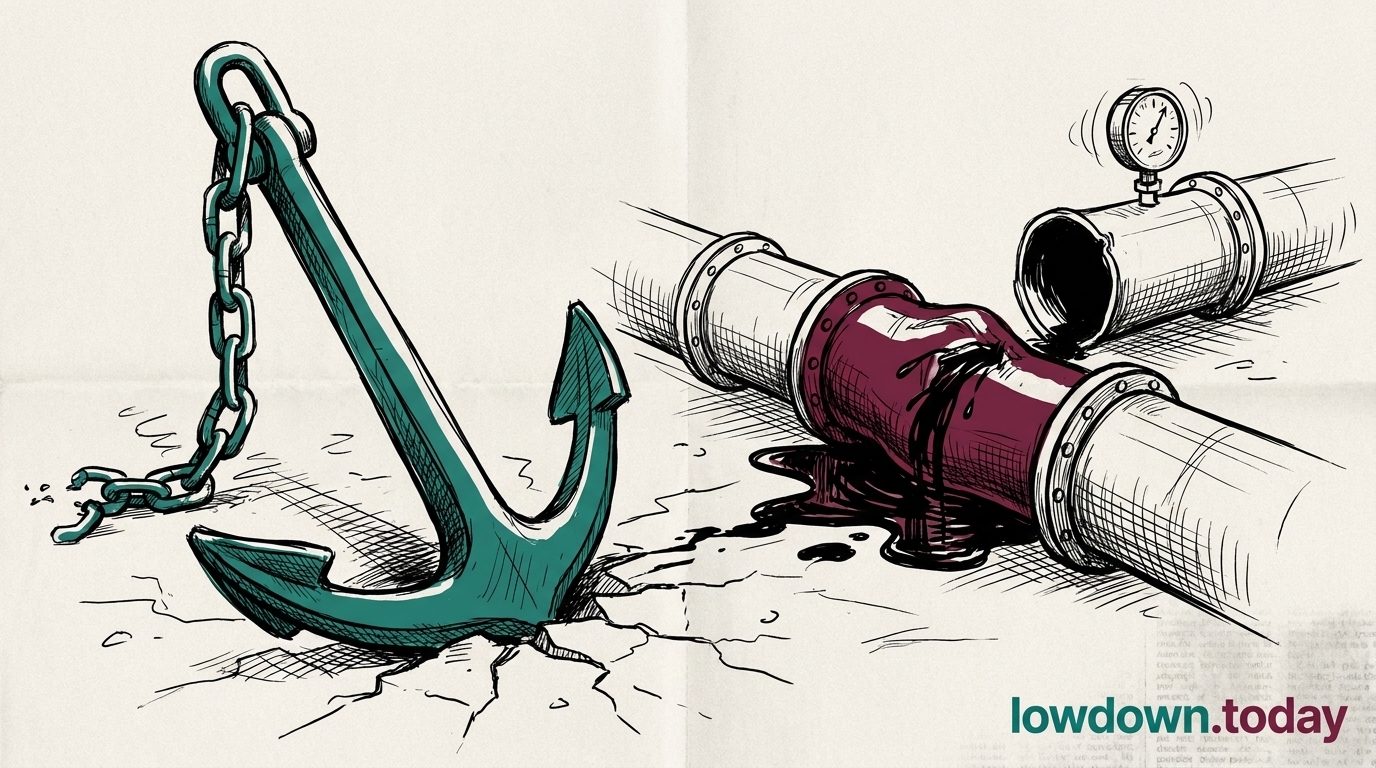
Into this vacuum, one commercial actor has moved. Greek shipowner George Prokopiou's Dynacom sent a second tanker, the Smyrni, through Hormuz with its AIS transponder off and armed guards on deck 3. Dynacom is chartering at $440,000 per day — roughly four times pre-war rates. Five Dynacom tankers have now transited the strait. No other major shipping company has followed. Where five navies hesitate, a single Greek shipowner has decided the premium justifies the risk. The market's answer to the Hormuz blockade is not a multinational fleet but a private one — and the price of passage is set not by diplomacy but by the willingness of one firm to bet its crews against Iranian mines.


Deep Analysis

In plain English

About 20% of the world's oil passes through the Strait of Hormuz every day. Iran has been attacking ships there, and Trump wants allied navies to help keep it open. Building a coalition normally requires months of behind-the-scenes negotiations — rules of engagement, cost-sharing, command structures. None of the five named countries has agreed. China's envoy is actively seeking a ceasefire rather than preparing warships, which is structurally the opposite of what Trump is requesting.

Deep Analysis
Synthesis

Trump's claim that Iran is '100% destroyed' and his simultaneous call for an emergency coalition are logically incompatible. A destroyed military requires no coalition; a required coalition signals intact threat capacity. The contradiction indicates domestic political messaging rather than strategic communication — a signal that allied governments will have read and discounted accordingly, further undermining coalition-building credibility.

Escalation

Coalition non-participation forces a binary US choice: act unilaterally — stretching already-committed naval assets — or implicitly accept partial Hormuz restriction. China's structural role as mediator and France's Lebanon-focused diplomatic posture make near-term allied naval commitment near-zero probability. Neither outcome reduces escalation risk in the strait.

What could happen next?
  • Risk

    Without allied naval participation, the US must choose between unilateral Hormuz protection — stretching deployed naval assets — or accepting partial strait closure.

    Short term · Assessed
  • Consequence

    Trump's internally contradictory messaging on Iranian capability undermines allied confidence in US threat assessments, reducing coalition-building credibility for future requests.

    Medium term · Assessed
  • Risk

    IRGC messaging that it controls the Hormuz strait gains credibility if no opposing naval coalition materialises to contest that claim operationally.

    Short term · Suggested
  • Opportunity

    Japan and South Korea's acute dependence on Gulf crude gives them structural economic incentive to eventually join an escort arrangement, despite constitutional constraints.

    Medium term · Suggested
First Reported In

Update #36 · Israel plans full Litani seizure

CNN· 15 Mar 2026
Read original
Causes and effects
Different Perspectives
Indian refiners
Indian refiners
Indian refiners kept lifting discounted Urals as the India/Baltic price split widened past $9-10 a barrel, a gap that only grows as GL X1's Iranian wind-down cuts an alternative discounted grade off the market by 17 July. Cheaper Russian feedstock is being locked in while it lasts.
Chinese refiners
Chinese refiners
Chinese refiners gain leverage as the Urals-Brent discount widens, since Beijing's state buyers already source discounted Russian barrels near the fiscal floor unaffected by Western insurance costs. A wider discount, if it holds past 23 July, lets them lock in cheaper term contracts regardless of the cap's outcome.
US money managers (CFTC-tracked)
Managed money trimmed WTI net length into the rally, positioning that reflects doubt the Hormuz premium survives without freight or war-risk confirmation. The Brent-WTI spread widening almost entirely on the Brent leg supports that scepticism about a broad-based repricing.
OPEC+ (Saudi-led subgroup)
Saudi Arabia is defending market share through a fourth straight 188kbd August hike even as OPEC's own July MOMR cut 2026 demand growth for the fourth consecutive month. At a $108-111 fiscal breakeven, every added barrel costs Riyadh revenue it cannot recoup, so the hike reads as a positioning signal, not a demand bet.
Greek shipping registries
Greece, backed by Cyprus and Malta, is pushing a three-month cap-freeze compromise against the Commission's freeze to January 2027 ahead of the 23 July vote. Athens' and Valletta's combined tanker registrations mean a shorter review gives their insurers more frequent chances to reprice risk on Russian cargoes.
Russia (Deputy PM Alexander Novak)
Novak extended the diesel export restriction to producers on 8 July, the first producer-binding curb of the war, protecting the domestic pump price ahead of any refinery repair timeline. Urals still trades below Russia's $59 budget floor even as Brent gained, so the ban trades export revenue for fiscal stability at home.