Skip to content
You can now search across every topic, entity and event.What's new
European Energy Markets
31JUL

Israeli-owned ship struck near Fujairah

3 min read
09:44UTC

A vessel struck by an unknown projectile seven nautical miles from Fujairah sustained steel plate damage. It was Israeli-owned. No crew were injured — but the attack extends the threat from port infrastructure to vessels in the approaches.

EconomicDeveloping
Key takeaway

Targeting an Israeli-owned vessel in international anchorage extends Iranian maritime doctrine from the Gulf of Oman to UAE-adjacent waters and signals that Israeli commercial ownership is a deliberate targeting criterion, not a coincidence.

UKMTO confirmed a vessel was struck by an unknown projectile 7 nautical miles east of Fujairah, sustaining steel plate damage. All crew were reported safe. The vessel was Israeli-owned, according to The Times of Israel. No attribution has been confirmed — UKMTO reported the projectile source as unknown.

Fujairah port itself was hit overnight on 3 March , a strike that targeted The Gulf's primary ship-to-ship fuel bunkering hub and the exit point for the Habshan-Fujairah pipeline — the 1.5 million-barrel-per-day conduit built specifically to bypass the strait of Hormuz. That attack degraded the fixed infrastructure. This one targets a commercial vessel in the approaches — a different layer of the same chokepoint.

The Israeli ownership is consistent with targeting patterns established in the Red Sea since late 2023, where Houthi forces selected targets by vessel ownership, flag state, and commercial affiliation. If confirmed here, it would indicate an actor with access to commercial shipping databases and the operational capacity to act on that intelligence in contested waters. The distinction matters: indiscriminate attacks close a waterway to everyone; discriminate attacks close it selectively while leaving a political argument that neutral shipping is safe. Neither is true once P&I clubs have withdrawn cover , but the targeting logic shapes how governments and insurers assess the risk.

With Hormuz traffic already down 80% , Fujairah's eastern anchorage had been one of the last positions where commercial vessels could hold without transiting the strait. More than 150 tankers were anchored in Gulf waters awaiting resolution as of 1 March . A vessel struck at anchor or in the approaches faces a threat it cannot manoeuvre away from — its position is predictable from publicly available port schedules and AIS transponder data.


Deep Analysis

In plain English

Fujairah is the UAE port just outside the Strait of Hormuz where ships refuel and resupply without entering the contested Strait itself — it is the main safety valve for maritime trade. A vessel struck while anchored 7 miles from that port in open water means ships cannot safely wait or shelter in the region's last alternative hub. The Israeli ownership detail matters because it suggests the vessel may have been chosen deliberately rather than struck at random, pointing toward a targeting database of ships by commercial ownership.

Deep Analysis
Synthesis

The Israeli ownership detail is the most analytically significant element of this event. It points toward a systematic targeting methodology based on ship registries and beneficial ownership databases — a capability that, if confirmed, means Israeli-linked commercial vessels in all major trade arteries (Mediterranean, Red Sea, Indian Ocean) face elevated risk, not only Gulf transit. Western and Israeli maritime intelligence agencies will need to assess this as a global rather than theatre-specific threat.

Escalation

If Iranian in origin, targeting an Israeli-linked vessel in waters adjacent to the UAE constitutes kinetic action near Emirati territory, distinct from the missile exchanges over Gulf airspace already reported. The UAE's tolerance for military action threatening its coastline and commercial infrastructure is limited; this could accelerate the UAE strike consideration already reported by Axios via a different trigger than accumulated missile absorption.

What could happen next?
  • Consequence

    War-risk insurance exclusion zones will extend to UAE east coast anchorage areas, closing Fujairah as a commercial shelter regardless of physical damage to port infrastructure.

    Immediate · Assessed
  • Risk

    If beneficial-ownership targeting is confirmed as deliberate, Israeli-linked commercial shipping in all major global trade arteries faces elevated and persistent risk.

    Short term · Suggested
  • Consequence

    UAE faces domestic pressure to respond to kinetic action in its near-territorial waters, complicating its declared neutral posture and accelerating strike consideration.

    Short term · Assessed
First Reported In

Update #19 · First US torpedo kill since 1945

Times of Israel· 4 Mar 2026
Read original
Causes and effects
This Event
Israeli-owned ship struck near Fujairah
The strike extends the threat to commercial shipping from Fujairah's fixed port infrastructure — hit overnight on 3 March — to vessels in the port's approaches, and the Israeli ownership of the targeted vessel suggests discriminate selection by registry or commercial affiliation.
Different Perspectives
Spain's LNG terminal operators
Spain's 9,145 GWh terminal inventory is the largest single stock in the EU LNG network, an option value that can reroute cargoes wherever the winter strip pays best rather than a cavern gas obligation tied to a fixed date. That flexibility matters more as Germany's cavern shortfall pushes more of the winter security question onto import infrastructure.
European Commission
European Commission
Brussels holds the bloc to 90% on a flexible window while Germany, holding roughly a quarter of EU storage capacity, tracks toward missing its own lower 80% figure by 21 points. A national shortfall this size in the anchor market matters more to bloc security than the flexible timetable alone can absorb.
French power exporters and CRE
French day-ahead rose in step with Germany but by less, reopening a EUR 7-17 premium that makes northward export flows commercially attractive again after the EUR 43.09 discount evaporated in days. CRE separately authorised RTE and Enedis to buy flexibility locally, betting the coming winter's binding constraint is grid congestion rather than a shortage of firm capacity.
TTF trading desk
TTF trading desk
A visible national shortfall like Germany's 21-point gap is a directional signal, not noise, for a desk holding the summer-winter spread. TTF's flat EUR 58-60 range through this week's German price swings says the market has not yet chosen to reprice refill risk into the front of the curve.
German cavern and CCGT operators
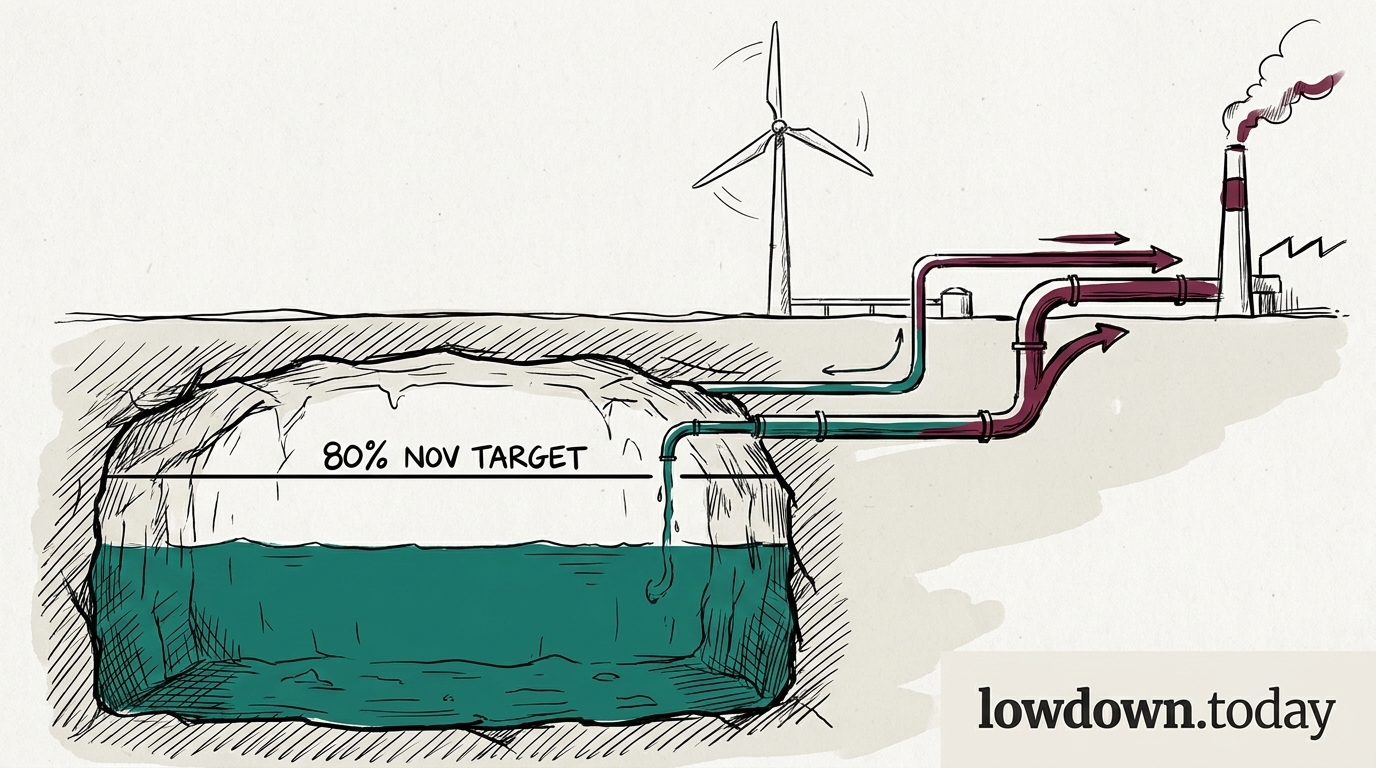
German caverns kept buying prompt gas at TTF near EUR 58-60 through the inversion; the wind collapse to 2.4 GW then flipped the spark spread to plus EUR 29 and put turbines back in the same queue. Every day turbines win that bid, injection at a third of the 877 GWh/day pace needed falls further behind.
Slovakia
Slovakia
Slovakia says it dropped its hold-out on the 21st sanctions package only after Ursula von der Leyen personally signed written gas-price and supply guarantees. The Council of the European Union's own 17,238-character release on the package names neither Slovakia nor any guarantee, leaving Bratislava's account unconfirmed by the institutional record.



