Skip to content
You can now search across every topic, entity and event.What's new
European Energy Markets
31JUL

Migrants killed in Saudi drone strike

3 min read
09:44UTC

An Indian national and a Bangladeshi national — migrant workers with no role in this war — became Saudi Arabia's first confirmed civilian fatalities when an Iranian drone struck their residential building in Al-Kharj.

EconomicDeveloping
Key takeaway

The deaths of Indian and Bangladeshi nationals transform a bilateral Saudi-Iran exchange into a multinational diplomatic incident with direct pressure on two non-aligned states that have so far stayed out of the conflict.

Two people — one Indian, one Bangladeshi — were killed and twelve Bangladeshis wounded when an Iranian drone struck a residential building in Al-Kharj, south of Riyadh, on Sunday. The IRGC stated the strike targeted nearby radar systems. The residential building was not the intended target. These are Saudi Arabia's first confirmed civilian fatalities since Operation EPIC FURY began on 28 February.

Al-Kharj sits near Prince Sultan Air Base, one of the largest military installations in The Gulf and a hub for US and Coalition air operations. The workers housed in residential blocks around such facilities are overwhelmingly South Asian migrants — employed under The Gulf's kafala sponsorship system as construction labourers, maintenance staff, and service workers. India and Bangladesh have no alliance commitments to any party in this conflict, no seat at its negotiating table, and limited diplomatic leverage to protect their nationals in theatre. Their citizens absorb the risk because they live where the targets are.

The IRGC's stated rationale — that the Building was collateral to a radar strike — follows a pattern established across ten days of conflict. Iranian strikes on Bahrain hit a hotel and residential towers . Strikes on Kuwait hit an airport and a social insurance headquarters . The declared target is military; the physical damage falls on civilian infrastructure and the people inside it. Saudi Arabia had absorbed Iranian strikes on the Shaybah mega-oilfield without confirmed fatalities. The Al-Kharj deaths change that — and the fact that neither victim held Saudi citizenship will shape how Riyadh frames the escalation domestically and whether the Saudi diplomatic backchannel to Tehran survives the week.

For New Delhi and Dhaka, the question is immediate: more than two million Indian nationals and a substantial Bangladeshi workforce are employed across Saudi Arabia. Both governments face pressure to organise evacuations from a country that has, until Sunday, avoided the civilian toll borne by Bahrain, Kuwait, and Lebanon. Commercial aviation across The Gulf remains severely restricted, and neither government has military transport capacity for extraction at that scale.


Deep Analysis

In plain English

Iran fired a drone at a radar system near Riyadh, but it struck a residential building instead, killing two foreign workers — one from India, one from Bangladesh — and wounding twelve more Bangladeshis. Saudi Arabia employs millions of migrant workers from South Asia who often live in housing near military or industrial sites because of how cities in the Gulf are built. These are the first people killed on Saudi soil since the war began, and the fact that they are Indian and Bangladeshi rather than Saudi creates an entirely new diplomatic dimension: two major non-aligned countries now have dead citizens and formal obligations to respond.

Deep Analysis
Root Causes

Gulf states have built military infrastructure inside populated urban areas and housed migrant labour in proximity to those installations as a function of land scarcity, cost, and decades of planning decisions that treated foreign workers as a transient rather than permanent population requiring separate safety zoning. IRGC drone targeting based on radar electromagnetic signatures cannot reliably distinguish a radar array from a residential building 200 metres away, particularly under wartime electronic countermeasures and degraded ISR.

Escalation

India's diplomatic response is the key indicator to watch. New Delhi has maintained studied neutrality and has relationships with both Washington and Tehran that Western interlocutors lack. One confirmed Indian fatality creates domestic political pressure on the Modi government to either facilitate worker evacuation or pursue active mediation — the latter of which would introduce a significant new de-escalation vector. Conversely, if India publicly attributes blame to Iran, it would harden the diplomatic coalition against Tehran.

What could happen next?
  • Consequence

    India and Bangladesh now carry formal diplomatic obligations to respond to the deaths of their nationals, ending their ability to remain fully outside the conflict's diplomatic alignment.

    Immediate · Assessed
  • Risk

    Repeated IRGC strikes on civilian residential areas near military sites risk triggering mass voluntary or government-mandated evacuation of South Asian workers, simultaneously collapsing Gulf labour supply and cutting remittance flows to India and Bangladesh.

    Short term · Suggested
  • Opportunity

    India's combination of relationships with both Tehran and Washington, and now a direct national interest in de-escalation, could position New Delhi as a credible mediation channel unavailable to Western interlocutors.

    Short term · Suggested
  • Risk

    If the pattern of misdirected IRGC strikes on civilian areas continues, the conflict's diplomatic footprint expands into South Asia — drawing in states whose non-alignment has been a tacit stabilising factor.

    Medium term · Suggested
First Reported In

Update #30 · Mojtaba named leader; oil $116; acid rain

Al Jazeera· 9 Mar 2026
Read original
Causes and effects
This Event
Migrants killed in Saudi drone strike
Saudi Arabia's first civilian deaths — both migrant workers from countries uninvolved in the conflict — expose the uneven distribution of risk in Gulf military geography, where foreign labourers live nearest the installations being targeted.
Different Perspectives
Spain's LNG terminal operators
Spain's 9,145 GWh terminal inventory is the largest single stock in the EU LNG network, an option value that can reroute cargoes wherever the winter strip pays best rather than a cavern gas obligation tied to a fixed date. That flexibility matters more as Germany's cavern shortfall pushes more of the winter security question onto import infrastructure.
European Commission
European Commission
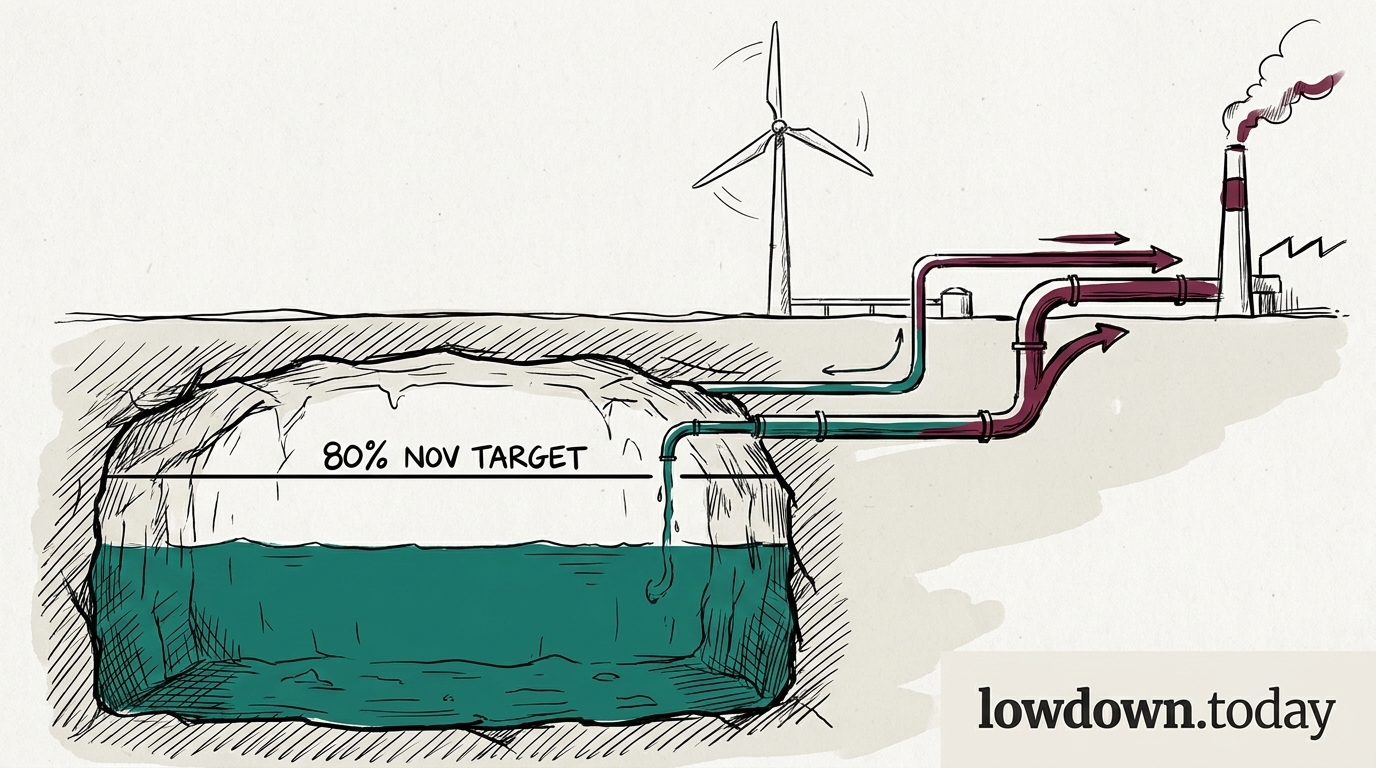
Brussels holds the bloc to 90% on a flexible window while Germany, holding roughly a quarter of EU storage capacity, tracks toward missing its own lower 80% figure by 21 points. A national shortfall this size in the anchor market matters more to bloc security than the flexible timetable alone can absorb.
French power exporters and CRE
French day-ahead rose in step with Germany but by less, reopening a EUR 7-17 premium that makes northward export flows commercially attractive again after the EUR 43.09 discount evaporated in days. CRE separately authorised RTE and Enedis to buy flexibility locally, betting the coming winter's binding constraint is grid congestion rather than a shortage of firm capacity.
TTF trading desk
TTF trading desk
A visible national shortfall like Germany's 21-point gap is a directional signal, not noise, for a desk holding the summer-winter spread. TTF's flat EUR 58-60 range through this week's German price swings says the market has not yet chosen to reprice refill risk into the front of the curve.
German cavern and CCGT operators
German caverns kept buying prompt gas at TTF near EUR 58-60 through the inversion; the wind collapse to 2.4 GW then flipped the spark spread to plus EUR 29 and put turbines back in the same queue. Every day turbines win that bid, injection at a third of the 877 GWh/day pace needed falls further behind.
Slovakia
Slovakia
Slovakia says it dropped its hold-out on the 21st sanctions package only after Ursula von der Leyen personally signed written gas-price and supply guarantees. The Council of the European Union's own 17,238-character release on the package names neither Slovakia nor any guarantee, leaving Bratislava's account unconfirmed by the institutional record.



