Skip to content
You can now search across every topic, entity and event.What's new
European Energy Markets
31JUL

IDF orders entire Dahiyeh evacuated

2 min read
09:44UTC

The shift from building-specific warnings to blanket evacuation of an entire urban district — hundreds of thousands of residents — signals a different scale of operation in southern Beirut.

EconomicDeveloping
Key takeaway

The shift from building-specific to district-wide evacuation warnings signals Israel intends infrastructure-level destruction of Hezbollah's urban stronghold, not another targeted strike package.

The IDF issued its most expansive ground instruction of the conflict: a blanket evacuation warning covering the entire Dahiyeh district of southern Beirut — hundreds of thousands of residents — alongside orders for 50 villages in southern and eastern Lebanon. Previous warnings had specified individual buildings or blocks; this order treats an entire urban district as a target zone.

Dahiyeh is the dense Shia-majority suburb that has been Hezbollah's organisational centre since the 1980s. The district gave its name to the 'Dahiyeh Doctrine' — a strategy attributed to former IDF Northern Command chief Gadi Eisenkot, which holds that disproportionate force applied to civilian infrastructure in areas associated with armed groups creates deterrence. The 2006 war levelled much of Dahiyeh; it was rebuilt and struck again during the June 2025 war. Each cycle displaces the same population and destroys the same infrastructure.

The evacuation order's scope, combined with seven children killed in Lebanon in the previous 24 hours and approximately 30,000 people displaced since fighting resumed on 2 March, indicates operations that will compound an already severe displacement crisis. Lebanon's capacity to absorb displaced populations — tested past its limits by the 2019 economic collapse, the 2020 Beirut port explosion, and the Syrian refugee influx — is being tested again. The order for 50 villages across the south and east suggests the IDF is preparing operations along the full border zone and into the Bekaa Valley, Hezbollah's logistical corridor to Syria.

The timing is bound to Lebanon's political moves. Beirut has ordered IRGC arrests and banned Hezbollah's military activities , aligning the government against the very organisation Israel is targeting. The IDF's response — expanding operations rather than pausing to let political pressure work — suggests military planners do not regard the Lebanese cabinet's decisions as operationally relevant to Hezbollah's armed capacity.


Deep Analysis

In plain English

In previous Israeli operations in Lebanon, the IDF warned specific buildings before striking — 'evacuate this address.' Now they have told everyone across an entire densely populated urban district to leave. This is the kind of warning that precedes massive, widespread bombardment of infrastructure across a whole area rather than precision strikes on individual targets. Dahiyeh is Hezbollah's political, financial, and social base — it contains hospitals, offices, and the homes of hundreds of thousands of civilians alongside military infrastructure.

Deep Analysis
Synthesis

Lebanon's formal break with Tehran (event 16) and Israel's blanket Dahiyeh warning are running as parallel, independent tracks — confirming that Israeli military objectives are not contingent on Lebanese political compliance. Beirut cannot offer Iranian expulsion as a trade for Israeli restraint if Israel has already decided to strike regardless of Beirut's posture.

Escalation

The simultaneous issuance of evacuation orders for 50 villages in southern and eastern Lebanon alongside the Dahiyeh district warning indicates Israel is preparing concurrent operations across multiple Lebanese theatres — not a single focused strike package. This operational breadth is consistent with preparation for the most extensive Israeli campaign in Lebanon since 2006.

What could happen next?
1 meaning2 risk1 precedent1 consequence
  • Meaning

    Israel has crossed from targeted to area-level warnings, operationalising the Dahiyeh doctrine at full scale for the first time since it was named after this district.

    Immediate · Assessed
  • Risk

    Hundreds of thousands of civilians unable or unwilling to evacuate face mass casualty risk once strikes begin at district scale.

    Immediate · Assessed
  • Precedent

    The first full-scale application of the Dahiyeh doctrine sets a template for how Israel will approach non-state actor urban infrastructure in future conflicts.

    Long term · Assessed
  • Consequence

    Physical destruction of Dahiyeh's infrastructure would sever Hezbollah's urban logistics, financial networks, and command communications concentrated in the district.

    Short term · Assessed
  • Risk

    Civilian deaths at district scale would generate ICC referral pressure and significant damage to Israel's international standing extending beyond the current conflict.

    Medium term · Suggested
First Reported In

Update #22 · IRGC drones hit Azerbaijan; CIA link cut

Al Jazeera· 5 Mar 2026
Read original
Causes and effects
This Event
IDF orders entire Dahiyeh evacuated
The blanket evacuation warning covering all of Dahiyeh and 50 villages marks a shift from targeted strikes to area-wide operations, with direct consequences for hundreds of thousands of civilians in a country whose absorption capacity was already exhausted.
Different Perspectives
Spain's LNG terminal operators
Spain's 9,145 GWh terminal inventory is the largest single stock in the EU LNG network, an option value that can reroute cargoes wherever the winter strip pays best rather than a cavern gas obligation tied to a fixed date. That flexibility matters more as Germany's cavern shortfall pushes more of the winter security question onto import infrastructure.
European Commission
European Commission
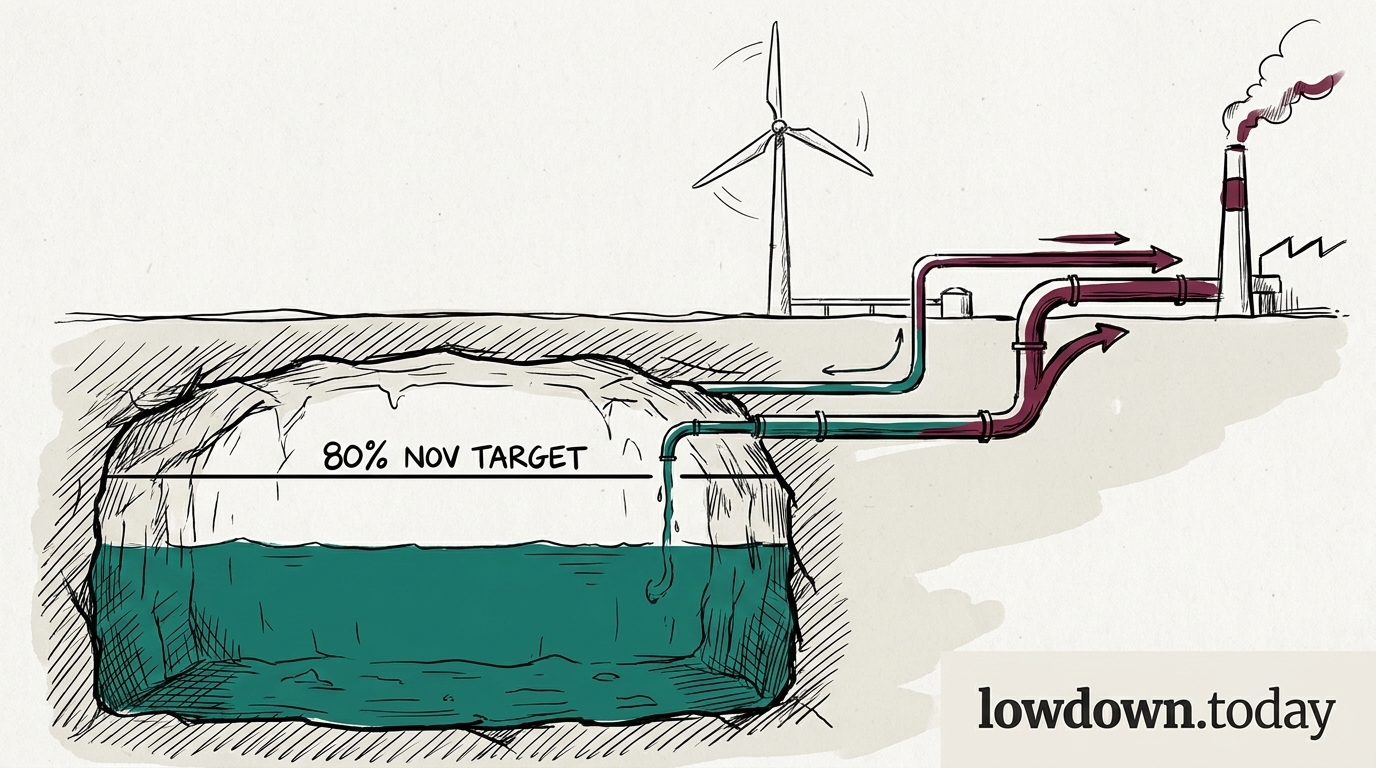
Brussels holds the bloc to 90% on a flexible window while Germany, holding roughly a quarter of EU storage capacity, tracks toward missing its own lower 80% figure by 21 points. A national shortfall this size in the anchor market matters more to bloc security than the flexible timetable alone can absorb.
French power exporters and CRE
French day-ahead rose in step with Germany but by less, reopening a EUR 7-17 premium that makes northward export flows commercially attractive again after the EUR 43.09 discount evaporated in days. CRE separately authorised RTE and Enedis to buy flexibility locally, betting the coming winter's binding constraint is grid congestion rather than a shortage of firm capacity.
TTF trading desk
TTF trading desk
A visible national shortfall like Germany's 21-point gap is a directional signal, not noise, for a desk holding the summer-winter spread. TTF's flat EUR 58-60 range through this week's German price swings says the market has not yet chosen to reprice refill risk into the front of the curve.
German cavern and CCGT operators
German caverns kept buying prompt gas at TTF near EUR 58-60 through the inversion; the wind collapse to 2.4 GW then flipped the spark spread to plus EUR 29 and put turbines back in the same queue. Every day turbines win that bid, injection at a third of the 877 GWh/day pace needed falls further behind.
Slovakia
Slovakia
Slovakia says it dropped its hold-out on the 21st sanctions package only after Ursula von der Leyen personally signed written gas-price and supply guarantees. The Council of the European Union's own 17,238-character release on the package names neither Slovakia nor any guarantee, leaving Bratislava's account unconfirmed by the institutional record.



