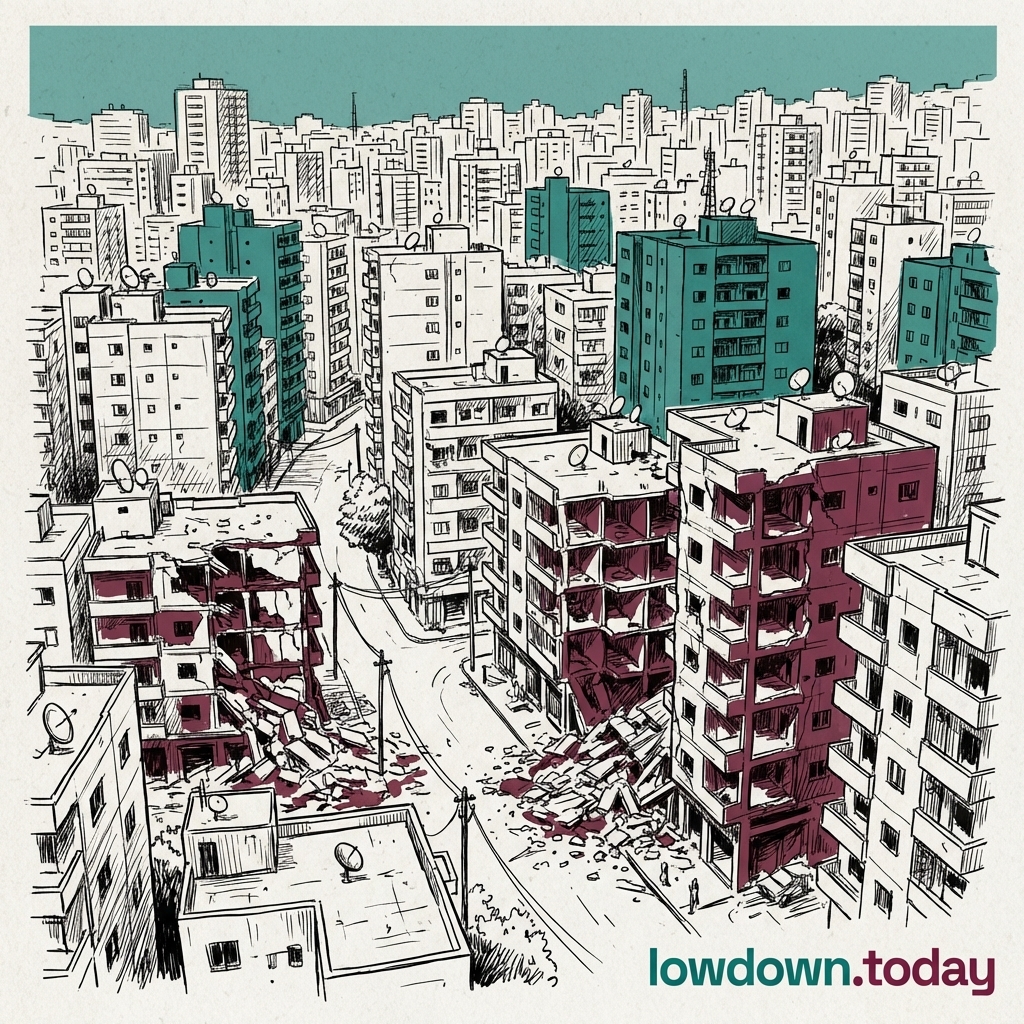
Dahiyeh
Hezbollah's southern Beirut stronghold, repeatedly struck by Israel and the first target hit since April 2026's Trump-brokered ceasefire.
Last refreshed: 7 May 2026 · Appears in 1 active topic
Will the Balout strike pull Dahiyeh back into full-scale bombardment despite the April ceasefire?
Timeline for Dahiyeh
Mentioned in: IDF names two more Hezbollah commanders killed
Iran Conflict 2026IDF kills Radwan commander in Beirut
Iran Conflict 2026IDF kills Radwan chief Balout in Beirut
Iran Conflict 2026Mentioned in: Lebanon toll nears 1,000; 20 more killed
Iran Conflict 2026Mentioned in: IDF destroys Litani bridge; a first
Iran Conflict 2026- What is Dahiyeh?
- Dahiyeh is Beirut's southern suburbs — a densely populated Shia Muslim area of an estimated 300,000–500,000 residents that serves as Hezbollah's political, military, and administrative headquarters. It has been the primary target of Israeli air campaigns since 2006.
- What is the Dahiyeh Doctrine?
- A 2008 Israeli military strategy, named after the district, formalising the use of disproportionate force against civilian-embedded military infrastructure to pressure Hezbollah's host population and degrade its support base.
- Why did Israel order evacuation of Dahiyeh in 2026?
- The IDF issued a blanket evacuation order covering the entire district, the first whole-district warning of the 2026 conflict, ahead of strikes targeting Hezbollah command centres and intelligence division satellite systems.
- How many people live in Dahiyeh?
- An estimated 300,000 to 500,000 residents lived in Dahiyeh before the 2026 displacement. Lebanon's overall displacement passed 800,000 within two weeks of the conflict opening, with Dahiyeh residents forming a substantial share.
- Is Dahiyeh controlled by Hezbollah?
- Effectively yes. The Lebanese state has no administrative presence there. Hezbollah provides governance, social services, security, and runs its political offices and Al-Manar television from the district.
- Was Dahiyeh struck after the April 2026 ceasefire?
- Yes. On 7 May 2026, Israeli forces struck Dahiyeh for the first time since the Trump-brokered Ceasefire of 16 April, killing Hezbollah Radwan Force commander Ahmed Ali Balout. Iran's Foreign Ministry warned the strike could collapse Iran's own Ceasefire with Israel.Source: iran-conflict-2026 Update 90
Background
On 7 May 2026, Israeli forces struck Dahiyeh for the first time since the Trump-brokered Ceasefire of 16 April 2026, killing Ahmed Ali Balout, commander of Hezbollah's elite Radwan Force. Iran's Foreign Ministry warned within hours that continued strikes on Lebanon would constitute grounds for the collapse of Iran's own Ceasefire with Israel. The strike broke a three-week pause during which the district had been conspicuously absent from Israeli targeting lists, and reignited fears of a wider regional escalation. Earlier in the conflict, Israel struck ten Hezbollah command centres and intelligence facilities across Dahiyeh in a single 30-minute window, then issued an unprecedented blanket evacuation order covering the entire district — the first whole-district warning of the conflict — forcing the displacement of hundreds of thousands.
Dahiyeh, Arabic for "suburb", is Beirut's southern suburbs: a densely populated Shia Muslim area of an estimated 300,000–500,000 residents before the 2026 displacement. Since the 1980s it has functioned as Hezbollah's administrative, political, and military nerve centre, housing the movement's political offices, Al-Manar television, social welfare networks, and weapons infrastructure. The Lebanese state has no administrative presence in Dahiyeh; Hezbollah fills that vacuum entirely. The district was heavily bombed and then rebuilt by Hezbollah after the 2006 Israel–Lebanon War, a reconstruction that became a central plank of the movement's popular legitimacy. Israel's Dahiyeh Doctrine, articulated in 2008 by then-Northern Command chief Gadi Eisenkot, explicitly named the district as the model for applying disproportionate force against civilian-embedded military infrastructure to pressure a movement's host population.
Dahiyeh sits at the intersection of three converging pressures in the 2026 conflict: Israeli targeting logic (degrade Hezbollah command capacity), Iranian strategic interest (protect the Axis of Resistance's forward infrastructure), and Lebanese state paralysis (no capacity to intervene militarily or diplomatically on the district's behalf). Each Israeli strike cycle — 2006, 2024, and 2026 — has reinforced its dual function as both Hezbollah's operational base and its most visible symbol of civilian–military entanglement. The May 2026 Balout strike, the first post-Ceasefire action in the Lebanese capital, sharply raised the stakes: the question is now whether targeted killings in Dahiyeh will trigger a renewal of full-scale bombardment or remain contained as precision operations.
