Skip to content
You can now search across every topic, entity and event.What's new
European Energy Markets
31JUL

Six Democrats join Senate war-powers push

3 min read
09:44UTC

Senate Democrats added six new co-sponsors to the War Powers Resolution forced to a vote this week. Lisa Murkowski and Susan Collins have publicly criticised Trump's rhetoric without committing to cross the floor.

EconomicDeveloping
Key takeaway

Six new sponsors force a Senate WPR vote into a deadline cluster lacking any signed presidential instrument.

Senate Democrats added six co-sponsors to the War Powers Resolution (WPR) forced to a vote in the week of 14 April: Jeff Merkley of Oregon, Kirsten Gillibrand of New York, Chris Van Hollen of Maryland, Mark Kelly of Arizona, Raphael Warnock of Georgia and Andy Kim of New Jersey 1. The resolution directs the withdrawal of US forces from hostilities with Iran absent a specific congressional authorisation. Lisa Murkowski of Alaska and Susan Collins of Maine have publicly criticised Trump's "annihilation" rhetoric without committing to cross the floor on the vote.

The previous three Senate WPR votes on the Iran campaign failed 47-53, with only Rand Paul of Kentucky crossing party lines. Adding six co-sponsors does not alter the arithmetic; it signals the floor vote this week is being treated as a public record rather than a procedural formality. The WPR's 60-day authorisation window expires around 29 April, and the clock is running against an executive action (the blockade, that was never filed as a signed document. The procedural complication is that with no presidential report on the books, the sponsors have had to force a standalone floor vote to create a record at all.

The Murkowski-Collins position is the variable. Both have on-record criticisms of Trump's war rhetoric. Neither has committed to a specific vote. The expanded sponsor list and the public criticisms do not produce a majority, but they produce the first record of a Republican Senate sub-caucus willing to be counted as critics before the vote lands rather than after. The ceasefire window closes 22 April, the GL-U sanctions licence lapses on the Saturday before the floor vote tracks the broader Treasury silence, and the WPR clock expires at the end of that same week.

For The Administration, the procedural weight is that a WPR vote this week creates a formal congressional instrument on the Iran operation at precisely the moment no presidential instrument exists. Whether the vote wins or loses, it is the only signed text on the record when the 29 April clock expires.


Deep Analysis

In plain English

The US Senate is set to vote this week on whether to require the president to stop the Iran military operation. This is called the War Powers Resolution, a law from 1973 that says Congress must approve any military action lasting more than 60 days. Six more senators have now backed the vote, bringing the number of supporters higher than before. Two Republican senators have publicly criticised the president's language about the war, though they have not said they will vote for the resolution. The problem is that even if the vote passes, it will be difficult to force the president to stop. The Senate would need a two-thirds majority to overcome a presidential veto, which is far more than the current level of support. The vote is more about creating a public record of dissent than about legally stopping the war. The extra complication is that the president has never filed the formal notification that is supposed to start the 60-day clock, so the legal mechanism the law was designed to use is not quite working as written.

What could happen next?
  • Precedent

    A Senate WPR resolution passing without a presidential report on record would create the first formal congressional instrument on this operation, establishing a paper trail even if the vote fails to compel withdrawal.

  • Risk

    If Murkowski and Collins vote for the resolution, the Republican Senate coalition fractures on war powers for the first time since the start of the Iran campaign, with implications for the GL-U lapse and the WPR clock expiry in the same week.

First Reported In

Update #68 · Sanctioned tankers slip the blockade

Fox News· 14 Apr 2026
Read original
Different Perspectives
Spain's LNG terminal operators
Spain's 9,145 GWh terminal inventory is the largest single stock in the EU LNG network, an option value that can reroute cargoes wherever the winter strip pays best rather than a cavern gas obligation tied to a fixed date. That flexibility matters more as Germany's cavern shortfall pushes more of the winter security question onto import infrastructure.
European Commission
European Commission
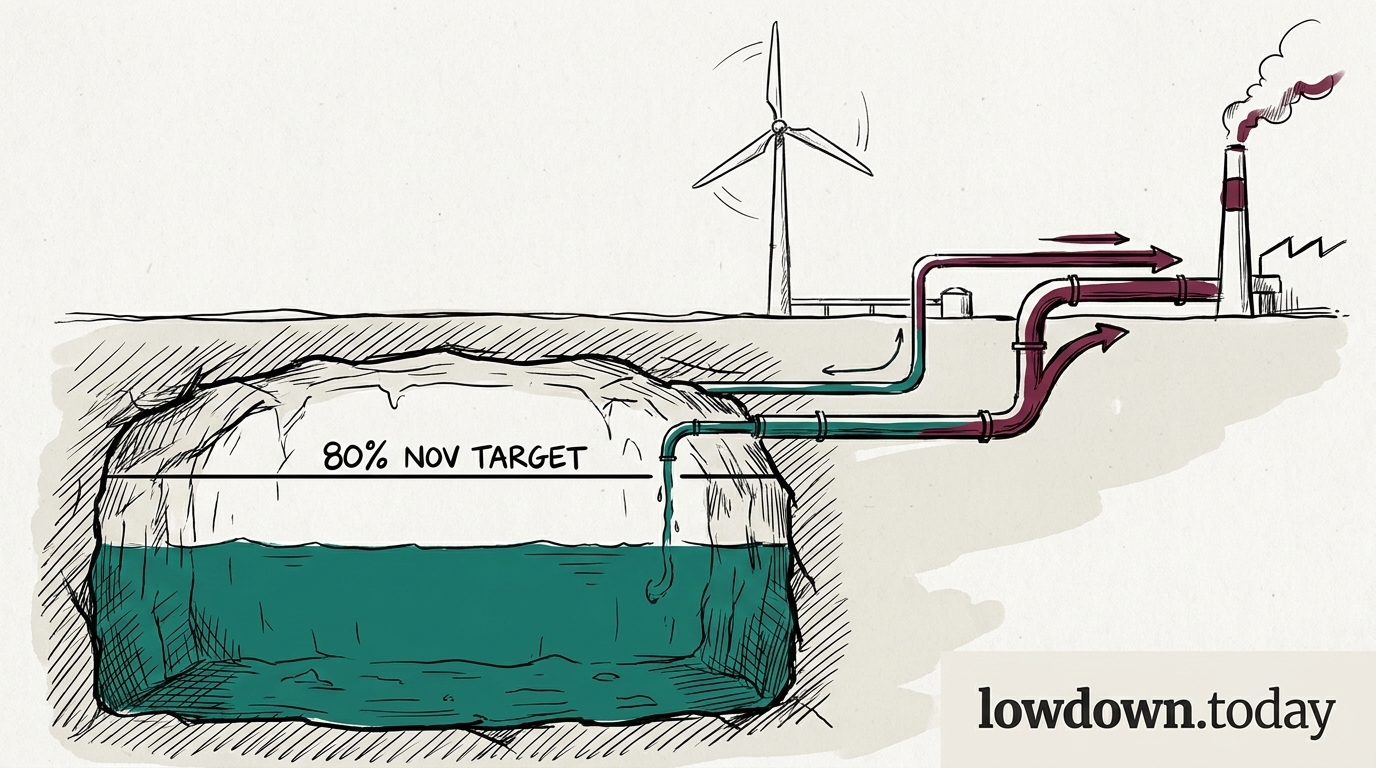
Brussels holds the bloc to 90% on a flexible window while Germany, holding roughly a quarter of EU storage capacity, tracks toward missing its own lower 80% figure by 21 points. A national shortfall this size in the anchor market matters more to bloc security than the flexible timetable alone can absorb.
French power exporters and CRE
French day-ahead rose in step with Germany but by less, reopening a EUR 7-17 premium that makes northward export flows commercially attractive again after the EUR 43.09 discount evaporated in days. CRE separately authorised RTE and Enedis to buy flexibility locally, betting the coming winter's binding constraint is grid congestion rather than a shortage of firm capacity.
TTF trading desk
TTF trading desk
A visible national shortfall like Germany's 21-point gap is a directional signal, not noise, for a desk holding the summer-winter spread. TTF's flat EUR 58-60 range through this week's German price swings says the market has not yet chosen to reprice refill risk into the front of the curve.
German cavern and CCGT operators
German caverns kept buying prompt gas at TTF near EUR 58-60 through the inversion; the wind collapse to 2.4 GW then flipped the spark spread to plus EUR 29 and put turbines back in the same queue. Every day turbines win that bid, injection at a third of the 877 GWh/day pace needed falls further behind.
Slovakia
Slovakia
Slovakia says it dropped its hold-out on the 21st sanctions package only after Ursula von der Leyen personally signed written gas-price and supply guarantees. The Council of the European Union's own 17,238-character release on the package names neither Slovakia nor any guarantee, leaving Bratislava's account unconfirmed by the institutional record.



