Skip to content
You can now search across every topic, entity and event.What's new
European Energy Markets
31JUL

Clerics call ceasefire treason

3 min read
09:44UTC

Within hours of Pezeshkian's Gulf apology, Iranian lawmakers called ceasefire 'treason' and demanded new leadership.

EconomicDeveloping
Key takeaway

Iran's elected president cannot deliver de-escalation the unelected security apparatus has not authorised, making presidential statements an unreliable guide to Iranian operational intent.

Within hours of President Masoud Pezeshkian's televised apology to Gulf neighbours , Iran's political establishment turned on him with coordinated fury. Mohammad Manan Raeisi, a Qom lawmaker, called the remarks "humiliating" and urged the Assembly of Experts to accelerate the installation of new leadership. Ebrahim Azizi, head of Parliament's national security committee, declared all US and Israeli bases in the region "legitimate and lawful targets" with "no red line in defending national interests." Conservative media activist Meisam Nili stated: "Any ceasefire is treason." Former lawmaker Jalal Rashidi Koochi addressed the president directly: "We made no mistake. Your message showed no sign of authority."

The backlash was directed at two audiences simultaneously. For Gulf foreign ministries who might have read Pezeshkian's apology as a genuine policy shift, the message was unambiguous: do not. For Iran's military apparatus — the same IRGC forces that ignored Pezeshkian's ceasefire order and continued striking Dubai, Saudi oil facilities, and Bahrain within hours of his address — the political class was signalling alignment with the military, not the president.

Pezeshkian occupies a position with no parallel among wartime leaders. His military does not obey him. His legislature repudiates him publicly. Ayatollah Khamenei's postponed funeral has frozen the succession process that might either consolidate or remove him. He rejected Trump's unconditional surrender demand in the same address , but this bought him nothing domestically — the system's objection was not to his defiance of Washington but to his conciliation towards Riyadh and Abu Dhabi. The structural reality of post-Khamenei Iran is now visible: the presidency retains the trappings of authority — a television studio, a teleprompter, an audience — without the capacity to command.

For Gulf capitals on the receiving end of Iranian missiles, the implications are direct. Saudi Arabia's backchannel to Tehran, deployed with "increased urgency" since mid-week , now runs through a political structure that has publicly declared any accommodation treason. When Iran's elected president attempts de-escalation, the system does not let him. That is the answer to the question Gulf diplomats have been asking since Thursday.


Deep Analysis

In plain English

Iran has two power centres: an elected president who can speak publicly, and a network of military commanders and religious authorities who actually control the guns and missiles. When Pezeshkian apologised to Gulf neighbours, he was speaking for himself — not for the people running the strikes. Iran's constitution gives ultimate authority to the Supreme Leader, not the president, and the IRGC answers to that chain of command. So the apology was genuine but carried no operational weight. The hardliner backlash is those commanders making sure no one — inside Iran or in Gulf capitals — mistakes the president's words for actual policy.

Deep Analysis
Synthesis

This episode operationalises a standing analytical problem for foreign interlocutors: de-escalation signals from Tehran must be verified against IRGC operational posture, not presidential speech. The hardliner response functions as real-time proof that Iran's diplomatic and military channels are structurally decoupled — previously inferrable, now demonstrated under combat conditions.

Root Causes

Iran's 1979 constitution embeds a dual-legitimacy structure in which elected institutions are formally subordinate to the Supreme Leader and the unelected Guardian Council, a structure the IRGC exploits as a de facto veto over foreign and security policy. The IRGC's parallel economic empire — estimated at 20–40% of GDP through bonyad foundations and front companies — gives it financial independence from the civilian budget, insulating military decision-making from presidential authority.

Escalation

The hardliner response forecloses the one off-ramp Pezeshkian was attempting to open. With the Assembly of Experts being urged to accelerate leadership transition, and parliament's security committee explicitly endorsing continued strikes on US and Israeli bases, institutional signals point toward operational escalation rather than restraint — independent of whatever the president says next.

What could happen next?
  • Consequence

    Gulf states receiving Pezeshkian's apology will discount it as undeliverable; any back-channel negotiations must route through the IRGC or the Supreme Leader's office to carry operational weight.

    Immediate · Assessed
  • Risk

    Accelerated Assembly of Experts pressure on Pezeshkian could produce a leadership transition mid-conflict, eliminating even the nominal moderate voice and removing residual diplomatic cover.

    Short term · Suggested
  • Precedent

    The episode confirms that Iran's elected presidency cannot unilaterally signal or deliver de-escalation during a security crisis — a structural constraint that will shape how any ceasefire negotiation must be architected.

    Long term · Assessed
First Reported In

Update #27 · Israel kills 41 on failed 1986 airman raid

Iran International· 7 Mar 2026
Read original
Causes and effects
This Event
Clerics call ceasefire treason
The coordinated repudiation of Pezeshkian by Iran's legislature and conservative establishment demonstrates that his presidential authority does not extend to war policy or Gulf relations — Iran's elected president cannot deliver de-escalation because the system that surrounds him has publicly defined any accommodation as treason.
Different Perspectives
Spain's LNG terminal operators
Spain's 9,145 GWh terminal inventory is the largest single stock in the EU LNG network, an option value that can reroute cargoes wherever the winter strip pays best rather than a cavern gas obligation tied to a fixed date. That flexibility matters more as Germany's cavern shortfall pushes more of the winter security question onto import infrastructure.
European Commission
European Commission
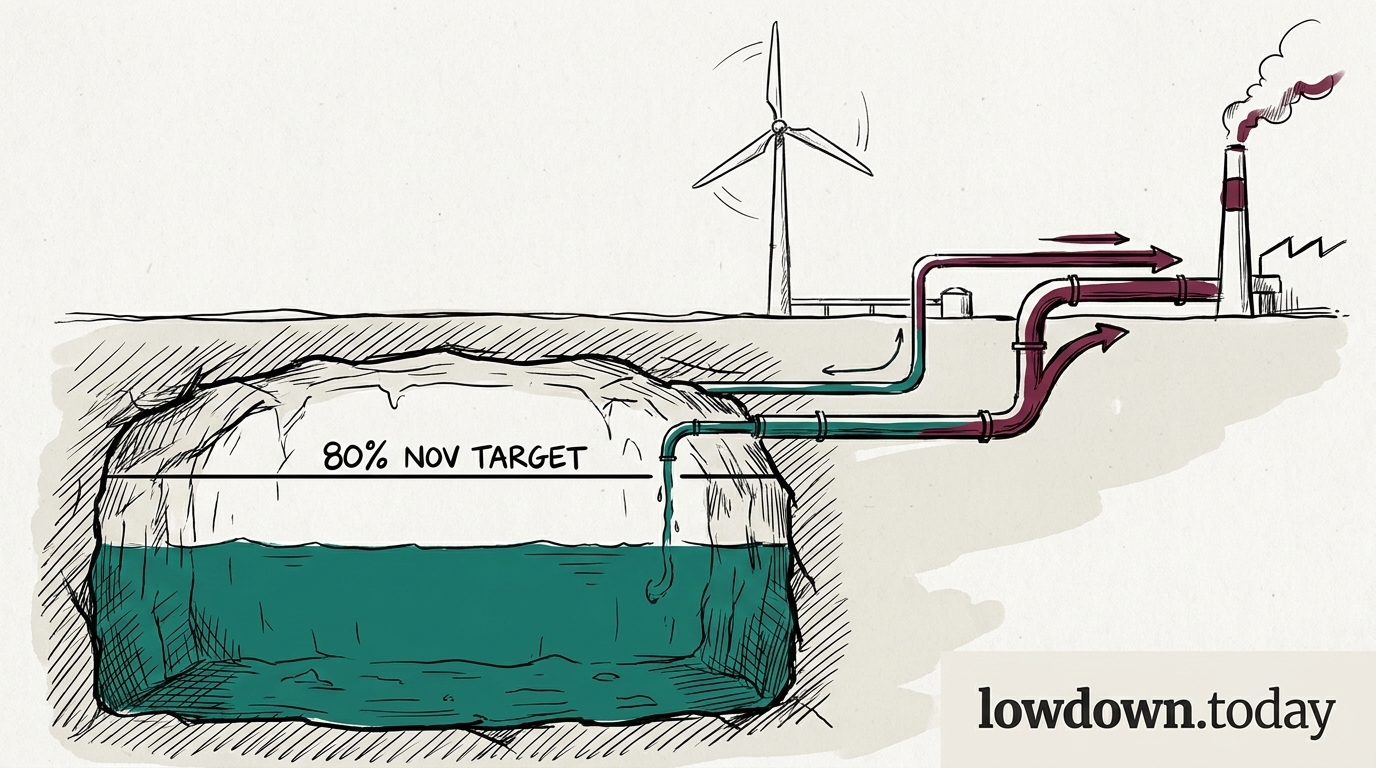
Brussels holds the bloc to 90% on a flexible window while Germany, holding roughly a quarter of EU storage capacity, tracks toward missing its own lower 80% figure by 21 points. A national shortfall this size in the anchor market matters more to bloc security than the flexible timetable alone can absorb.
French power exporters and CRE
French day-ahead rose in step with Germany but by less, reopening a EUR 7-17 premium that makes northward export flows commercially attractive again after the EUR 43.09 discount evaporated in days. CRE separately authorised RTE and Enedis to buy flexibility locally, betting the coming winter's binding constraint is grid congestion rather than a shortage of firm capacity.
TTF trading desk
TTF trading desk
A visible national shortfall like Germany's 21-point gap is a directional signal, not noise, for a desk holding the summer-winter spread. TTF's flat EUR 58-60 range through this week's German price swings says the market has not yet chosen to reprice refill risk into the front of the curve.
German cavern and CCGT operators
German caverns kept buying prompt gas at TTF near EUR 58-60 through the inversion; the wind collapse to 2.4 GW then flipped the spark spread to plus EUR 29 and put turbines back in the same queue. Every day turbines win that bid, injection at a third of the 877 GWh/day pace needed falls further behind.
Slovakia
Slovakia
Slovakia says it dropped its hold-out on the 21st sanctions package only after Ursula von der Leyen personally signed written gas-price and supply guarantees. The Council of the European Union's own 17,238-character release on the package names neither Slovakia nor any guarantee, leaving Bratislava's account unconfirmed by the institutional record.



