Skip to content
You can now search across every topic, entity and event.What's new
European Energy Markets
31JUL

Paris and London convene forty nations

4 min read
09:44UTC

Lowdown Newsroom

EconomicDeveloping
Key takeaway

Europe is drafting the Hormuz framework Washington never put on paper.

Emmanuel Macron and Keir Starmer will chair a leaders' video conference on Friday of nations willing to contribute to 'a purely defensive multilateral mission' to restore freedom of navigation in the Strait of Hormuz once security conditions permit. The Elysée announcement, published on Tuesday, confirmed senior diplomats would hold a preparatory call on Thursday and that over forty nations were expected to participate. The conference is the operational successor to the earlier UK-convened Hormuz coordination meeting .

The difference is what is being drafted. At the earlier meeting the coalition agreed to coordinate. On Friday it plans to design a physical mission, command structure, and rules of engagement for a post-war passage framework. In international maritime law, the first credible multilateral framework tends to hold. Subsequent proposals negotiate against it rather than replacing it. Europe's advantage is written documents where the United States has only posts.

The US blockade has been running for several days on a social-media post and a self-generated CENTCOM operational order. The instrument-free record The White House's own presidential-actions page confirmed this week is what gives Paris and London space to hold the pen. With no American presidential text on record, any framework published on Friday becomes the document any post-war passage arrangement must reference. The Anglo-French summit is not framed as a challenge to Washington; it does not need to be. Roughly eighty per cent of the named nations host US bases, which complicates formal opposition to the blockade, but does not prevent them signing a post-war framework the United States has not written.


Deep Analysis

In plain English

France and the UK have invited more than 40 countries to a video conference on Friday to plan what happens at the Strait of Hormuz after the war ends. The Strait is a 33-kilometre-wide waterway between Iran and the Arabian peninsula, and about 20 per cent of the world's oil normally passes through it. Right now the US is running a blockade there; but it has never written down the formal rules on paper. The idea is: if no one writes the rules, whoever writes them first gets to set the terms. Europe is trying to be that writer. The conference would design a security mission; which countries contribute ships, what those ships are allowed to do, and under what legal authority. If it succeeds, the post-war Hormuz rules will have been written in Paris and London, not Washington.

Deep Analysis
Root Causes

The summit's genesis is the US instrument gap. Europe cannot negotiate a post-war passage regime against a text that does not exist. The blockade, the ceasefire, and the toll list are all Truth Social posts; no signed American instrument describes what a post-war Hormuz looks like from Washington's perspective.

The 2 April UK-led coordination meeting established that Europe had the political will but not the framework. The 17 April summit converts political will into a draft mission document; command structure, rules of engagement, force contributions; before the ceasefire window closes on 22 April. Europe is not challenging Washington; it is filling a governance vacuum Washington has not moved to fill.

What could happen next?
  • Consequence

    If the summit produces operational rules of engagement, Europe holds the pen on post-war Hormuz governance regardless of US diplomatic position

    Short term · 0.7
  • Risk

    Italy's parallel bilateral Gulf trip and France's simultaneous flag-state protest erode the claim that Europe speaks with a unified voice, weakening the framework's negotiating weight

    Immediate · 0.8
  • Opportunity

    A UNCLOS-compatible multilateral mandate gives Tehran a non-US framework to negotiate passage terms against, potentially breaking the Islamabad deadlock by providing an alternative interlocutor

    Medium term · 0.65
First Reported In

Update #69 · Cooper joins the instrument gap

Al-Monitor (Elysée)· 15 Apr 2026
Read original
Different Perspectives
Spain's LNG terminal operators
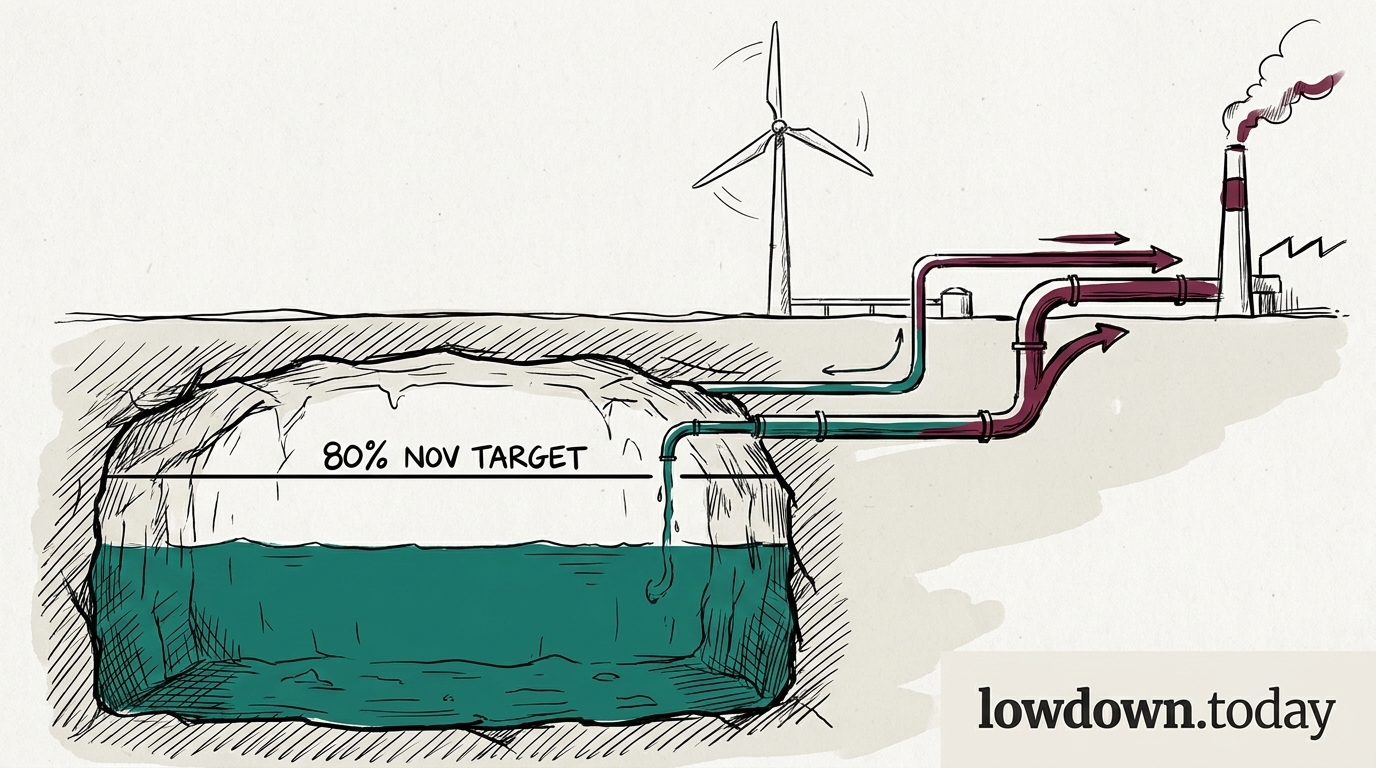
Spain's 9,145 GWh terminal inventory is the largest single stock in the EU LNG network, an option value that can reroute cargoes wherever the winter strip pays best rather than a cavern gas obligation tied to a fixed date. That flexibility matters more as Germany's cavern shortfall pushes more of the winter security question onto import infrastructure.
European Commission
European Commission
Brussels holds the bloc to 90% on a flexible window while Germany, holding roughly a quarter of EU storage capacity, tracks toward missing its own lower 80% figure by 21 points. A national shortfall this size in the anchor market matters more to bloc security than the flexible timetable alone can absorb.
French power exporters and CRE
French day-ahead rose in step with Germany but by less, reopening a EUR 7-17 premium that makes northward export flows commercially attractive again after the EUR 43.09 discount evaporated in days. CRE separately authorised RTE and Enedis to buy flexibility locally, betting the coming winter's binding constraint is grid congestion rather than a shortage of firm capacity.
TTF trading desk
TTF trading desk
A visible national shortfall like Germany's 21-point gap is a directional signal, not noise, for a desk holding the summer-winter spread. TTF's flat EUR 58-60 range through this week's German price swings says the market has not yet chosen to reprice refill risk into the front of the curve.
German cavern and CCGT operators
German caverns kept buying prompt gas at TTF near EUR 58-60 through the inversion; the wind collapse to 2.4 GW then flipped the spark spread to plus EUR 29 and put turbines back in the same queue. Every day turbines win that bid, injection at a third of the 877 GWh/day pace needed falls further behind.
Slovakia
Slovakia
Slovakia says it dropped its hold-out on the 21st sanctions package only after Ursula von der Leyen personally signed written gas-price and supply guarantees. The Council of the European Union's own 17,238-character release on the package names neither Slovakia nor any guarantee, leaving Bratislava's account unconfirmed by the institutional record.



