Skip to content
You can now search across every topic, entity and event.What's new
European Energy Markets
31JUL

Lebanon: 1,029 dead, a million displaced

4 min read
09:44UTC

Lebanon's death toll passes 1,000 with one in five citizens displaced, as UNICEF counts the daily cost to the country's youngest.

EconomicDeveloping
Key takeaway

Lebanon's humanitarian system was already at breaking point before this conflict — displacement compounds an existing structural collapse.

Lebanon's cumulative death toll has reached approximately 1,029 — including 118 children and 40 medical workers — with more than one million displaced since Israeli ground and air operations expanded on 2 March. One in five Lebanese has been forced from home.

UNICEF deputy executive director Chaiban put a measure on the child toll: "one classroom of children" killed or wounded every day 1. The count has climbed steadily — from 968 five days earlier , through 1,000 on 19 March , to the current figure. Over 22 days of operations, 118 children dead averages more than five child deaths per day. The wounded raise the daily child casualty figure to the classroom-scale numbers Chaiban described.

The acceleration tracks a deliberate shift in Israeli strategy. Defence Minister Katz ordered "accelerated demolition of Lebanese houses in the border villages" following what he explicitly called the "Beit Hanoun and Rafah models" — a reference to two of the most comprehensively destroyed population centres in the Gaza conflict. His stated aim: that "hundreds of thousands of Shiite residents of southern Lebanon will not return to their homes south of the Litani area."

The physical infrastructure for return is being systematically removed. Israeli strikes severed bridges over the Litani and destroyed the Qasmiyeh Bridge , cutting the south's road links north. Displacement orders issued on 12 March pushed residents not to the Litani — the line established by UN Security Council Resolution 1701 in 2006 — but 15 km further north to the Zahrani River, 40 km from the border. The displacement zone NOW exceeds anything contemplated under the post-2006 framework.

Hezbollah responded with a claimed record 63 operations in 24 hours — rockets, drones, and artillery against Israeli forces in the south 2. The organisation retains operational capacity even as the civilian population around it bears the war's full weight. The pattern replicates what unfolded in Gaza: military targets persist while the civilian fabric — homes, hospitals, roads, bridges — is destroyed around them. For Lebanon's displaced million, the question is no longer when fighting stops but whether what they left behind will exist when it does.


Deep Analysis

In plain English

More than one million Lebanese — roughly one in five people in a country the size of Wales — have been forced from their homes. Lebanon was already hosting millions of Syrian refugees before this war began, meaning hospitals, shelters, and emergency services were already stretched to their limits. Now nine hospitals have been put out of action by strikes and 40 medical workers have been killed, meaning the displaced population has diminishing access to treatment even as casualties accumulate.

Deep Analysis
Synthesis

The 40 medical workers killed and nine hospitals non-operational creates a cascading mortality effect: civilians cannot receive treatment, which will drive deaths higher even if strike intensity plateaus. UNICEF's 'one classroom per day' metric is analytically significant beyond its rhetorical impact — it maps onto the child casualty rate from Gaza at comparable conflict stages, suggesting a structural pattern in Israeli urban operations across both theatres rather than incidental targeting in either.

Root Causes

Lebanon has lacked a functional government capable of coordinating mass civilian evacuation since the 2019–20 financial collapse and the 2020 Beirut port explosion destroyed state institutional capacity. The Lebanese Armed Forces have no logistics infrastructure for displacement management at this scale. UNHCR and ICRC are effectively the primary response actors inside a sovereign state — an institutional vacuum that guarantees the humanitarian gap will widen as conflict intensity persists.

What could happen next?
2 consequence2 risk1 precedent
  • Consequence

    Lebanon's healthcare system approaching functional collapse in conflict zones, with downstream mortality rising above reported figures as hospital capacity is systematically removed.

    Immediate · Assessed
  • Risk

    Permanent demographic emptying of south Lebanon converting Israel's stated security objective into a fait accompli before ceasefire negotiations can begin.

    Medium term · Assessed
  • Risk

    European asylum and border systems face rising pressure as Lebanese diaspora networks activate emergency migration pathways.

    Short term · Suggested
  • Precedent

    Israel's explicit 'will not return' statements create a legal record for ICC forcible-transfer charges that is legally distinct from and potentially stronger than the war crimes documentation in event 12.

    Long term · Suggested
  • Consequence

    UNICEF and ICRC capacity diverted from Sudan and the DRC, degrading humanitarian response in conflicts with fewer Western media resources.

    Short term · Assessed
First Reported In

Update #46 · Trump delays strikes; oil crashes to $99

Tribune India· 24 Mar 2026
Read original
Causes and effects
This Event
Lebanon: 1,029 dead, a million displaced
The humanitarian toll in Lebanon has crossed 1,000 dead with one million displaced in three weeks. The rate of child casualties — averaging more than five deaths per day — and the systematic destruction of road infrastructure point to operations aimed at permanently depopulating southern Lebanon, not temporarily securing it.
Different Perspectives
Spain's LNG terminal operators
Spain's 9,145 GWh terminal inventory is the largest single stock in the EU LNG network, an option value that can reroute cargoes wherever the winter strip pays best rather than a cavern gas obligation tied to a fixed date. That flexibility matters more as Germany's cavern shortfall pushes more of the winter security question onto import infrastructure.
European Commission
European Commission
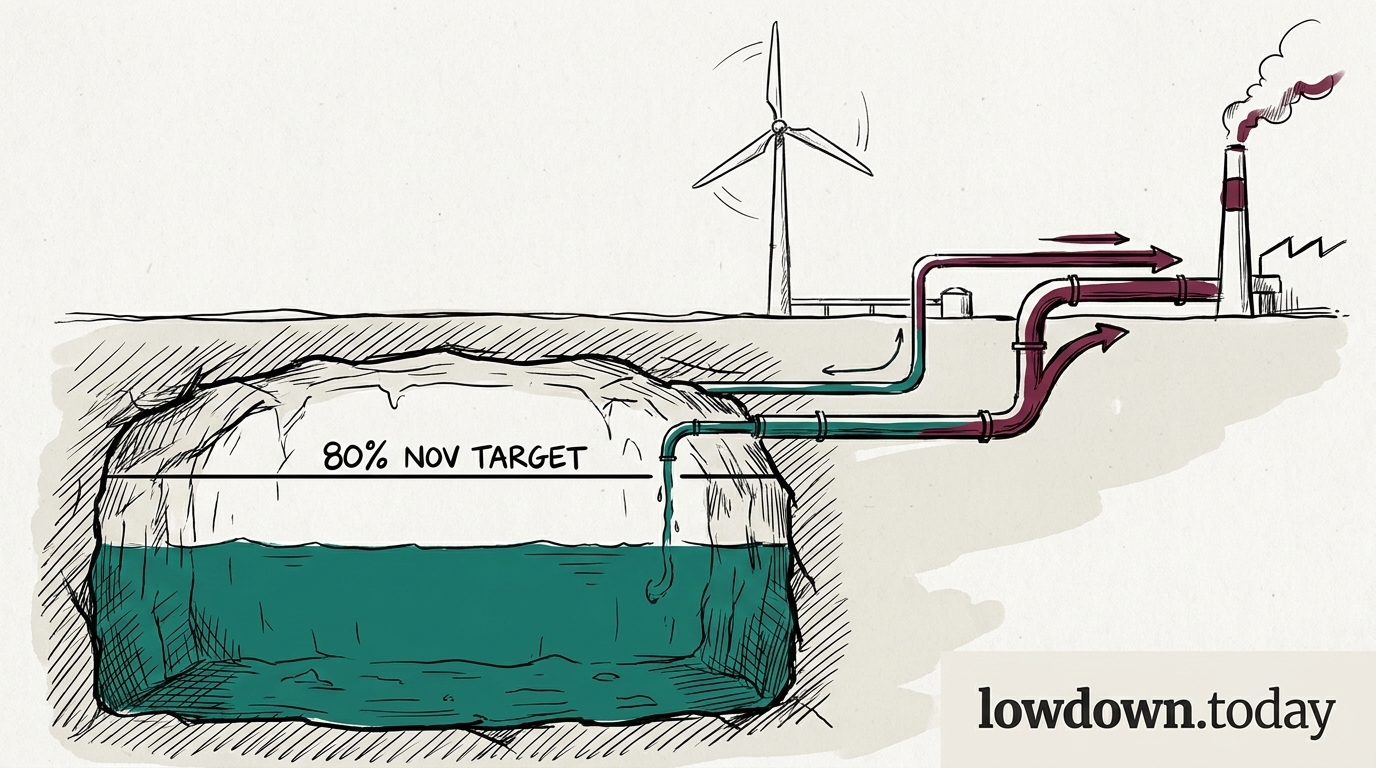
Brussels holds the bloc to 90% on a flexible window while Germany, holding roughly a quarter of EU storage capacity, tracks toward missing its own lower 80% figure by 21 points. A national shortfall this size in the anchor market matters more to bloc security than the flexible timetable alone can absorb.
French power exporters and CRE
French day-ahead rose in step with Germany but by less, reopening a EUR 7-17 premium that makes northward export flows commercially attractive again after the EUR 43.09 discount evaporated in days. CRE separately authorised RTE and Enedis to buy flexibility locally, betting the coming winter's binding constraint is grid congestion rather than a shortage of firm capacity.
TTF trading desk
TTF trading desk
A visible national shortfall like Germany's 21-point gap is a directional signal, not noise, for a desk holding the summer-winter spread. TTF's flat EUR 58-60 range through this week's German price swings says the market has not yet chosen to reprice refill risk into the front of the curve.
German cavern and CCGT operators
German caverns kept buying prompt gas at TTF near EUR 58-60 through the inversion; the wind collapse to 2.4 GW then flipped the spark spread to plus EUR 29 and put turbines back in the same queue. Every day turbines win that bid, injection at a third of the 877 GWh/day pace needed falls further behind.
Slovakia
Slovakia
Slovakia says it dropped its hold-out on the 21st sanctions package only after Ursula von der Leyen personally signed written gas-price and supply guarantees. The Council of the European Union's own 17,238-character release on the package names neither Slovakia nor any guarantee, leaving Bratislava's account unconfirmed by the institutional record.



