Skip to content
You can now search across every topic, entity and event.What's new
European Energy Markets
31JUL

Hezbollah fires rockets hours after ban

2 min read
09:44UTC

Hours after the cabinet demanded Hezbollah surrender its weapons, the group struck Israel's Ramat Airbase — the distance between Lebanon's legal authority and its military reality measured in minutes.

EconomicDeveloping
Key takeaway

Hezbollah's immediate strike is a doctrinal response designed to foreclose diplomatic ambiguity before international pressure on the ban could solidify — a deliberate closure of off-ramps rather than reactive escalation.

Hezbollah struck Israel's Ramat Airbase with rockets within hours of the Lebanese cabinet's formal ban on its military activities — the most direct possible answer to a government demand for disarmament.

The strike exposed the distance between Lebanon's legal authority and its physical power. The same armed forces that withdrew from border positions rather than confront Israel's advancing 91st Division were now nominally responsible for preventing precisely the kind of attack Hezbollah had just carried out. The justice minister's order to arrest those who fire at Israel remains on the books. No arrests have been reported.

Hezbollah's defiance carries its own logic. The organisation has survived Israeli assassination campaigns that killed Secretary-General Hassan Nasrallah in September 2024 and parliamentary bloc chief Mohammad Raad days ago . Israel has named current Secretary-General Naim Qassem as a target for elimination and declared "no immunity" for any Hezbollah figure, including political leaders and civilian supporters . Under these conditions, Hezbollah's leadership calculates that disarming means accepting an existential threat without the capacity to retaliate. The cabinet's demand asks Hezbollah to lay down arms without offering any security guarantee in return.

The Ramat Airbase strike also complicates Salam's position with Washington. The US conditioned its restraint of Israeli operations on Lebanese action against Hezbollah . Hours after the cabinet delivered that action, Hezbollah demonstrated it was irrelevant to the military reality on the ground. Israel's Defence Minister Katz had already ordered the 91st Division to "advance and seize additional controlling areas" in southern Lebanon . The ban gives Israel no reason to pause and Hezbollah no reason to comply. Lebanon's government has declared what it wants. It has no means to achieve it.


Deep Analysis

In plain English

Hours after Lebanon's government banned Hezbollah from firing weapons, Hezbollah fired weapons at Israel. This was not impulsive — Hezbollah did the same thing in 2008 when the Lebanese government tried to restrict its phone network, with fighters in the streets of Beirut within a day. The pattern is consistent: when the Lebanese state asserts authority over Hezbollah, Hezbollah immediately demonstrates that the assertion is empty. Acting within hours means there is no time for international observers to ask whether Hezbollah might comply — the answer is given before the question can form.

Deep Analysis
Synthesis

The strike's primary strategic function was temporal: by acting before international reaction to the Lebanese cabinet decision could solidify, Hezbollah foreclosed any period of ambiguity in which it might have appeared to be reviewing compliance. This eliminated the diplomatic space in which Salam could have claimed Hezbollah was 'considering' the ban — a deliberate act of political closure as much as a military one. The body identifies the defiance; the novel element is the timing as an instrument of diplomatic denial.

Escalation

The choice of Ramat Airbase — an active Israeli Air Force installation rather than a border settlement or civilian area — indicates calibrated military-to-military targeting intended to demonstrate operational capability and rejection of the ban without generating civilian harm optics that would invite disproportionate Israeli retaliation. Direction: lateral (demonstrates defiance without crossing the strategic escalation threshold; neither advancing nor retreating from the current conflict level).

What could happen next?
1 meaning1 risk1 consequence1 precedent1 opportunity
  • Meaning

    Hezbollah's immediate defiance publicly establishes that Lebanese cabinet decisions carry no operational authority over its military wing, rendering the ban politically and legally significant but militarily irrelevant.

    Immediate · Assessed
  • Risk

    If Israel retaliates against Lebanese state infrastructure rather than exclusively Hezbollah positions, Salam's government faces a credibility crisis — it banned Hezbollah but cannot shield Lebanon from the consequences of Hezbollah's actions.

    Immediate · Assessed
  • Consequence

    The ban is publicly defied on day one; any future Lebanese government claim of implementation requires a qualitative change in enforcement capability that does not currently exist and has no identified pathway to development.

    Short term · Assessed
  • Precedent

    Establishes that Lebanese government sovereignty assertions over Hezbollah military activities will receive an immediate military demonstration in response, raising the political cost for any future Beirut government that attempts enforcement.

    Long term · Assessed
  • Opportunity

    Israeli restraint in retaliation — limiting response to Hezbollah military sites rather than Lebanese state assets — would preserve Salam's government as a useful interlocutor, giving Israel a structural incentive not to destroy the political infrastructure that just formally banned Hezbollah.

    Short term · Suggested
First Reported In

Update #16 · 165 girls buried; European gas doubles

Al Jazeera· 3 Mar 2026
Read original
Causes and effects
This Event
Hezbollah fires rockets hours after ban
Hezbollah's immediate defiance demonstrates that the Lebanese state's formal legal authority over its territory has no operational force against the country's most powerful armed actor. The strike also undermines Salam's diplomatic position with Washington, which conditioned protection from Israeli operations on Lebanese action against Hezbollah.
Different Perspectives
Spain's LNG terminal operators
Spain's 9,145 GWh terminal inventory is the largest single stock in the EU LNG network, an option value that can reroute cargoes wherever the winter strip pays best rather than a cavern gas obligation tied to a fixed date. That flexibility matters more as Germany's cavern shortfall pushes more of the winter security question onto import infrastructure.
European Commission
European Commission
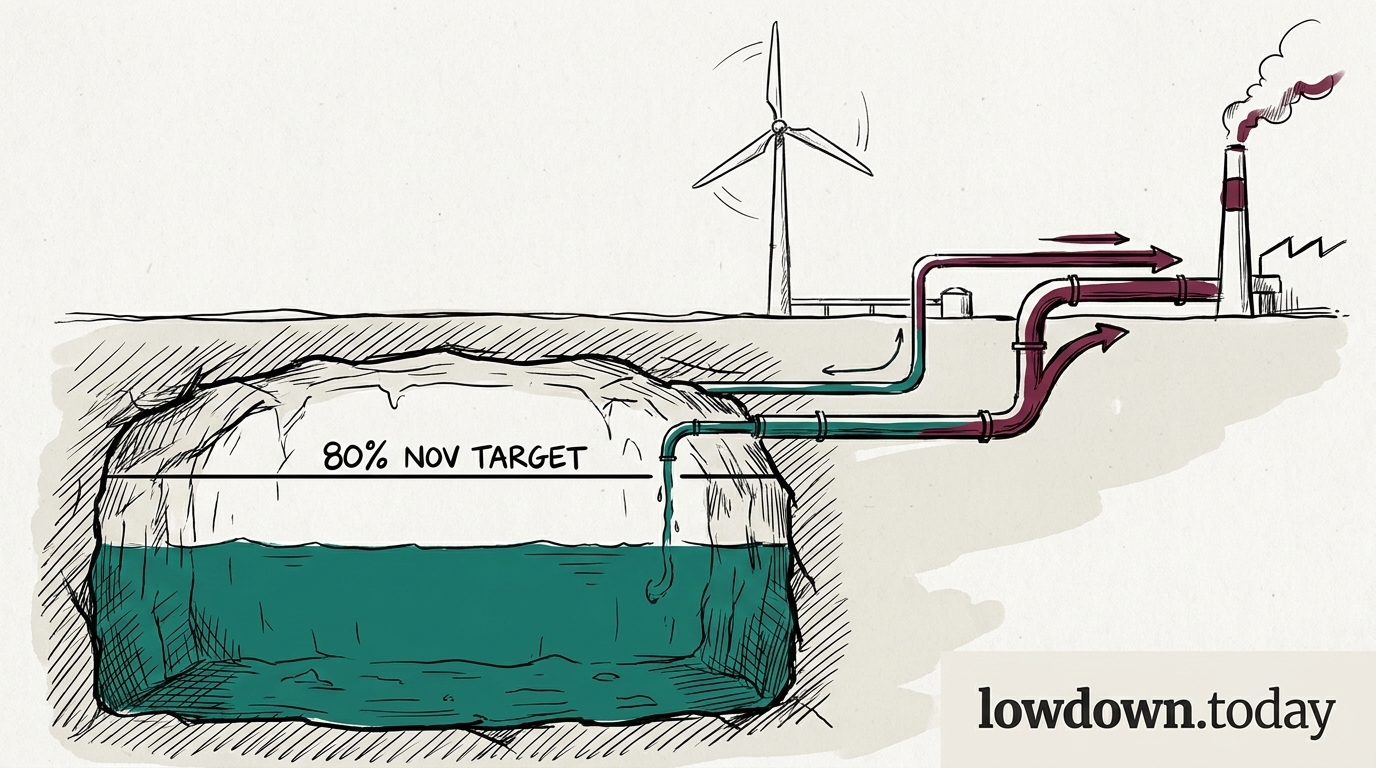
Brussels holds the bloc to 90% on a flexible window while Germany, holding roughly a quarter of EU storage capacity, tracks toward missing its own lower 80% figure by 21 points. A national shortfall this size in the anchor market matters more to bloc security than the flexible timetable alone can absorb.
French power exporters and CRE
French day-ahead rose in step with Germany but by less, reopening a EUR 7-17 premium that makes northward export flows commercially attractive again after the EUR 43.09 discount evaporated in days. CRE separately authorised RTE and Enedis to buy flexibility locally, betting the coming winter's binding constraint is grid congestion rather than a shortage of firm capacity.
TTF trading desk
TTF trading desk
A visible national shortfall like Germany's 21-point gap is a directional signal, not noise, for a desk holding the summer-winter spread. TTF's flat EUR 58-60 range through this week's German price swings says the market has not yet chosen to reprice refill risk into the front of the curve.
German cavern and CCGT operators
German caverns kept buying prompt gas at TTF near EUR 58-60 through the inversion; the wind collapse to 2.4 GW then flipped the spark spread to plus EUR 29 and put turbines back in the same queue. Every day turbines win that bid, injection at a third of the 877 GWh/day pace needed falls further behind.
Slovakia
Slovakia
Slovakia says it dropped its hold-out on the 21st sanctions package only after Ursula von der Leyen personally signed written gas-price and supply guarantees. The Council of the European Union's own 17,238-character release on the package names neither Slovakia nor any guarantee, leaving Bratislava's account unconfirmed by the institutional record.



