Skip to content
You can now search across every topic, entity and event.What's new
European Energy Markets
31JUL

Iran and Hezbollah: first joint strike

3 min read
09:44UTC

Iranian ballistic missiles and Hezbollah rockets struck at Tel Aviv and Haifa simultaneously — the first coordinated two-axis attack of the conflict, executed despite the destruction of Iranian command infrastructure.

EconomicDeveloping
Key takeaway

Iran and Hezbollah have validated operational coordination at a level that requires Israel to treat every future salvo as a potential multi-axis saturation event, permanently raising the defensive resource cost of each attack regardless of whether damage is caused.

Iran and Hezbollah launched the first simultaneous, coordinated strike of the conflict overnight — Iranian ballistic missiles from the east and Hezbollah rockets from the north, aimed concurrently at Tel Aviv and Haifa. No confirmed large-scale damage to either city was reported. The damage question is secondary; the coordination is the development.

Simultaneous two-axis targeting forces Israel's layered air defence — Iron Dome for short-range rockets, David's Sling for medium-range, Arrow for ballistic threats — to allocate interceptors across two threat bearings at once. Prior Hezbollah attacks had been sequenced separately from Iranian salvos, allowing Israeli systems to concentrate on one threat axis at a time. Concurrent fire from Lebanon and Iran compresses the decision window and raises the probability of saturation in overlapping coverage zones.

The coordination survived two conditions that should have degraded it. The US-Israeli campaign has struck IRGC command infrastructure in Tehran, including the Sarallah headquarters and the state broadcaster IRIB . Lebanon's emergency cabinet formally banned all Hezbollah military and security activities three days ago — a ban Hezbollah defied within hours by striking Israel's Ramat Airbase . That the Iran-Hezbollah attack axis remained intact through both the systematic destruction of centralised Iranian command nodes and an unprecedented governmental prohibition on Hezbollah operations implies either pre-arranged attack protocols that do not require real-time coordination from Tehran, or communication channels the campaign has failed to sever.

Each possibility carries distinct implications. Pre-arranged protocols would suggest Iran and Hezbollah planned for the loss of centralised command — a doctrinal adaptation possibly informed by the successive elimination of Hezbollah's senior leadership in 2024. Intact communications would mean the US-Israeli intelligence picture of Iranian command-and-control networks is incomplete. In either case, the coordination has been demonstrated, and what has been demonstrated is repeatable.


Deep Analysis

In plain English

Israel's missile defence systems — Iron Dome, David's Sling, and Arrow — are sophisticated but finite: each interceptor is expensive, each radar can only track so many targets simultaneously, and the systems oriented north towards Lebanon are partly separate from those oriented east towards Iran. By firing from both directions at the exact same moment, Iran and Hezbollah force Israel to split its defensive attention and consume interceptors from multiple batteries simultaneously rather than sequentially. Even if nothing gets through today, this serves two purposes: it depletes intercept stockpiles faster and it generates observable data about how Israeli defences respond under simultaneous pressure, which can be used to find the gaps next time.

Deep Analysis
Synthesis

The shift from sequential to simultaneous multi-axis attack represents the operationalisation of Iran's 'axis of resistance' as a functionally unified military command structure rather than a collection of proxy relationships managed separately. Each successful coordination proof-of-concept reduces the deterrence value of Israel's qualitative military edge, which was premised on fighting adversaries separately and sequentially rather than simultaneously across multiple fronts under a single operational concept.

Root Causes

Successful simultaneous launch timing implies that Iranian-Hezbollah command-and-control communication links have survived Israeli intelligence efforts to sever them — either through redundant encrypted communications infrastructure or through pre-agreed time-on-target launch windows requiring no real-time coordination. The body notes the tactical precedent but does not address what it implies: that the Israeli intelligence campaign targeting Hezbollah command infrastructure has not achieved the communication severance it may have sought.

Escalation

Each repetition of this tactic generates targeting intelligence: intercept engagement timings, radar handoff signatures between battery types, and reload cycles become observable over multiple strikes. Iran and Hezbollah will analyse this engagement to identify specific timing windows that maximise channel saturation stress — the escalation trajectory is toward higher-volume, better-timed salvos calibrated against the specific signature of Israeli defensive responses observed in this and subsequent strikes.

What could happen next?
  • Precedent

    Simultaneous multi-axis attack has been operationally validated under active wartime conditions for the first time, making it the baseline assumption for all future Iranian-Hezbollah strike planning rather than an aspirational theoretical capability.

    Immediate · Assessed
  • Risk

    Repeated coordinated strikes will generate observable data on Israeli intercept timings, radar handoffs, and battery reload cycles, enabling progressive refinement of saturation timing to exploit specific coverage gaps in the Israeli multi-tier defence architecture.

    Short term · Assessed
  • Consequence

    Israel faces accelerating depletion of high-tier interceptor stocks if Iran and Hezbollah maintain coordinated high-volume salvos, increasing dependency on US resupply pipelines that are already under competing demands from other theatres.

    Short term · Assessed
  • Meaning

    Surviving Iranian-Hezbollah communication links enabling real-time or pre-coordinated simultaneous launch timing indicates that the Israeli intelligence campaign to degrade Hezbollah command infrastructure has not achieved communication severance, undermining a core assumption of Israel's degradation strategy.

    Immediate · Suggested
First Reported In

Update #20 · Hormuz sealed; Senate war powers bill fails

Times of Israel· 5 Mar 2026
Read original
Causes and effects
This Event
Iran and Hezbollah: first joint strike
First demonstrated simultaneous coordination between Iranian ballistic missiles and Hezbollah rockets against Israeli cities. Establishes a repeatable two-axis threat that complicates Israeli air defence allocation regardless of damage inflicted in any single salvo.
Different Perspectives
Spain's LNG terminal operators
Spain's 9,145 GWh terminal inventory is the largest single stock in the EU LNG network, an option value that can reroute cargoes wherever the winter strip pays best rather than a cavern gas obligation tied to a fixed date. That flexibility matters more as Germany's cavern shortfall pushes more of the winter security question onto import infrastructure.
European Commission
European Commission
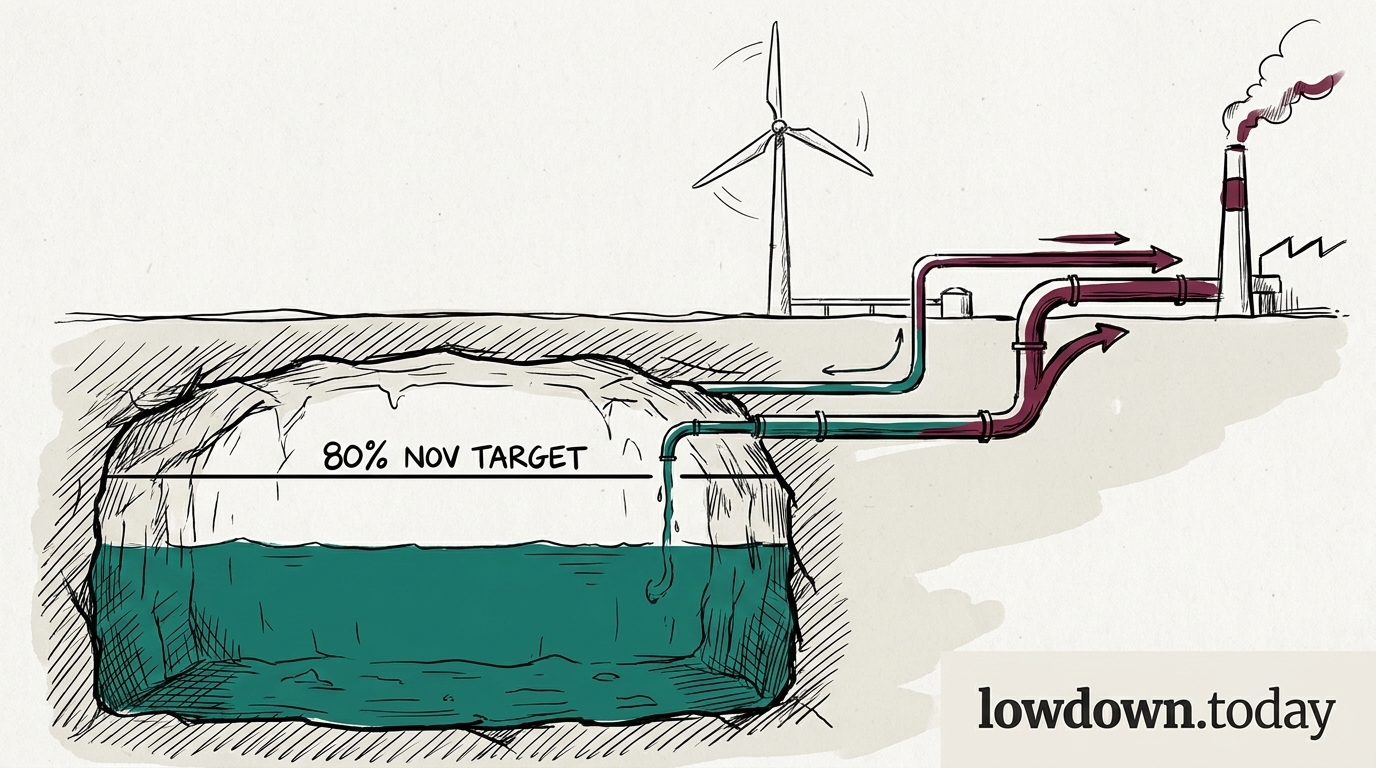
Brussels holds the bloc to 90% on a flexible window while Germany, holding roughly a quarter of EU storage capacity, tracks toward missing its own lower 80% figure by 21 points. A national shortfall this size in the anchor market matters more to bloc security than the flexible timetable alone can absorb.
French power exporters and CRE
French day-ahead rose in step with Germany but by less, reopening a EUR 7-17 premium that makes northward export flows commercially attractive again after the EUR 43.09 discount evaporated in days. CRE separately authorised RTE and Enedis to buy flexibility locally, betting the coming winter's binding constraint is grid congestion rather than a shortage of firm capacity.
TTF trading desk
TTF trading desk
A visible national shortfall like Germany's 21-point gap is a directional signal, not noise, for a desk holding the summer-winter spread. TTF's flat EUR 58-60 range through this week's German price swings says the market has not yet chosen to reprice refill risk into the front of the curve.
German cavern and CCGT operators
German caverns kept buying prompt gas at TTF near EUR 58-60 through the inversion; the wind collapse to 2.4 GW then flipped the spark spread to plus EUR 29 and put turbines back in the same queue. Every day turbines win that bid, injection at a third of the 877 GWh/day pace needed falls further behind.
Slovakia
Slovakia
Slovakia says it dropped its hold-out on the 21st sanctions package only after Ursula von der Leyen personally signed written gas-price and supply guarantees. The Council of the European Union's own 17,238-character release on the package names neither Slovakia nor any guarantee, leaving Bratislava's account unconfirmed by the institutional record.



