Skip to content
You can now search across every topic, entity and event.What's new
European Energy Markets
31JUL

Ghalibaf pre-refuses any Iran deal text

3 min read
09:44UTC

Majlis speaker Mohammad Bagher Ghalibaf told Tasnim on Monday that Iran's parliament will ratify no memorandum until Iranian rights are upheld, rejecting a deal text it has not yet seen.

EconomicDeveloping
Key takeaway

Ghalibaf's pre-refusal hands Iran's Revolutionary Guard a domestic veto over any text the foreign minister negotiates.

Majlis speaker Mohammad Bagher Ghalibaf told Tasnim on Monday 1 June that no memorandum of understanding will be ratified "until we are certain the rights of the Iranian people have been upheld" 1. The Majlis is Iran's 290-seat parliament; Ghalibaf, a former Revolutionary Guard commander, leads the bloc that voted 221-0 to suspend cooperation with the International Atomic Energy Agency (IAEA), the United Nations nuclear watchdog. His statement pre-commits the chamber to refusing a deal whose text it has not yet seen.

The refusal lands the same week Trump returned a revised text demanding Iran's enriched-uranium stockpile be destroyed, a draft Iran's own security council has framed as a 10-point victory that recognises its enrichment . Foreign Minister Abbas Araghchi is negotiating that document, and a public pre-refusal from the speaker hands the Guard a domestic veto over whatever Araghchi brings home.

Much of that veto reads as theatre. Iran's war posture and the Islamic Revolutionary Guard Corps (IRGC) budget run through The Supreme Leader's office, not the parliament, so a chamber that never controlled the instrument cannot bind the war by refusing to ratify it. What the refusal does change is the negotiating floor: every public condition Ghalibaf sets in advance becomes a line Araghchi cannot trade away without being seen to sell out the rights the speaker invoked.


Deep Analysis

In plain English

Iran has a parliament called the Majlis. To be legally binding, a peace deal with the United States would need the Majlis to approve it , similar to how the US Senate ratifies international treaties. The speaker of the Majlis, Mohammad Bagher Ghalibaf, publicly said on 1 June that the Majlis will not approve any agreement unless it fully protects Iran's rights. The catch: the Majlis voted 221-0 just weeks ago to cut off the United Nations nuclear inspectors from Iran, which is one of America's main demands in the deal. So the body that must ratify any agreement has already voted against one of the deal's key requirements. This creates a situation where Iran's chief diplomat could agree to a deal, but Iran's parliament refuses to confirm it.

Deep Analysis
Root Causes

Ghalibaf's statement reflects the structural split between Iran's two overlapping power centres. The elected civilian government , Pezeshkian's presidency and Araghchi's Foreign Ministry , holds the negotiating mandate but not the ratification authority. The Majlis, controlled by a principlist-IRGC bloc, holds ratification power but was not involved in the negotiating rounds.

This separation was not accidental. Mojtaba Khamenei's appointment as Supreme Leader was engineered by IRGC networks that distrust civilian deal-making. Ghalibaf, a career IRGC officer, sat on the 221-0 IAEA suspension vote as a political signal to Tehran's negotiators that any deal must clear the IRGC institutional bloc before it clears the Majlis. The pre-refusal is the Majlis's institutional mechanism for asserting that the deal's terms must satisfy the IRGC before ratification proceeds.

Escalation

Direction: escalatory on the diplomatic track. A parliamentary veto of any text, regardless of its contents, removes the ratification pathway that would give an MOU legal standing inside Iran. This raises the probability that any deal is executive-only , a handshake between Trump and Khamenei without institutional anchoring on either side.

What could happen next?
  • Risk

    Ghalibaf's public pre-commitment narrows Iran's internal space for a face-saving ratification; the Supreme Leader would need to explicitly override the Majlis speaker to secure parliamentary approval, requiring a public humiliation of a senior IRGC ally.

    Short term · Assessed
  • Consequence

    Any MOU that lacks Majlis ratification will lack the legal standing required for OFAC sanctions relief, since US Treasury requires treaty-level instruments for broad sanctions suspension , leaving any 'deal' as a verbal executive arrangement with no enforcement on either side.

    Medium term · Reported
  • Precedent

    The JCPOA 2015 precedent shows Majlis pre-refusals can dissolve under Supreme Leader pressure, but that required a different Supreme Leader with stronger theological legitimacy than Mojtaba Khamenei currently holds.

    Medium term · Reported
First Reported In

Update #114 · Two parliaments, one war neither can govern

Al Jazeera· 1 Jun 2026
Read original
Causes and effects
This Event
Ghalibaf pre-refuses any Iran deal text
Iran's parliament has committed in advance to rejecting any negotiated text, narrowing the deal space for the foreign minister even though the body it speaks for never controlled the war.
Different Perspectives
Spain's LNG terminal operators
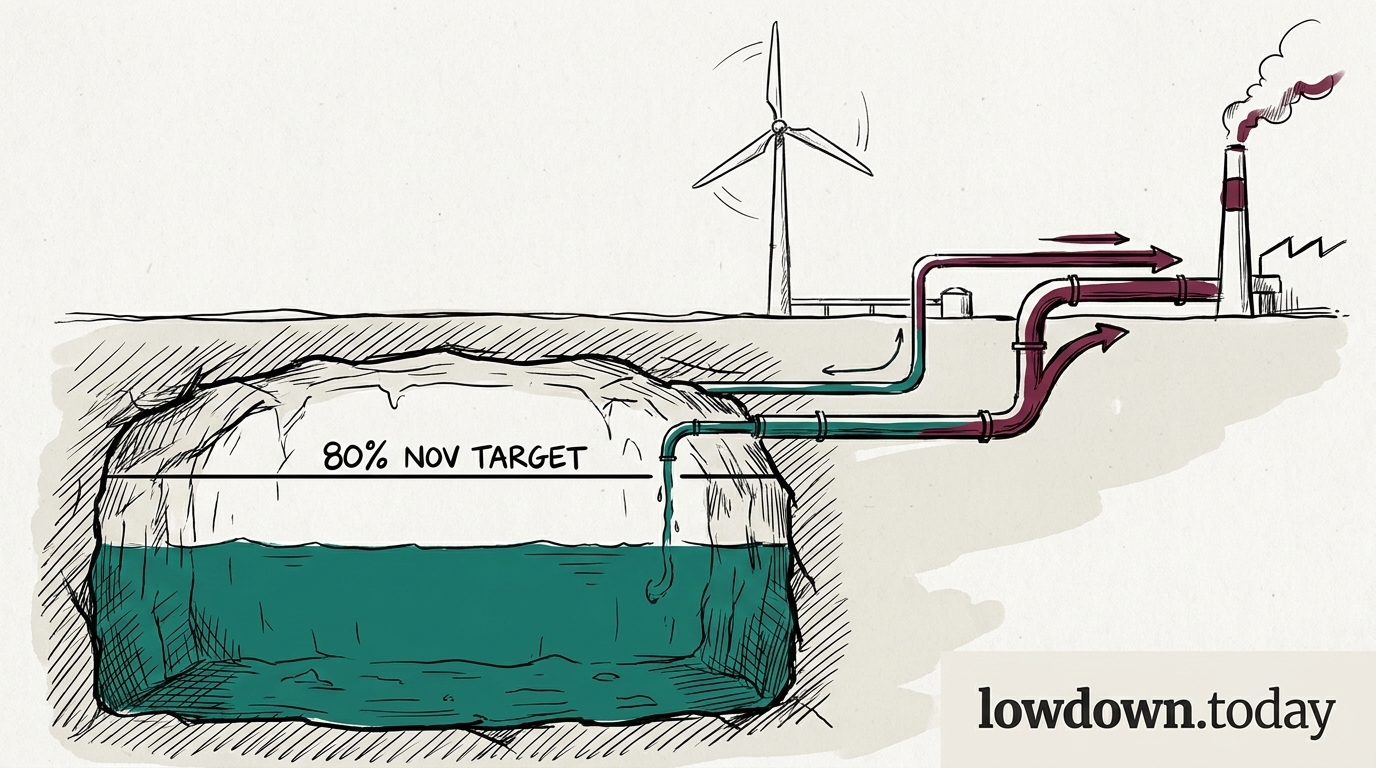
Spain's 9,145 GWh terminal inventory is the largest single stock in the EU LNG network, an option value that can reroute cargoes wherever the winter strip pays best rather than a cavern gas obligation tied to a fixed date. That flexibility matters more as Germany's cavern shortfall pushes more of the winter security question onto import infrastructure.
European Commission
European Commission
Brussels holds the bloc to 90% on a flexible window while Germany, holding roughly a quarter of EU storage capacity, tracks toward missing its own lower 80% figure by 21 points. A national shortfall this size in the anchor market matters more to bloc security than the flexible timetable alone can absorb.
French power exporters and CRE
French day-ahead rose in step with Germany but by less, reopening a EUR 7-17 premium that makes northward export flows commercially attractive again after the EUR 43.09 discount evaporated in days. CRE separately authorised RTE and Enedis to buy flexibility locally, betting the coming winter's binding constraint is grid congestion rather than a shortage of firm capacity.
TTF trading desk
TTF trading desk
A visible national shortfall like Germany's 21-point gap is a directional signal, not noise, for a desk holding the summer-winter spread. TTF's flat EUR 58-60 range through this week's German price swings says the market has not yet chosen to reprice refill risk into the front of the curve.
German cavern and CCGT operators
German caverns kept buying prompt gas at TTF near EUR 58-60 through the inversion; the wind collapse to 2.4 GW then flipped the spark spread to plus EUR 29 and put turbines back in the same queue. Every day turbines win that bid, injection at a third of the 877 GWh/day pace needed falls further behind.
Slovakia
Slovakia
Slovakia says it dropped its hold-out on the 21st sanctions package only after Ursula von der Leyen personally signed written gas-price and supply guarantees. The Council of the European Union's own 17,238-character release on the package names neither Slovakia nor any guarantee, leaving Bratislava's account unconfirmed by the institutional record.



