Skip to content
You can now search across every topic, entity and event.What's new
European Energy Markets
31JUL

G7 opens at Evian as Trump pivots back

3 min read
09:44UTC

The G7 opened at Evian-les-Bains on Monday 15 June with Ukraine top of the agenda, a day after Trump called Putin and Zelenskyy separately and pledged to refocus on the war now the Iran deal is done.

EconomicDeveloping
Key takeaway

Europe now runs Ukraine diplomacy and has tied G7 sanctions to whether Russia engages in talks.

The Group of Seven (G7) opened its summit at Evian-les-Bains, a French spa town on Lake Geneva, on Monday 15 June with Ukraine at the top of the agenda 1. Volodymyr Zelenskyy attended at French invitation and proposed a summit with Vladimir Putin, Trump and European leaders on the sidelines; Moscow showed no interest. The G7 groups the major Western industrial democracies, and this meeting tried to merge their economic and diplomatic pressure on Russia into one track.

Donald Trump had called Putin and Zelenskyy separately on Sunday 14 June, his 80th birthday. Kremlin aide Yuri Ushakov described the Putin call as "friendly and frank", while Zelenskyy concluded from his own that Russia is not ready for a truce 2. Trump said he would "focus again on Ukraine" now the US-Iran deal is done.

With US mediation formally declared stagnated on 22 May , Europe is carrying the diplomacy. Emmanuel Macron set the format he wants: "Ukraine and Russia at the table, but with Europeans and Americans present." The G7 agreed to tie further Russia sanctions to the course of any peace talks, which turns a fixed penalty into a conditional instrument. Putin's terms have not moved since he rejected Zelenskyy's summit letter and the E3 backed the line of contact as a baseline . European leverage is growing; the Russian precondition is the same one that has frozen every round since May.


Deep Analysis

In plain English

The leaders of the world's seven wealthiest democracies, the G7, met in the French town of Evian-les-Bains starting 15 June. Ukraine's President Zelenskyy attended and proposed a peace summit that would include Putin and Trump alongside European leaders. Putin showed no interest. The day before the summit opened, US President Trump called both Putin and Zelenskyy separately. Trump said he would focus on Ukraine again now that the Iran ceasefire is done. The G7 agreed to link any future easing of Russia sanctions to progress on peace talks, which means Russia would in theory have a reason to engage. Whether that incentive actually changes Moscow's position depends on whether Russia believes the war's overall trajectory still favours waiting.

Deep Analysis
Root Causes

Putin's precondition that Ukraine accept Russia's territorial annexations as a baseline before any summit reflects the structural asymmetry in negotiating positions: Russia holds roughly 18-20% of Ukrainian territory and assesses that time works in its favour given Ukrainian manpower constraints and Western political fatigue.

Trump's re-engagement after the Iran deal is structurally conditioned by domestic political logic: the US cannot afford to be seen as abandoning Ukraine in an election year while simultaneously claiming the Iran deal as a foreign policy success. But re-engagement without PAC-3 supply, concrete security guarantees, or a shift on Russian territorial preconditions is rhetorical rather than substantive, leaving Europe as the operational manager of Ukraine's long-term strategic position.

What could happen next?
  • Consequence

    The G7's sanctions-to-peace-talks linkage gives European capitals a lever to ease economic pressure on Russia without requiring a Trump decision, potentially allowing a European-managed ceasefire framework to develop before NATO Ankara in July.

    Medium term · Suggested
  • Risk

    If Trump's post-Iran diplomatic attention to Ukraine proves rhetorical rather than substantive, and the NATO Ankara summit fails to harden the E3 framework, Putin has no material incentive to shift from the pre-agreed-treaty precondition that has blocked every round since Istanbul Round 1 in May.

    Short term · Assessed
  • Precedent

    Zelenskyy attending the G7 at French invitation, rather than at US arrangement, signals a structurally European diplomatic framework for Ukraine that is independent of Trump's engagement cycle, which has direct implications for how future ceasefire frameworks will be constructed.

    Medium term · Reported
First Reported In

Update #20 · Oil vise shuts as Russia torches the Lavra

PBS News / AP· 16 Jun 2026
Read original
Different Perspectives
Spain's LNG terminal operators
Spain's 9,145 GWh terminal inventory is the largest single stock in the EU LNG network, an option value that can reroute cargoes wherever the winter strip pays best rather than a cavern gas obligation tied to a fixed date. That flexibility matters more as Germany's cavern shortfall pushes more of the winter security question onto import infrastructure.
European Commission
European Commission
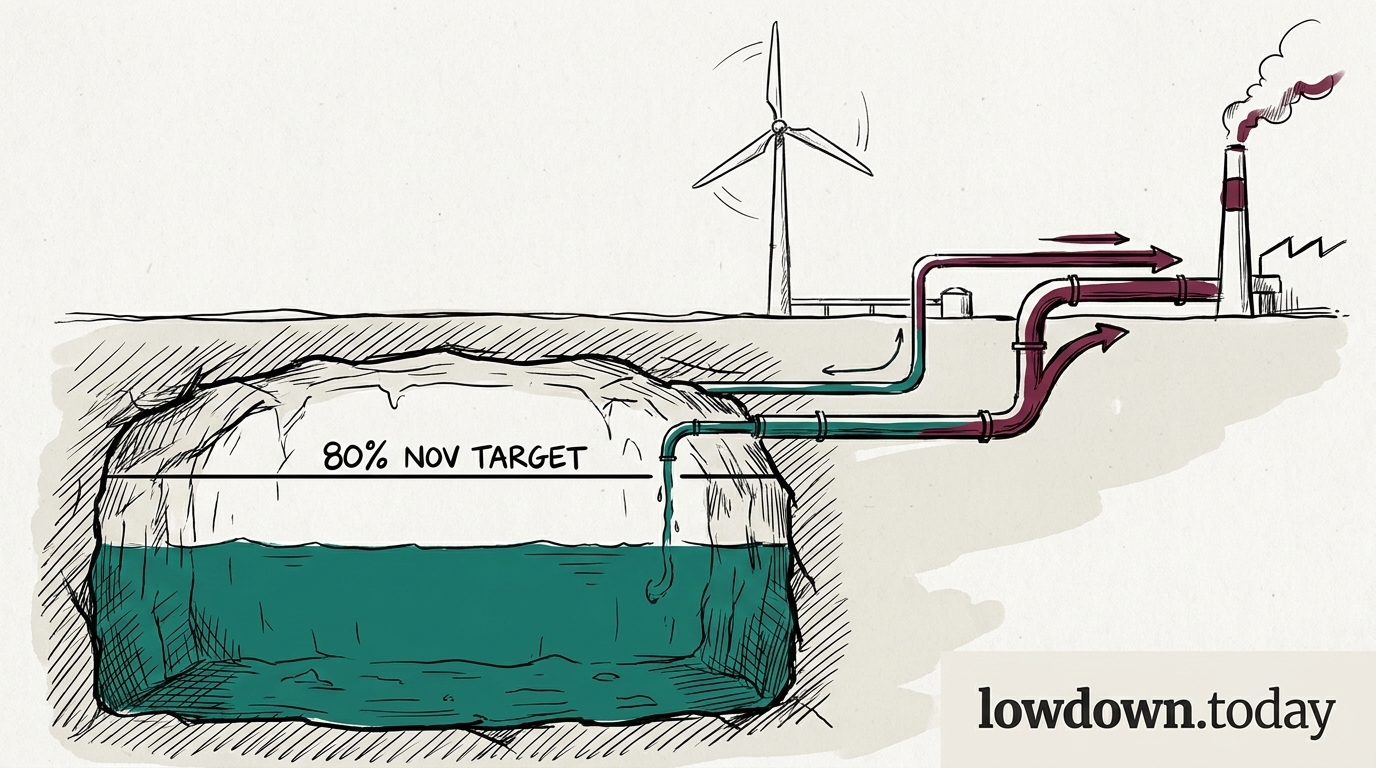
Brussels holds the bloc to 90% on a flexible window while Germany, holding roughly a quarter of EU storage capacity, tracks toward missing its own lower 80% figure by 21 points. A national shortfall this size in the anchor market matters more to bloc security than the flexible timetable alone can absorb.
French power exporters and CRE
French day-ahead rose in step with Germany but by less, reopening a EUR 7-17 premium that makes northward export flows commercially attractive again after the EUR 43.09 discount evaporated in days. CRE separately authorised RTE and Enedis to buy flexibility locally, betting the coming winter's binding constraint is grid congestion rather than a shortage of firm capacity.
TTF trading desk
TTF trading desk
A visible national shortfall like Germany's 21-point gap is a directional signal, not noise, for a desk holding the summer-winter spread. TTF's flat EUR 58-60 range through this week's German price swings says the market has not yet chosen to reprice refill risk into the front of the curve.
German cavern and CCGT operators
German caverns kept buying prompt gas at TTF near EUR 58-60 through the inversion; the wind collapse to 2.4 GW then flipped the spark spread to plus EUR 29 and put turbines back in the same queue. Every day turbines win that bid, injection at a third of the 877 GWh/day pace needed falls further behind.
Slovakia
Slovakia
Slovakia says it dropped its hold-out on the 21st sanctions package only after Ursula von der Leyen personally signed written gas-price and supply guarantees. The Council of the European Union's own 17,238-character release on the package names neither Slovakia nor any guarantee, leaving Bratislava's account unconfirmed by the institutional record.



