Skip to content
You can now search across every topic, entity and event.What's new
European Energy Markets
31JUL

Dozens of IRGC officers flee Beirut

3 min read
09:44UTC

Dozens of Quds Force officers left Lebanon in 48 hours — not because of Beirut's arrest order, but because Israeli intelligence demonstrated it can find them.

EconomicDeveloping
Key takeaway

Removing Iranian oversight does not automatically weaken Hezbollah; it removes the moderating constraint that Iranian strategic interests imposed on Hezbollah's tactical decisions.

Dozens of IRGC Quds Force officers fled Beirut in the past 48 hours, fearing Israeli targeting. An Israeli defence official told Axios the exodus is expected to continue over the coming days. A small contingent remained to maintain liaison with Hezbollah — but liaison from a skeleton crew is not the command architecture Iran maintained for four decades.

The physical departure matters more than the Lebanese government's order to arrest IRGC members on its territory . Beirut also banned Hezbollah's military activities and reinstated visa requirements for Iranian citizens — the most complete formal break with Tehran's security architecture since the 1989 Taif Agreement . But Lebanon's state has never possessed the enforcement capacity to act against the IRGC or Hezbollah on its own. The officers are leaving not because of Lebanese warrants but because Israel demonstrated, through the killing of Hussain Makled — described as Hezbollah's intelligence chief and the most senior Hezbollah figure killed since the campaign began — that it can identify and reach individuals inside Lebanon's Shia-majority areas.

Iran's security presence in Lebanon dates to 1982, when IRGC Revolutionary Guards deployed to the Bekaa Valley during Israel's first invasion and helped establish what became Hezbollah. For over 40 years, the Quds Force maintained command relationships, training pipelines, weapons transfers, and financial channels that made Hezbollah the most capable non-state armed force in the Middle East. That infrastructure is now being dismantled from three directions simultaneously: Israeli air strikes have killed 123 people across Lebanon this week, with IDF ground forces confirmed in five south Lebanese towns; Hezbollah's own operational capacity is degrading with each leadership loss; and the Lebanese state has formally renounced the arrangement that tolerated Iranian military presence on its soil.

The closest parallel is Syria after 2019, when Israel conducted hundreds of strikes on IRGC positions and Damascus gradually acquiesced to the degradation of Iranian military infrastructure on its territory. That erosion took years. In Lebanon, the same process is compressing into days. The difference is that Syria had a functioning military that could absorb the IRGC's withdrawal. Lebanon does not. More than 83,000 civilians were evacuated before Thursday's blanket Dahiyeh evacuation order; further displacement followed. What fills the vacuum left by a departing IRGC and a degraded Hezbollah — the Lebanese Armed Forces, an extended Israeli military presence, or factional fragmentation — is the question Lebanon's own history answers poorly.


Deep Analysis

In plain English

Iran's officers in Lebanon were not just military advisers — they were the link between Hezbollah and Iran's national command authority, effectively filtering which operations Tehran approved and which it counselled against. With those officers gone, Hezbollah's field commanders make their own calls. Whether that makes Hezbollah stronger or weaker depends on whether those commanders are disciplined or impulsive — and whether they feel pressure to prove their continued relevance with visible action.

Deep Analysis
Synthesis

The simultaneous departure of IRGC liaison officers (Event 5) and the killing of Hezbollah's intelligence chief (Event 6) strips the organisation of its two critical information nodes — Iranian strategic guidance and internal intelligence — at the same moment. This is not coincidental: Israel's targeting sequence suggests a deliberate strategy to blind Hezbollah before any deeper operation, consistent with the IDF's ground presence in south Lebanese villages confirmed in Event 8.

Root Causes

Iran's 'forward defence' doctrine required IRGC physical presence in Lebanon to maintain command oversight of its largest proxy. That presence — accumulated over four decades — was always a vulnerability once Israel decided to prioritise it as a target set. The contradiction between needing officers on the ground to control Hezbollah and those officers being exposed to precision targeting has never been resolved; Iran chose exposure over loss of control until the targeting pressure became unsustainable.

Escalation

The Washington Institute for Near East Policy and RAND have both documented that Hezbollah sub-unit commanders in south Lebanon and Beirut's southern suburbs hold pre-delegated launch authority for short-range rockets and anti-tank missiles. The IRGC's departure does not revoke that authority. The greater escalation risk is a rogue operation by a Hezbollah unit acting without IRGC oversight that Iran would have blocked — not a failure of capability but a failure of restraint.

What could happen next?
  • Risk

    Hezbollah commanders without IRGC oversight may launch operations Iran would have restrained, widening the conflict in ways Tehran cannot control.

    Immediate · Suggested
  • Consequence

    Iran's four-decade investment in command integration with Hezbollah is being physically severed, requiring a post-conflict rebuild of liaison architecture if the relationship is to retain its strategic coherence.

    Long term · Assessed
  • Meaning

    The departure signals Iran has prioritised officer survival over command continuity, implying Tehran believes the Lebanon front is entering a phase it cannot control regardless of IRGC presence.

    Immediate · Suggested
First Reported In

Update #23 · Iran loses half its navy; China eyes Hormuz

Axios· 6 Mar 2026
Read original
Causes and effects
This Event
Dozens of IRGC officers flee Beirut
The IRGC's physical withdrawal from Lebanon, combined with Israeli strikes on Hezbollah leadership and the Lebanese government's formal break with Tehran, is collapsing Iran's primary means of projecting power into the Levant — built over 40 years — in days. The speed exceeds the multi-year degradation of Iran's position in Syria after 2019.
Different Perspectives
Spain's LNG terminal operators
Spain's 9,145 GWh terminal inventory is the largest single stock in the EU LNG network, an option value that can reroute cargoes wherever the winter strip pays best rather than a cavern gas obligation tied to a fixed date. That flexibility matters more as Germany's cavern shortfall pushes more of the winter security question onto import infrastructure.
European Commission
European Commission
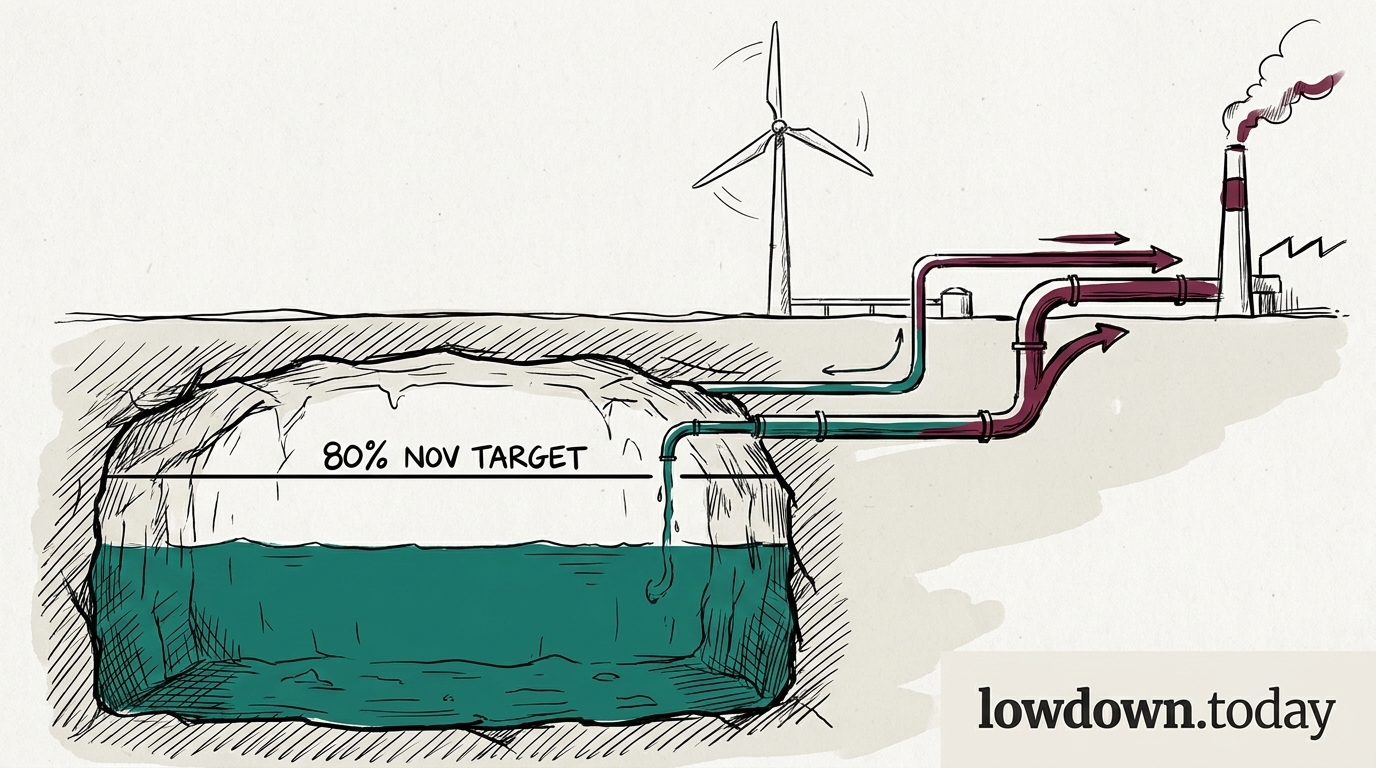
Brussels holds the bloc to 90% on a flexible window while Germany, holding roughly a quarter of EU storage capacity, tracks toward missing its own lower 80% figure by 21 points. A national shortfall this size in the anchor market matters more to bloc security than the flexible timetable alone can absorb.
French power exporters and CRE
French day-ahead rose in step with Germany but by less, reopening a EUR 7-17 premium that makes northward export flows commercially attractive again after the EUR 43.09 discount evaporated in days. CRE separately authorised RTE and Enedis to buy flexibility locally, betting the coming winter's binding constraint is grid congestion rather than a shortage of firm capacity.
TTF trading desk
TTF trading desk
A visible national shortfall like Germany's 21-point gap is a directional signal, not noise, for a desk holding the summer-winter spread. TTF's flat EUR 58-60 range through this week's German price swings says the market has not yet chosen to reprice refill risk into the front of the curve.
German cavern and CCGT operators
German caverns kept buying prompt gas at TTF near EUR 58-60 through the inversion; the wind collapse to 2.4 GW then flipped the spark spread to plus EUR 29 and put turbines back in the same queue. Every day turbines win that bid, injection at a third of the 877 GWh/day pace needed falls further behind.
Slovakia
Slovakia
Slovakia says it dropped its hold-out on the 21st sanctions package only after Ursula von der Leyen personally signed written gas-price and supply guarantees. The Council of the European Union's own 17,238-character release on the package names neither Slovakia nor any guarantee, leaving Bratislava's account unconfirmed by the institutional record.



