Skip to content
You can now search across every topic, entity and event.What's new
European Energy Markets
31JUL

Beijing shields Iran's new leader

3 min read
09:44UTC

China's Foreign Ministry declared Mojtaba Khamenei's appointment constitutional and explicitly opposed any targeting of the new Supreme Leader — a direct counter to the IDF's Farsi-language assassination threat hours earlier.

EconomicDeveloping
Key takeaway

China weaponised its non-interference doctrine as an active assassination deterrent — unprecedented in its live-conflict application.

China's Foreign Ministry called Mojtaba Khamenei's appointment constitutional, demanded respect for Iranian sovereignty and an immediate end to the conflict, and stated Beijing "opposes any external interference in Iran's internal affairs" — including any targeting of the new Supreme Leader. The statement arrived within hours of the Assembly of Experts' formal announcement of the succession and responded directly to the IDF's Farsi-language threat to "pursue every person who seeks to appoint a successor" and the successor himself .

The speed of recognition matters. Beijing typically allows days or weeks before committing to new foreign leadership. China's Foreign Minister Wang Yi had already warned against "plotting colour revolution or seeking Regime change" at his NPC press conference earlier in the week ; Monday's statement converted that general principle into protection for a specific person. Moscow moved in parallel — Putin pledged "unwavering support" — giving Iran's new leader simultaneous backing from both permanent Security Council members capable of vetoing Western resolutions.

The recognition completes a diplomatic architecture that mirrors Cold War proxy-conflict alignments: two nuclear powers backing one side, two backing the other, the Security Council paralysed by vetoes on any resolution addressing the conflict. The geographic difference is that both blocs are now operating inside the same waterway. China has deployed its 48th PLA Navy fleet — including the 30,000-tonne signals intelligence vessel Liaowang-1 — to the strait of Hormuz, where it operates alongside joint Chinese-Russian-Iranian naval exercises. The diplomatic shield and the naval shield now overlap.

For Beijing, the calculation extends beyond Iran. Any precedent in which external military pressure dictates leadership succession in a sovereign state threatens China's own position on Taiwan. The defence of Mojtaba is also a defence of the principle that internal political arrangements lie beyond the reach of foreign military force — a principle China has made central to its foreign policy doctrine since the 1999 NATO bombing of its Belgrade embassy. Beijing's explicit opposition to targeting the new leader transforms an Israeli threat against one individual into a test of the non-interference norm that underpins China's entire diplomatic framework.


Deep Analysis

In plain English

China's government publicly said Iran's new leader was chosen legally and warned other countries not to interfere — including not to attempt to kill him. China almost never names specific individuals in these kinds of statements. The significance is that Beijing has publicly staked its diplomatic reputation on Mojtaba's safety. If Israel now attempts to assassinate him, China must respond visibly or absorb a credibility loss on a position it has formally committed to.

Deep Analysis
Synthesis

China's invocation of 'constitutional' legitimacy adopts Iran's own legal framing — a deliberate choice that forecloses the counter-argument that Mojtaba's appointment was irregular and therefore subject to different rules. This legal-framework adoption, rare in Chinese Foreign Ministry statements on Middle East conflicts, suggests the response was drafted specifically against the IDF's assassination threat rather than as standard diplomatic boilerplate about sovereignty.

Root Causes

China's 2021 Comprehensive Strategic Partnership with Iran committed approximately $400bn in investment over 25 years in exchange for discounted oil. Iranian regime collapse would void or force renegotiation of those terms under hostile conditions. Protecting Mojtaba's authority directly protects Chinese economic continuity in a way that no other Iranian political outcome could guarantee.

Escalation

China's statement creates a diplomatic tripwire. An Israeli assassination attempt on Mojtaba forces Beijing to respond publicly or absorb a visible credibility loss. China's naval presence in Hormuz provides a physical escalation lever that makes any Chinese diplomatic response actionable rather than merely rhetorical — the two developments together are structurally linked.

What could happen next?
  • Meaning

    China has publicly staked diplomatic credibility on Mojtaba's survival, converting the IDF's rhetorical threat into a named Chinese red line.

    Immediate · Assessed
  • Risk

    An Israeli assassination attempt on Mojtaba would force China to respond publicly or absorb a credibility loss, potentially triggering naval escalation in the Strait of Hormuz.

    Short term · Suggested
  • Consequence

    Gulf Arab states must recalibrate their relationship with Beijing, which is now openly protective of their primary regional adversary's new leadership.

    Medium term · Assessed
  • Precedent

    China has expanded its non-interference doctrine to active leadership protection during live conflict — a doctrinal shift applicable to future cases involving Chinese partner states.

    Long term · Suggested
First Reported In

Update #31 · Iran moves to heavy warheads; China deploys

Al Jazeera· 10 Mar 2026
Read original
Causes and effects
This Event
Beijing shields Iran's new leader
China's formal recognition of Mojtaba Khamenei, paired with an explicit warning against targeting him, converts a general non-interference principle into specific diplomatic protection for a named individual. Combined with Russia's parallel recognition, this creates a Security Council veto shield around Iran's wartime leadership succession and establishes a Cold War-style bipolar alignment compressed into a single 21-nautical-mile strait.
Different Perspectives
Spain's LNG terminal operators
Spain's 9,145 GWh terminal inventory is the largest single stock in the EU LNG network, an option value that can reroute cargoes wherever the winter strip pays best rather than a cavern gas obligation tied to a fixed date. That flexibility matters more as Germany's cavern shortfall pushes more of the winter security question onto import infrastructure.
European Commission
European Commission
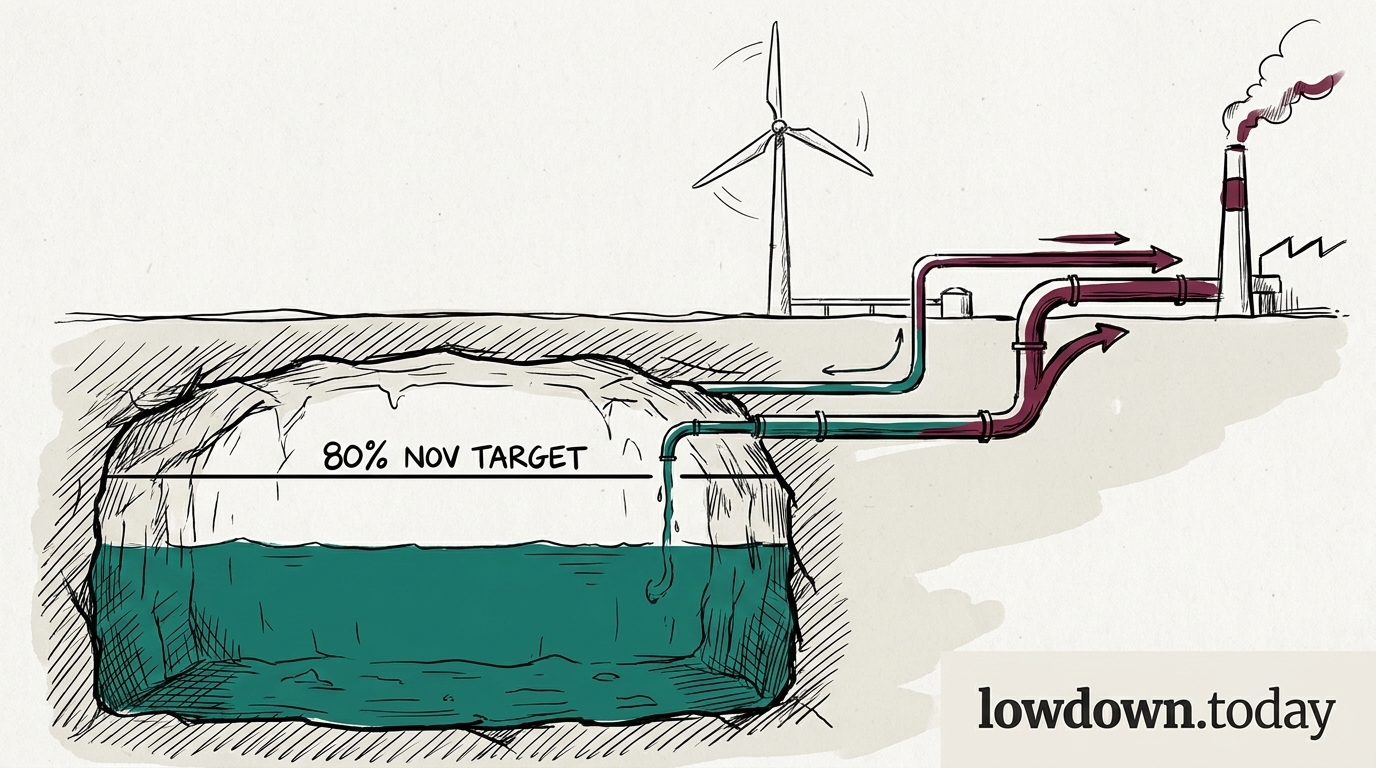
Brussels holds the bloc to 90% on a flexible window while Germany, holding roughly a quarter of EU storage capacity, tracks toward missing its own lower 80% figure by 21 points. A national shortfall this size in the anchor market matters more to bloc security than the flexible timetable alone can absorb.
French power exporters and CRE
French day-ahead rose in step with Germany but by less, reopening a EUR 7-17 premium that makes northward export flows commercially attractive again after the EUR 43.09 discount evaporated in days. CRE separately authorised RTE and Enedis to buy flexibility locally, betting the coming winter's binding constraint is grid congestion rather than a shortage of firm capacity.
TTF trading desk
TTF trading desk
A visible national shortfall like Germany's 21-point gap is a directional signal, not noise, for a desk holding the summer-winter spread. TTF's flat EUR 58-60 range through this week's German price swings says the market has not yet chosen to reprice refill risk into the front of the curve.
German cavern and CCGT operators
German caverns kept buying prompt gas at TTF near EUR 58-60 through the inversion; the wind collapse to 2.4 GW then flipped the spark spread to plus EUR 29 and put turbines back in the same queue. Every day turbines win that bid, injection at a third of the 877 GWh/day pace needed falls further behind.
Slovakia
Slovakia
Slovakia says it dropped its hold-out on the 21st sanctions package only after Ursula von der Leyen personally signed written gas-price and supply guarantees. The Council of the European Union's own 17,238-character release on the package names neither Slovakia nor any guarantee, leaving Bratislava's account unconfirmed by the institutional record.



