Skip to content
You can now search across every topic, entity and event.What's new
European Energy Markets
31JUL

Brent's kinetic premium settles at $6.81

3 min read
09:44UTC

Brent crude surged 6 per cent intraday to $114.44 on 4 May as Project Freedom's kinetic exchange unfolded, then the Trump pause walked it back to $109.87, with $108.51 by 6 May leaving a $6.81 net kinetic premium above Monday's open.

EconomicDeveloping
Key takeaway

Six dollars eighty-one of kinetic premium remained priced after the pause. Goldman's lower bound held.

Brent Crude settled at $101.70 on Monday 4 May before the IRGC opened fire on Project Freedom, then surged nearly 6 per cent to $114.44 intraday as the kinetic exchange unfolded and Fujairah was struck 1. The Trump pause on Tuesday 5 May reversed most of that move; Brent settled at $109.87. By Wednesday 6 May the price drifted to $108.51 2. Net change from Monday's opening settlement: +$6.81. The market priced the kinetic exchange at $12 per barrel; the verbal pause walked back only $5 of it.

A $6.81 move on Brent translates to roughly 1 to 2 pence per litre at British pumps within four to six weeks if the premium holds. The price action confirms the deeds-versus-words asymmetry the briefing has tracked since the UAE walkout from OPEC on Friday 1 May . Kinetic action moves the curve fast; verbal action partially walks it back. Goldman Sachs and Lloyd's P&I clubs had estimated a single Project Freedom escort contact would recover $15 to $20 per barrel; the outcome landed near the lower bound, suggesting the market reads the pause as a credible attempt at de-escalation rather than a tactical retreat.

OPEC+ added 206 thousand barrels per day for June into a market already absorbing the loss of Iranian export capacity and the closure of Hormuz transit, exposing the asymmetry in the underlying supply curve. The cartel's decision to add barrels into a bullish kinetic backdrop, days before the UAE walkout, established the supply-side ceiling against which the kinetic premium is now pricing.


Deep Analysis

In plain English

When the US Navy fought its way through the Strait of Hormuz on 4 May, oil prices spiked nearly 6% in a single day, reaching over $114 per barrel. The next day, when Trump said he was pausing the operation, prices fell back to around $108-109. Oil prices swing because traders are betting on whether ships will be able to get through the strait. If they can, oil flows freely and prices fall. If they cannot, the world gets less oil and prices rise. The net result after three days of drama: oil is still about $6.80 per barrel more expensive than it was on Monday morning, before the fighting started. That works out to roughly 2-3 pence more per litre of petrol at British filling stations.

Deep Analysis
Root Causes

Brent rose $12 in hours but fell only $6 over two days, reflecting the structural thinness of the Brent spot market in conflict conditions: the P&I war-risk cover suspensions that have been in place since mid-April have reduced the number of vessels actively pricing cargoes in the ICE market, concentrating price discovery in a smaller pool of speculative and hedging positions. A thin market amplifies moves in both directions.

OPEC+'s June production increase of 206,000 barrels per day, agreed the week prior, provided a partial supply buffer; but the UAE's 1 May OPEC exit removed the institutional constraint that kept its 5 million barrels per day within quota discipline, creating a two-layer price uncertainty: kinetic risk premium compounding a cartel coordination breakdown.

What could happen next?
  • Consequence

    The partial price reversal on the Trump pause reduces pressure on OPEC+ to accelerate production increases, as the net kinetic premium of $6.81 falls below the $10-12 threshold Saudi Arabia considers its intervention trigger.

  • Risk

    Any resumption of Project Freedom convoy transits will re-test the $114 intraday level with reduced friction, as the market has now established a price pathway and the algorithms will execute faster.

First Reported In

Update #89 · Truxtun gets through; Trump pulls back

Al Jazeera· 6 May 2026
Read original
Different Perspectives
Spain's LNG terminal operators
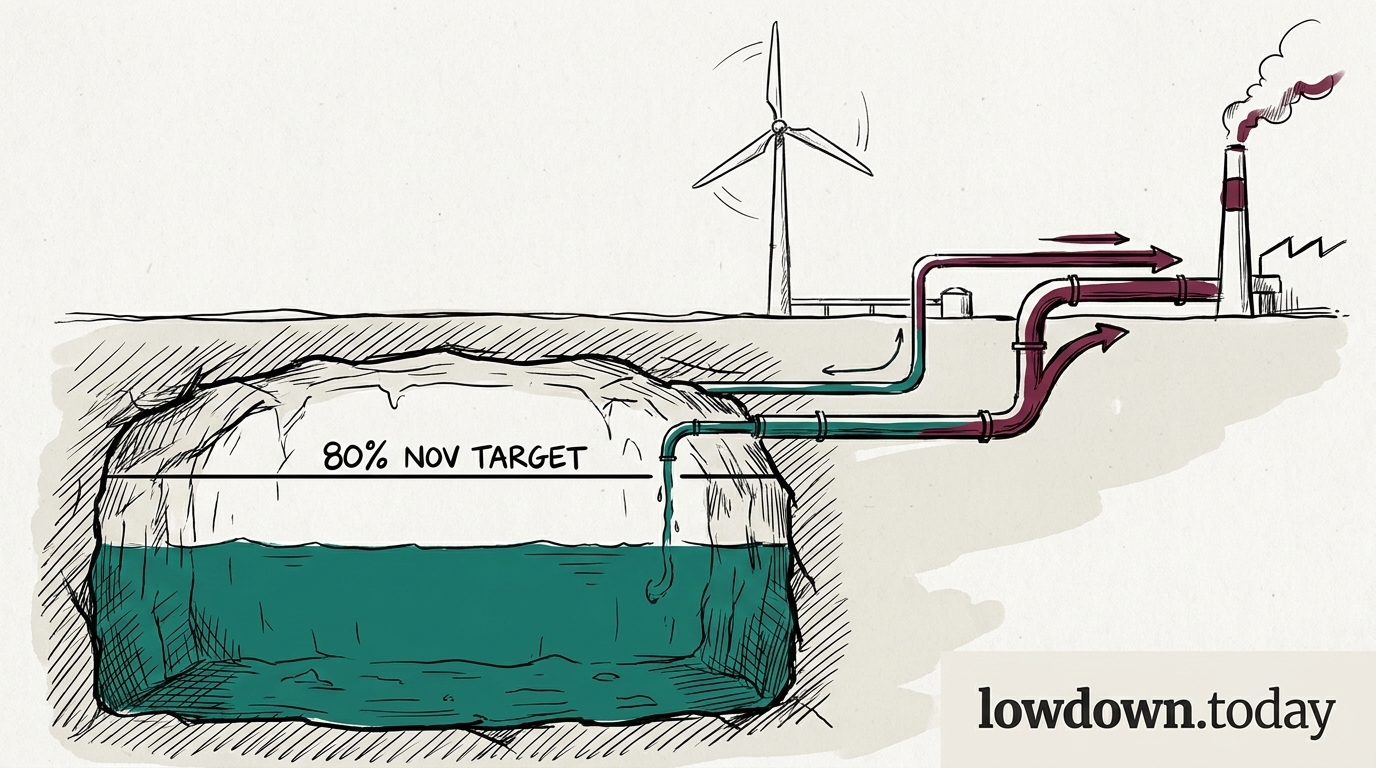
Spain's 9,145 GWh terminal inventory is the largest single stock in the EU LNG network, an option value that can reroute cargoes wherever the winter strip pays best rather than a cavern gas obligation tied to a fixed date. That flexibility matters more as Germany's cavern shortfall pushes more of the winter security question onto import infrastructure.
European Commission
European Commission
Brussels holds the bloc to 90% on a flexible window while Germany, holding roughly a quarter of EU storage capacity, tracks toward missing its own lower 80% figure by 21 points. A national shortfall this size in the anchor market matters more to bloc security than the flexible timetable alone can absorb.
French power exporters and CRE
French day-ahead rose in step with Germany but by less, reopening a EUR 7-17 premium that makes northward export flows commercially attractive again after the EUR 43.09 discount evaporated in days. CRE separately authorised RTE and Enedis to buy flexibility locally, betting the coming winter's binding constraint is grid congestion rather than a shortage of firm capacity.
TTF trading desk
TTF trading desk
A visible national shortfall like Germany's 21-point gap is a directional signal, not noise, for a desk holding the summer-winter spread. TTF's flat EUR 58-60 range through this week's German price swings says the market has not yet chosen to reprice refill risk into the front of the curve.
German cavern and CCGT operators
German caverns kept buying prompt gas at TTF near EUR 58-60 through the inversion; the wind collapse to 2.4 GW then flipped the spark spread to plus EUR 29 and put turbines back in the same queue. Every day turbines win that bid, injection at a third of the 877 GWh/day pace needed falls further behind.
Slovakia
Slovakia
Slovakia says it dropped its hold-out on the 21st sanctions package only after Ursula von der Leyen personally signed written gas-price and supply guarantees. The Council of the European Union's own 17,238-character release on the package names neither Slovakia nor any guarantee, leaving Bratislava's account unconfirmed by the institutional record.



