Skip to content
You can now search across every topic, entity and event.What's new
European Energy Markets
31JUL

Brent jumps as Iran fires from empty coffers

4 min read
09:44UTC

Brent crude rose to $96.34 on 10 June, erasing a week of deal optimism, even as Iran's oil exports run dry below 300,000 barrels a day.

EconomicDeveloping
Key takeaway

Iran is trading military risk for coalition pressure because it can no longer break the blockade economically.

Brent Crude rose to $96.34 on 10 June, up about 2.2 per cent, after shedding more than 7 per cent across the week on optimism about a possible US deal and the Iran-Israel halt 1. The exchange of US strikes and Iranian counter-strikes wiped the week's deal-optimism discount in a single session, repricing the Strait of Hormuz risk premium overnight. Brent sets the price of roughly two-thirds of internationally traded crude, so the move ripples straight into import bills well beyond the Gulf.

Iran fired missiles across three countries this week from an empty balance sheet. The US naval blockade has cut Iranian oil exports below 300,000 barrels per day, down from 1.84 million in March, and erased roughly $5.8bn in revenue since April, with Kpler data showing a runway of weeks, not months, for the China-bound trade 2. A regime striking US bases in three countries while it cannot move its own crude is buying military leverage it has no economic means to sustain.

That weakness cuts two ways, which is where the night's contained outcome meets a darker read. Iran failed to inflict real damage, Jordan intercepted every missile aimed at it, and no US personnel were hurt, the markers of a calibrated exchange rather than the opening of a campaign. Yet a government with this little left to lose at sea may find escalation cheaper than restraint. The same empty coffers that cap Tehran's options also lower the price of crossing a threshold a second time, which is precisely what makes a cornered adversary hard to deter.


Deep Analysis

In plain English

Oil prices jumped about 2 per cent on 10 June after the US strikes on Iran. To understand why this matters, it helps to know that about one-fifth of the world's oil flows through the Strait of Hormuz, the narrow waterway near Iran. When that passage looks more dangerous, traders pay more for oil as a precaution. What makes this situation unusual is that Iran was already in serious economic trouble before the 10 June escalation. The US naval blockade had cut Iranian oil exports from about 1.84 million barrels a day before the war to below 300,000 barrels a day by June. Iran had lost roughly $5.8 billion in oil revenue since April. Iran's IRGC was firing ballistic missiles at US bases while its oil revenue had collapsed by 84 per cent since March.

What could happen next?
  • Consequence

    Iran's escalation from a position of 84 per cent export collapse and $5.8 billion in lost revenue signals the IRGC has concluded the economic cost of further military action is marginal: it cannot lose oil revenues it no longer has.

    Immediate · Assessed
  • Risk

    CENTCOM's 9 June radar suppression at Qeshm and Bandar Abbas targets the sensor layer Iran uses to identify and intercept vessels for toll collection; if the IRGC toll mechanism collapses, Tehran loses its last functioning hard-currency inflow, removing any remaining economic incentive to keep Hormuz partially open.

    Short term · Assessed
  • Opportunity

    Saudi Arabia and the UAE, as swing producers with fiscal breakeven points above current Brent levels, benefit from the Hormuz risk premium sustaining Brent above $95; both have an indirect incentive to see the conflict persist at a level of tension that supports oil prices without triggering a full strait closure.

    Medium term · Suggested
First Reported In

Update #123 · Trump orders strikes on Iranian soil

OilPrice.com· 10 Jun 2026
Read original
Different Perspectives
Spain's LNG terminal operators
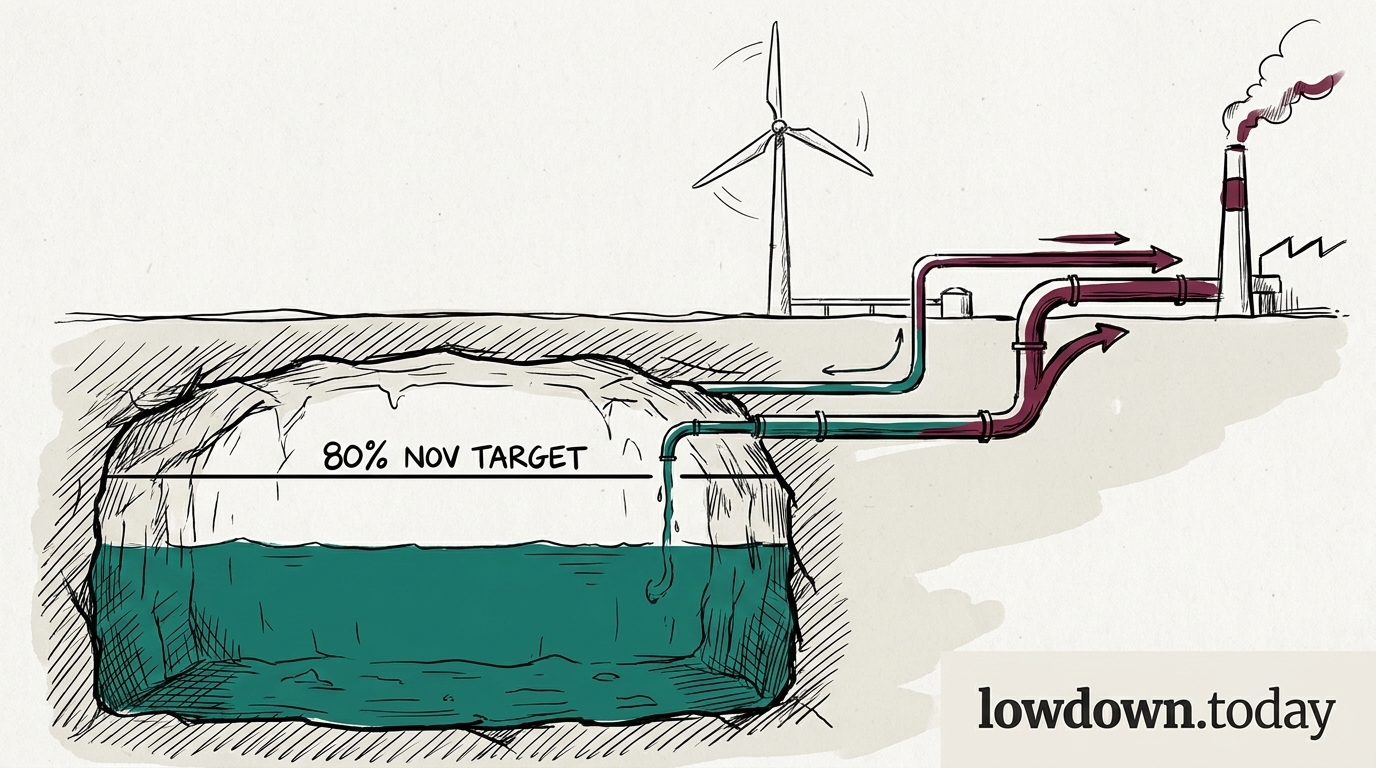
Spain's 9,145 GWh terminal inventory is the largest single stock in the EU LNG network, an option value that can reroute cargoes wherever the winter strip pays best rather than a cavern gas obligation tied to a fixed date. That flexibility matters more as Germany's cavern shortfall pushes more of the winter security question onto import infrastructure.
European Commission
European Commission
Brussels holds the bloc to 90% on a flexible window while Germany, holding roughly a quarter of EU storage capacity, tracks toward missing its own lower 80% figure by 21 points. A national shortfall this size in the anchor market matters more to bloc security than the flexible timetable alone can absorb.
French power exporters and CRE
French day-ahead rose in step with Germany but by less, reopening a EUR 7-17 premium that makes northward export flows commercially attractive again after the EUR 43.09 discount evaporated in days. CRE separately authorised RTE and Enedis to buy flexibility locally, betting the coming winter's binding constraint is grid congestion rather than a shortage of firm capacity.
TTF trading desk
TTF trading desk
A visible national shortfall like Germany's 21-point gap is a directional signal, not noise, for a desk holding the summer-winter spread. TTF's flat EUR 58-60 range through this week's German price swings says the market has not yet chosen to reprice refill risk into the front of the curve.
German cavern and CCGT operators
German caverns kept buying prompt gas at TTF near EUR 58-60 through the inversion; the wind collapse to 2.4 GW then flipped the spark spread to plus EUR 29 and put turbines back in the same queue. Every day turbines win that bid, injection at a third of the 877 GWh/day pace needed falls further behind.
Slovakia
Slovakia
Slovakia says it dropped its hold-out on the 21st sanctions package only after Ursula von der Leyen personally signed written gas-price and supply guarantees. The Council of the European Union's own 17,238-character release on the package names neither Slovakia nor any guarantee, leaving Bratislava's account unconfirmed by the institutional record.



