Skip to content
You can now search across every topic, entity and event.What's new
European Energy Markets
16JUL

LNG arb hits parity, Qatar trains dark

3 min read
09:48UTC

JKM fell to near USD 11.1/MMBtu by late June, level with TTF, yet QatarEnergy's two destroyed LNG trains stay offline until mid-July at the earliest, capping any Gulf cargo recovery.

EconomicDeveloping
Key takeaway

JKM-TTF parity reopens Europe's LNG pull, but Qatar's two offline trains leave the cargoes unmoved.

The JKM-TTF arbitrage has all but closed. JKM (the Japan-Korea Marker spot-LNG price) sat near USD 11.1/MMBtu by 29-30 June, level with TTF and at times below it, so a cargo no longer earns more by sailing to Asia than to Europe 1. The Asian pull that had dragged Atlantic cargoes east through the spring has drained , .

Until late June the spread had paid shippers to point flexible cargoes at Asian terminals, leaving European berths short. With the legs at parity, the physics now favour Europe. The supply side does not co-operate. QatarEnergy, Qatar's state energy company, still has two LNG trains offline after the March strikes, and its 17 June restart guidance points no earlier than mid-July, capping any Gulf recovery .

The 21 June blast at Ras Laffan, Qatar's main LNG export complex, hit the domestic Barzan gas-processing plant rather than the export trains; energy minister Saad al-Kaabi said LNG exports were unaffected 2. So the cap on Gulf supply is the two missing trains, not the Barzan damage. Even so, no named Atlantic cargo has been confirmed turning back toward a European berth. The arbitrage has opened on price; the molecules have not yet moved.


Deep Analysis

In plain English

Liquefied natural gas (LNG) is natural gas that has been cooled to minus 162 degrees Celsius so it turns into a liquid and can be carried by tankers. Most LNG tankers carry gas under contracts signed years in advance: a buyer in Japan, South Korea, or Europe agrees to take a fixed volume at a pre-agreed price formula. In late June, European spot gas prices briefly rose above Asian spot gas prices. In theory that should have made European ports the more attractive destination. In practice, almost all of Qatar's gas is already sold under long-term contracts that specify where the gas goes, and the two Qatar production units destroyed by missiles in March will not restart before mid-July at the earliest. So even though the price signal pointed to Europe, there were no flexible spot cargoes to redirect and no new supply to send. The arb moved; the physical molecules did not.

First Reported In

Update #22 · Germany refills as the autumn cliff nears

Wikipedia· 30 Jun 2026
Read original
Causes and effects
This Event
LNG arb hits parity, Qatar trains dark
The price case for sending LNG to Europe has opened, but Qatar's offline trains mean no extra Gulf molecules can answer it yet.
Different Perspectives
LNG spreads desk
LNG spreads desk
The JKM-TTF arb flipped to a TTF premium of roughly USD 0.6/MMBtu on 15 July, the first time this cycle Europe has outbid Asia, yet no Atlantic cargo has rerouted west. Until a cargo actually moves, the desk reads the Hormuz premium as unconfirmed and the EUR 55 print as vulnerable to a fast reversal.
United States
United States
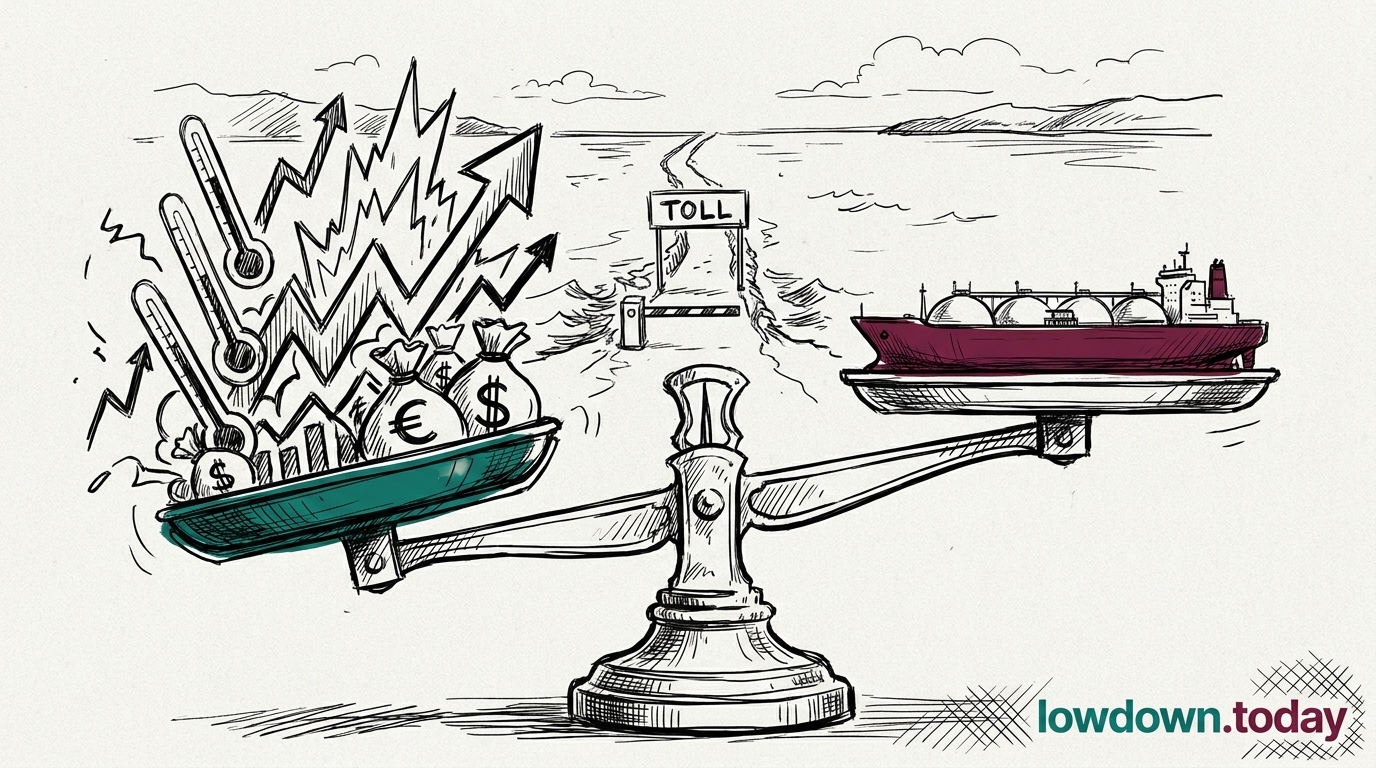
Washington reimposed a blockade on Iranian ports and a 20% Strait of Hormuz cargo toll on 13 July, driving TTF's 9% two-session rally to EUR 54.995/MWh. The posture is again setting Europe's gas benchmark by sentiment rather than by any confirmed change in cargo flows.
EDF
EDF
EDF slipped the Bugey 3, Golfech 2 and Chooz 2 restarts to 19, 22 and 25 July, pushing all three past the 20 July Bugey heat exemption, after river-cooling limits on the Rhone, Garonne and Meuse forced the cuts. The same thermal ceiling has capped the fleet in every major heatwave since 2003, and this cycle is no exception.
German power desk
German power desk
German day-ahead power climbed from EUR 126 to EUR 156/MWh over 14-16 July as the heat dome held, flipping the clean spark spread positive for the first time since 14 July. Gas-for-power demand is now back in competition with mandate storage injection right as the injection margin itself is thinning.
EU carbon and storage regulators
EUA carbon broke EUR 81/tonne on 13 July as the ETS Market Stability Reserve's scheduled withdrawals met fresh fuel-switching demand from France's nuclear curtailment. Brussels' mandatory storage-fill rule kept German and French injection running regardless of the TTF swings, the mechanism working as designed four years after the 2022 shock.
Equinor
Equinor
Equinor returned its Asgard field from maintenance on 11 July, lifting Gassco's exit nominations to 319.8 mcm/day just as TTF round-tripped on Hormuz risk. The restart gave Norway spare pipeline capacity to help Europe absorb the gas rally without drawing down storage, reinforcing its role as the post-2022 swing supplier.
