Skip to content
You can now search across every topic, entity and event.What's new
European Energy Markets
16JUL

Qatar restart leaves a fifth out

3 min read
09:48UTC

QatarEnergy told buyers it can reach 50% of capacity within a month of safe Hormuz passage and 80% within two, but two production trains destroyed in March cap full recovery for years.

EconomicDeveloping
Key takeaway

QatarEnergy can restart to 80% in two months, but two destroyed trains cap a fifth of global LNG for years.

QatarEnergy told buyers it can reach 50% of capacity within one month of safe Hormuz passage and 80% within two months, but full recovery of its Ras Laffan complex runs to years because two production trains were destroyed in March 1. QatarEnergy is the world's largest LNG exporter; Ras Laffan is its industrial city on the Gulf coast, the single largest LNG export complex on the planet. It shipped close to a fifth of global LNG last year, which makes the two-train loss a permanent structural cap of roughly 20% on what can return whenever the strait clears.

QatarEnergy starts that restart clock only once a Hormuz safe-passage date lands, which the US-Iran memorandum has not yet set. Even then, the 50% and 80% milestones describe a partial plant: the destroyed trains are not a maintenance outage that clears with a schedule, but capacity that has to be rebuilt. Pre-conflict European import volumes are therefore off the table at any reopening date, not merely delayed.

That gap matters because the curve is not pricing it. The same forward strip that prices a fuller refill than the physical balance supports also prices a fuller Qatari recovery than the destroyed plant can deliver, the wedge OIES quantified this week and covered in event 4. Goldman Sachs reinforced the read on 17 June, pushing its end-of-July restart estimate later as anchored vessels queued (covered in event 6), against a benchmark that had already begun selling into the diplomacy . The restart math says the supply side recovers slower and shallower than the prompt collapse implies.


Deep Analysis

In plain English

Qatar owns the world's largest liquefied natural gas export terminal at Ras Laffan, which ships gas chilled to liquid form onto specialised tankers that carry it to Europe and Asia. During the conflict in spring 2026, two of the factory-like production units at the terminal were destroyed. Qatar says it can restart to half-capacity within a month of the shipping route reopening, and to 80% within two months. But the two destroyed units represent about a fifth of the terminal's total output, and rebuilding them from scratch takes years. Meanwhile, roughly 500 cargo ships are still waiting outside the Strait of Hormuz, the narrow sea passage that all Qatar's tankers must use. Shipping companies are cautious: the strait may have been mined during the conflict, and insurers want proof it is safe before allowing normal operations. Goldman Sachs estimates full shipping normalisation will not happen until the end of July at the earliest.

Deep Analysis
Root Causes

The two-train loss at Ras Laffan is a structural supply constraint arising from infrastructure destruction rather than market dynamics. Ras Laffan's production trains are large cryogenic process units, each typically 4-8 mtpa of LNG capacity, whose destruction during the March 2026 conflict requires replacement of heat exchangers, compressor trains, and in some cases structural foundations that cannot be patched in situ.

The 500 vessels still anchored outside Hormuz after the memorandum reflect a second structural delay: shipowners and war-risk insurers require physical evidence of mine-clearance completion and insurance market re-opening before resuming commercial transit through a recent conflict zone.

The Lloyd's of London and Scandinavian P&I clubs, which cover the majority of global LNG tanker liability, typically require a mine-free certificate from a recognised naval authority before removing enhanced war-risk premiums, a process that takes weeks to months, explaining Goldman's end-July normalisation estimate.

What could happen next?
  • Consequence

    A permanent 20% cap on Qatari LNG output, equivalent to roughly 4 bcm/month below pre-conflict levels, requires Europe to source replacement LNG from Atlantic Basin suppliers at freight premiums that may widen TTF-JKM competition over winter.

  • Risk

    Goldman's end-July LNG normalisation date, if it slips further due to insurer hesitancy or mine-clearance delays, would directly shrink the July injection window, the highest-volume injection month in the EU calendar, and push storage further below the 80% floor.

First Reported In

Update #19 · German spark spread flips +EUR 15 in 48hrs

InvestingLive· 18 Jun 2026
Read original
Different Perspectives
LNG spreads desk
LNG spreads desk
The JKM-TTF arb flipped to a TTF premium of roughly USD 0.6/MMBtu on 15 July, the first time this cycle Europe has outbid Asia, yet no Atlantic cargo has rerouted west. Until a cargo actually moves, the desk reads the Hormuz premium as unconfirmed and the EUR 55 print as vulnerable to a fast reversal.
United States
United States
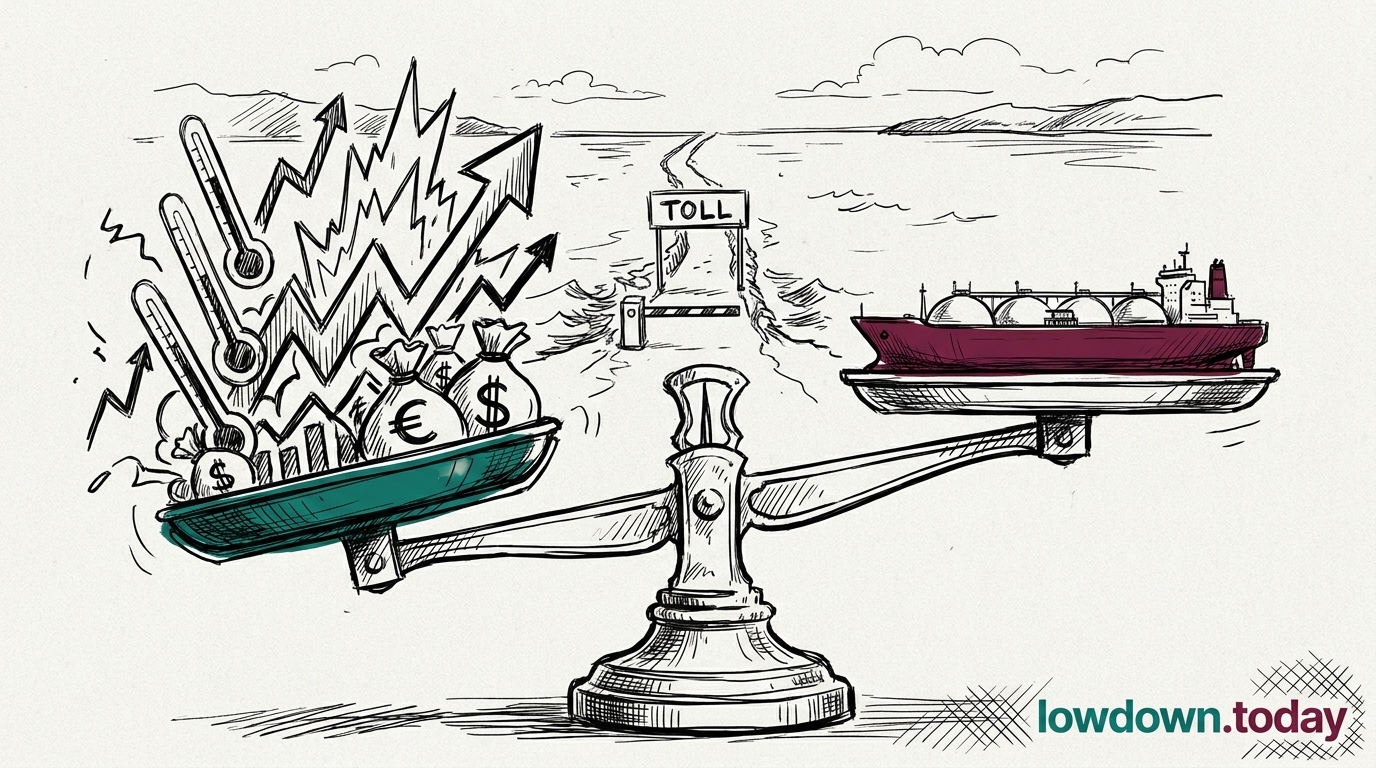
Washington reimposed a blockade on Iranian ports and a 20% Strait of Hormuz cargo toll on 13 July, driving TTF's 9% two-session rally to EUR 54.995/MWh. The posture is again setting Europe's gas benchmark by sentiment rather than by any confirmed change in cargo flows.
EDF
EDF
EDF slipped the Bugey 3, Golfech 2 and Chooz 2 restarts to 19, 22 and 25 July, pushing all three past the 20 July Bugey heat exemption, after river-cooling limits on the Rhone, Garonne and Meuse forced the cuts. The same thermal ceiling has capped the fleet in every major heatwave since 2003, and this cycle is no exception.
German power desk
German power desk
German day-ahead power climbed from EUR 126 to EUR 156/MWh over 14-16 July as the heat dome held, flipping the clean spark spread positive for the first time since 14 July. Gas-for-power demand is now back in competition with mandate storage injection right as the injection margin itself is thinning.
EU carbon and storage regulators
EUA carbon broke EUR 81/tonne on 13 July as the ETS Market Stability Reserve's scheduled withdrawals met fresh fuel-switching demand from France's nuclear curtailment. Brussels' mandatory storage-fill rule kept German and French injection running regardless of the TTF swings, the mechanism working as designed four years after the 2022 shock.
Equinor
Equinor
Equinor returned its Asgard field from maintenance on 11 July, lifting Gassco's exit nominations to 319.8 mcm/day just as TTF round-tripped on Hormuz risk. The restart gave Norway spare pipeline capacity to help Europe absorb the gas rally without drawing down storage, reinforcing its role as the post-2022 swing supplier.
