Skip to content
You can now search across every topic, entity and event.What's new
European Energy Markets
16JUL

ACER names Hungary, Slovakia at TurkStream

4 min read
09:48UTC

ACER's 6 May derogation opinions covered seven national regulators, and named Hungary and Slovakia among the EU member states most exposed at the TurkStream entry ahead of the 5 August code-application date.

EconomicDeveloping
Key takeaway

Hungary and Slovakia face a regulatory checkpoint on TurkStream entry from 5 August.

ACER, the Agency for the Cooperation of Energy Regulators, published opinions on 6 May covering derogation requests from seven national regulatory authorities (NRAs) on EU gas network code application at third-country interconnection points. The seven NRAs are Bulgaria, Estonia, Hungary, Italy, Lithuania, Slovakia and Spain. The codes apply from 5 August 2026.

ACER is the Ljubljana-based EU body that coordinates national energy regulators and enforces the recast REMIT (Regulation on Wholesale Energy Market Integrity and Transparency) wholesale market rules in force from 29 April . Network codes set the technical, balancing and transaction-reporting standards for cross-border gas; at a third-country entry, they bind the EU side only, which is the structural problem the derogations target.

ACER found that Hungary and Bulgaria had implemented the codes "to the maximum extent possible" pending neighbouring Russian and Turkish operators' simultaneous implementation. Hungary and Slovakia are the two EU member states most dependent on the TurkStream pipeline, which ran at roughly 41 mcm/day in April routing Russian gas through Turkey and the Balkans. The bottleneck on third-country TSO (transmission system operator) cooperation is therefore concentrated on the route already carrying the bloc's heaviest physical-supply political risk.

Final decisions sit with the European Commission. If derogations are granted, EU measurement, balancing and REMIT transaction-reporting standards do not bind at the TurkStream entry from August. For desks running cross-border positions through Hungarian and Slovak hubs, the 5 August date is now a discrete regulatory checkpoint.


Deep Analysis

In plain English

The EU has rules about how gas should be measured, balanced, and reported when it crosses international borders into Europe. These rules were designed to make the gas market transparent and prevent price manipulation. TurkStream is a pipeline that carries Russian gas through Turkey and the Balkans into Hungary and Slovakia. The problem is that Russia and Turkey, who run the pipeline on their side of the border, do not follow EU rules. Europe can only set rules for EU members, not for Russia or Turkey. ACER, the EU energy regulator, has now formally acknowledged this gap. Hungary and Slovakia, the countries that rely most on TurkStream, asked for an exemption from the rules they technically cannot enforce at the border. ACER has given its opinion; now the European Commission has to decide whether to grant the exemption.

Deep Analysis
Root Causes

The structural cause is the 2019 recast Gas Directive's provision exempting new pipelines from third-country operators from unbundling and network code requirements, the provision that Russia successfully used to seek and receive (initially, before later being reversed) regulatory carve-outs for Nord Stream 2.

TurkStream was built and operates under an expectation of permanent exceptionalism from the EU regulatory framework, because the regulatory framework as designed cannot compel third-country TSO compliance.

The 5 August 2026 application date creates the immediate pressure: REMIT 2.0's transaction reporting obligations and the network code balancing standards that ACER is now opining on were designed as a coherent package. If TurkStream's entry point operates outside REMIT-equivalent transaction reporting from August, positions crossing the Hungarian and Slovak entry hubs carry a measurement and audit gap that compliance functions at trading houses will need to account for.

What could happen next?
  • Risk

    If the Commission grants derogations without conditions, REMIT 2.0 transaction reporting standards will not bind at TurkStream's EU entry from 5 August, creating an audit gap for cross-border positions referencing Hungarian and Slovak gas hubs.

    Short term · 0.7
  • Consequence

    A denied derogation creates a compliance default at TurkStream entry from 5 August without any practical mechanism to force Russian-Turkish TSO cooperation, meaning the denied outcome is a regulatory fiction rather than an enforcement improvement.

    Short term · 0.8
  • Precedent

    The ACER opinion establishes TurkStream as the test case for how EU network code architecture handles permanent third-country route dependencies, with implications for any future non-EU interconnection that cannot be governed through EEA-adjacent bilateral frameworks.

    Long term · 0.82
First Reported In

Update #8 · Storage 34.3 as 12 May test nears; Hammerfest silent

ACER· 8 May 2026
Read original
Different Perspectives
LNG spreads desk
LNG spreads desk
The JKM-TTF arb flipped to a TTF premium of roughly USD 0.6/MMBtu on 15 July, the first time this cycle Europe has outbid Asia, yet no Atlantic cargo has rerouted west. Until a cargo actually moves, the desk reads the Hormuz premium as unconfirmed and the EUR 55 print as vulnerable to a fast reversal.
United States
United States
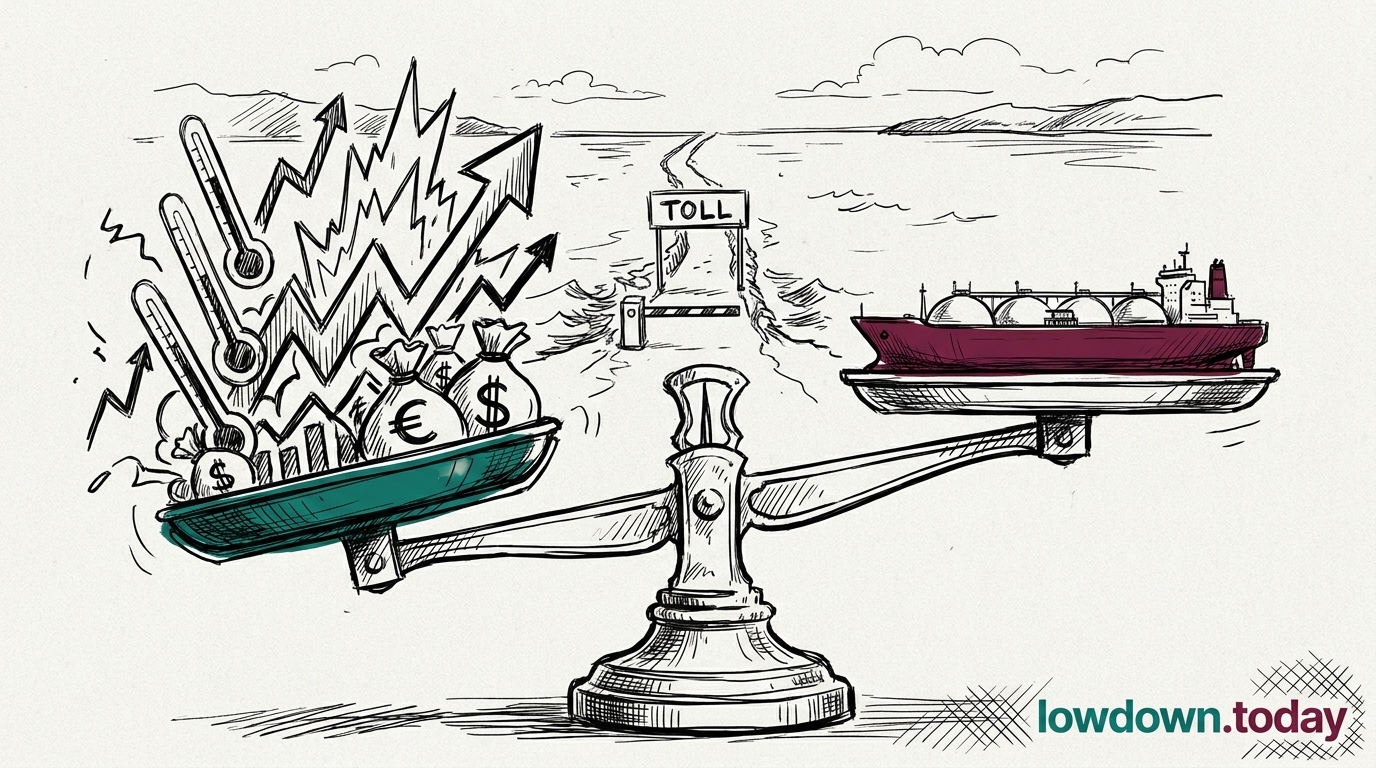
Washington reimposed a blockade on Iranian ports and a 20% Strait of Hormuz cargo toll on 13 July, driving TTF's 9% two-session rally to EUR 54.995/MWh. The posture is again setting Europe's gas benchmark by sentiment rather than by any confirmed change in cargo flows.
EDF
EDF
EDF slipped the Bugey 3, Golfech 2 and Chooz 2 restarts to 19, 22 and 25 July, pushing all three past the 20 July Bugey heat exemption, after river-cooling limits on the Rhone, Garonne and Meuse forced the cuts. The same thermal ceiling has capped the fleet in every major heatwave since 2003, and this cycle is no exception.
German power desk
German power desk
German day-ahead power climbed from EUR 126 to EUR 156/MWh over 14-16 July as the heat dome held, flipping the clean spark spread positive for the first time since 14 July. Gas-for-power demand is now back in competition with mandate storage injection right as the injection margin itself is thinning.
EU carbon and storage regulators
EUA carbon broke EUR 81/tonne on 13 July as the ETS Market Stability Reserve's scheduled withdrawals met fresh fuel-switching demand from France's nuclear curtailment. Brussels' mandatory storage-fill rule kept German and French injection running regardless of the TTF swings, the mechanism working as designed four years after the 2022 shock.
Equinor
Equinor
Equinor returned its Asgard field from maintenance on 11 July, lifting Gassco's exit nominations to 319.8 mcm/day just as TTF round-tripped on Hormuz risk. The restart gave Norway spare pipeline capacity to help Europe absorb the gas rally without drawing down storage, reinforcing its role as the post-2022 swing supplier.
