Skip to content
You can now search across every topic, entity and event.What's new
European Energy Markets
16JUL

REMIT 2.0 hits first 14-day reporting deadline

3 min read
09:48UTC

The REMIT 2.0 recast entered force on Wednesday 29 April. The first 14-day transaction reporting deadline lands around Tuesday 12 May, the recast framework's first compliance test.

EconomicDeveloping
Key takeaway

REMIT 2.0's first 14-day transaction reporting deadline around 12 May sets the recast framework's compliance baseline.

REMIT 2.0 (Regulation on Wholesale Energy Market Integrity and Transparency), the recast EU framework, has its first 14-day transaction reporting deadline landing around Tuesday 12 May, the first compliance test of the recast framework that entered force on Wednesday 29 April . ACER (the EU Agency for the Cooperation of Energy Regulators) published four REMIT 2.0 documents on entry day , confirming the recast operative without simultaneity waiver or grace period . The recast had been preceded by an ACER consultation opened on 16 April .

The 14-day reporting cycle introduces an exposure-reporting obligation that was not present in the original REMIT framework, and the framework now binds market participants to disclose net positions on a rolling basis rather than on event-driven triggers. No ACER guidance note or enforcement signal has yet been issued in the days following entry into force, which is the standard pattern: the agency typically lets the first deadline run before issuing operational guidance. The 12 May print is therefore both the first compliance test and the data point against which ACER calibrates whatever follows.

For positioning, the REMIT 2.0 obligations matter alongside the storage-pace question because tighter market integrity rules raise the cost of speculative positioning into a contract that is already pricing the headline rather than the arithmetic. TTF participants whose 14-day exposure prints diverge sharply from physical positions risk supervisory attention from a regulator that has just acquired a new disclosure tool and has not yet shown how aggressively it intends to use it. Whether ACER issues any guidance note or enforcement signal in the week after 12 May is the operative read.


Deep Analysis

In plain English

REMIT 2.0 is a new European Union rule about fairness and transparency in the wholesale energy market, the market where energy companies buy and sell gas and electricity in large quantities. From 29 April 2026, energy traders have to report their net positions in those markets to the EU's energy regulator, ACER, every 14 days. The first of those reports is due around 12 May. This is designed to make it harder for large traders to build up dominant positions that could push up prices for everyone. The regulator has not yet said how strictly it will enforce the new rules.

Deep Analysis
Root Causes

REMIT 2.0's 14-day transaction reporting cycle was accelerated from the originally proposed 21-day window during the trilogue finalisation in January 2026, in direct response to the August 2022 TTF manipulation concerns and the evidence base ACER accumulated during its 2023-2025 Horizonte investigation into TTF position-concentration by three major commodity trading houses.

The structural driver is a regulatory architecture gap: original REMIT was calibrated to a 2011 EU gas market dominated by pipeline supply under long-term contracts.

The 2026 market is a spot-dominated LNG market with algorithmic position-taking and automated roll strategies that generate large intraday net-position swings invisible to a monthly or quarterly reporting cycle. The 14-day window is the minimum cycle at which ACER can observe position-concentration developing before it reaches manipulative scale.

What could happen next?
  • Consequence

    TTF participants whose 14-day net-position disclosures reveal concentration above ACER's (unpublished) threshold could face supervisory inquiries in the week after 12 May, before any formal enforcement action.

    Immediate · 0.6
  • Risk

    MiFID II precedent suggests 30-40% of first-deadline reporters will fail to comply with the technical reporting specifications; ACER's initial enforcement posture, whether it issues warning letters or opens formal investigations, sets the compliance culture for the rest of the season.

    Immediate · 0.62
  • Opportunity

    If ACER uses the 14-day position data to challenge concentrated speculative TTF shorts during the injection season, it could reduce the market's tendency to underprice storage-pace risk relative to the arithmetic, directly relevant to the gap between TTF's settled range and the 0.045 pp/day injection shortfall.

    Medium term · 0.55
First Reported In

Update #7 · Storage pace 0.21 vs 0.257; floor not yet met

Gasunie Transport Services· 4 May 2026
Read original
Different Perspectives
LNG spreads desk
LNG spreads desk
The JKM-TTF arb flipped to a TTF premium of roughly USD 0.6/MMBtu on 15 July, the first time this cycle Europe has outbid Asia, yet no Atlantic cargo has rerouted west. Until a cargo actually moves, the desk reads the Hormuz premium as unconfirmed and the EUR 55 print as vulnerable to a fast reversal.
United States
United States
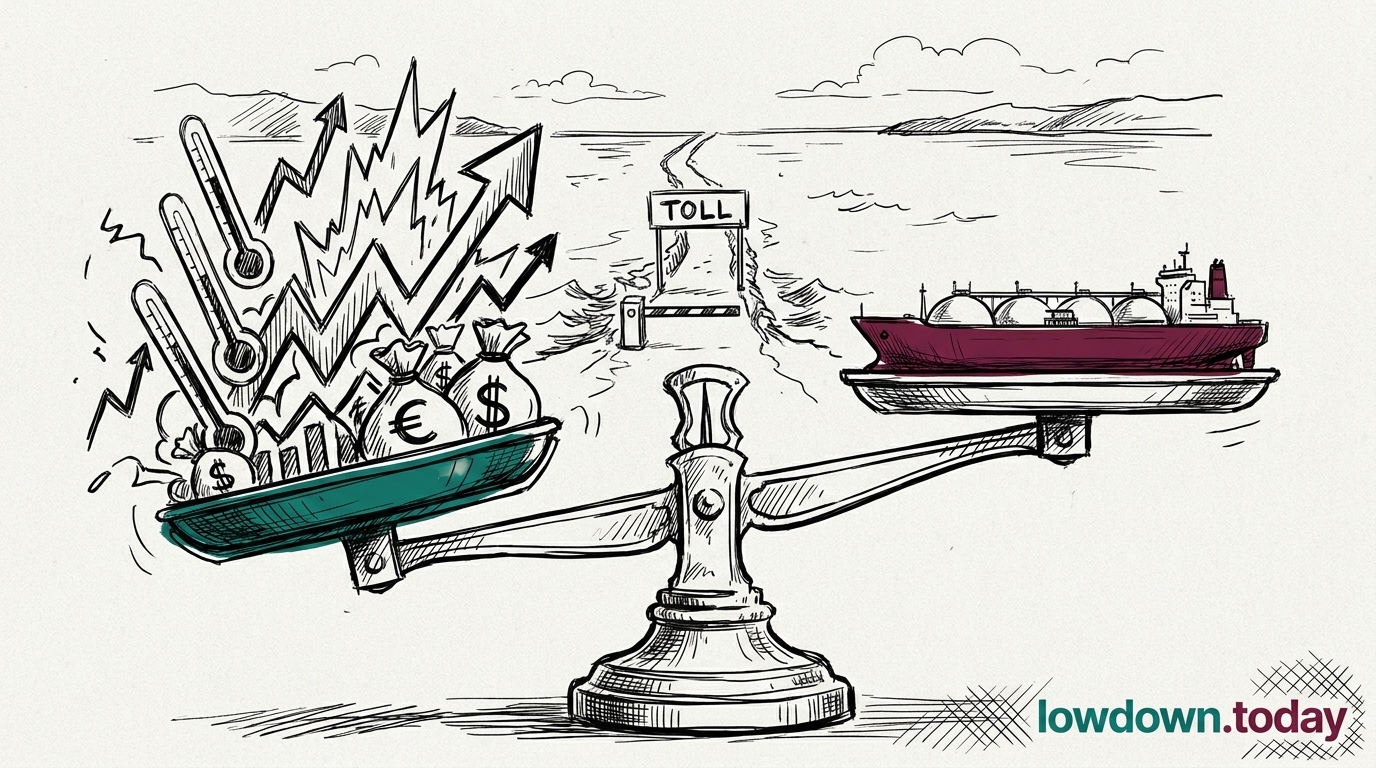
Washington reimposed a blockade on Iranian ports and a 20% Strait of Hormuz cargo toll on 13 July, driving TTF's 9% two-session rally to EUR 54.995/MWh. The posture is again setting Europe's gas benchmark by sentiment rather than by any confirmed change in cargo flows.
EDF
EDF
EDF slipped the Bugey 3, Golfech 2 and Chooz 2 restarts to 19, 22 and 25 July, pushing all three past the 20 July Bugey heat exemption, after river-cooling limits on the Rhone, Garonne and Meuse forced the cuts. The same thermal ceiling has capped the fleet in every major heatwave since 2003, and this cycle is no exception.
German power desk
German power desk
German day-ahead power climbed from EUR 126 to EUR 156/MWh over 14-16 July as the heat dome held, flipping the clean spark spread positive for the first time since 14 July. Gas-for-power demand is now back in competition with mandate storage injection right as the injection margin itself is thinning.
EU carbon and storage regulators
EUA carbon broke EUR 81/tonne on 13 July as the ETS Market Stability Reserve's scheduled withdrawals met fresh fuel-switching demand from France's nuclear curtailment. Brussels' mandatory storage-fill rule kept German and French injection running regardless of the TTF swings, the mechanism working as designed four years after the 2022 shock.
Equinor
Equinor
Equinor returned its Asgard field from maintenance on 11 July, lifting Gassco's exit nominations to 319.8 mcm/day just as TTF round-tripped on Hormuz risk. The restart gave Norway spare pipeline capacity to help Europe absorb the gas rally without drawing down storage, reinforcing its role as the post-2022 swing supplier.
