Skip to content
You can now search across every topic, entity and event.What's new
European Energy Markets
10JUL

Asia clears the LNG queue first

3 min read
10:05UTC

Goldman Sachs pushed Hormuz LNG normalisation to end-July from end-June on 17 June, citing roughly 500 vessels still anchored outside the strait; the first post-conflict carrier routed to India, not Europe.

EconomicDeveloping
Key takeaway

Goldman pushed Hormuz LNG normalisation to end-July as 500 vessels queued and the first carrier cleared India.

Goldman Sachs revised its Hormuz LNG normalisation timeline to end-July from end-June on 17 June, citing roughly 500 commercial vessels still anchored outside the strait despite the US-Iran memorandum 1. The bank held its 2H 2026 TTF forecast at EUR 41/MWh but flagged an upside tail above EUR 100/MWh if the blockade persists. A two-to-three-month mine-clearing and security-assessment tail means the physical cargo benefit arrives after the heart of the July injection window 2, with Qatar's partial restart clock (covered in event 5) layered behind that.

The arbitrage tells the same story. The JKM-TTF spread, the gap between the Japan-Korea Marker for Asian spot LNG and the European benchmark, compressed to roughly USD 4.35/MMBtu by 18 June from USD 5.26 on 12 June as TTF fell faster than JKM on the Hormuz deal 3. The compression is real but partial: the arb still sits above the USD 2.50 to 3.00 freight-adjusted diversion threshold, so uncommitted Atlantic cargoes still route east rather than into European terminals.

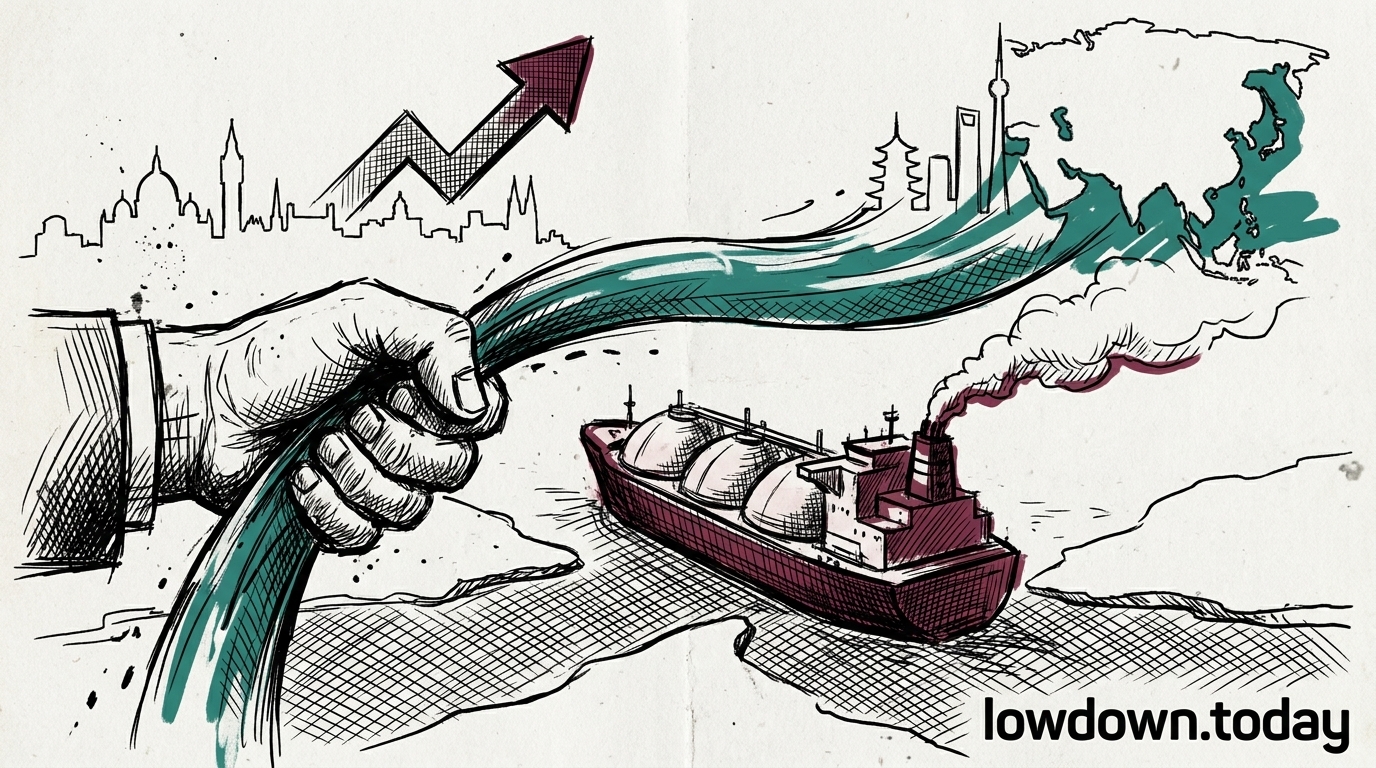
The physical flow confirms the routing. The Disha, the first LNG carrier to cross Hormuz after the conflict, transited on 15 June bound for Dahej in India, not a European berth 4. The first post-conflict cargo cleared an Asian terminal while Europe's regas berths stayed the losing bid. The narrowing margin is the early signal of European storage re-entering the cargo auction, not yet its return: front-month TTF has fallen on a diplomatic deal that the physical cargo flow has not yet routed to a European regas berth.


Deep Analysis

In plain English

Liquefied natural gas tankers can choose where to deliver, to Europe or to Asia, depending on which destination pays more. The price difference between Asia (measured by the Japan-Korea Marker, or JKM) and Europe (TTF) determines the routing choice. When Asia pays USD 4.35 more per unit than Europe, after accounting for the cost of the longer journey, tanker owners route east. The first LNG ship to sail through the Strait of Hormuz after the conflict ended was the Disha. Despite months of European concern about gas shortages, the Disha went to India, the commercial signals pointed there, not to a European terminal. Until TTF rises enough to narrow the gap with Asian prices, the same pattern will repeat: available LNG flows to the highest bidder, which is currently Asia.

Deep Analysis
Root Causes

The JKM-TTF arb persists above the diversion breakeven because two independent conditions hold simultaneously: first, Asian spot LNG demand has not yet been destroyed sufficiently by high prices, as Japanese utilities and South Korean importers face winter 2026-27 procurement obligations and are rebuilding storage; second, Atlantic LNG cargo owners face a choice between a EUR 41 TTF equivalent (approximately USD 14.2/MMBtu) and a JKM above USD 18/MMBtu, with freight costs of approximately USD 2.50/MMBtu for a Europe-versus-Asia diversion, leaving USD 1.35 of net advantage for routing east.

The Disha routing to Dahej confirms that even the first post-conflict Hormuz transit, which might have been expected to prioritise European storage security as the diplomatically significant choice, followed commercial routing logic: India offered a closer destination and a JKM-linked offtake price that beat any European terminal bid at current TTF levels.

What could happen next?
  • Risk

    Every week the JKM-TTF arb stays above USD 4/MMBtu, European storage injection misses approximately 700 GWh of LNG supply that would otherwise arrive at Northwest European terminals under a routing-neutral arb environment.

  • Consequence

    India and other South Asian LNG importers receiving the first post-conflict Hormuz cargoes establish an emerging commercial pattern that could persist into the winter procurement window, structurally competing with European buyers for Qatari restarter volumes.

First Reported In

Update #19 · German spark spread flips +EUR 15 in 48hrs

InvestingLive· 18 Jun 2026
Read original
Different Perspectives
EU carbon and storage regulators
EUA carbon broke EUR 81/tonne on 13 July as the ETS Market Stability Reserve's scheduled withdrawals met fresh fuel-switching demand from France's nuclear curtailment. Brussels' mandatory storage-fill rule kept German and French injection running regardless of the TTF swings, the mechanism working as designed four years after the 2022 shock.
Equinor
Equinor
Equinor returned its Asgard field from maintenance on 11 July, lifting Gassco's exit nominations to 319.8 mcm/day just as TTF round-tripped on Hormuz risk. The restart gave Norway spare pipeline capacity to help Europe absorb the gas rally without drawing down storage, reinforcing its role as the post-2022 swing supplier.
Germany
Germany
Germany briefly became the cheaper leg of the FR-DE spread on 12 July as French reactors went offline, while its own storage injection tripled to 723 GWh on 11 July under the EU's mandatory fill rule. Berlin's CCGT fleet absorbed the extra load at a time when EUA's climb past EUR 81 is raising its own marginal cost too.
EDF
EDF
EDF took Chooz, Golfech and Bugey fully offline on 12 July under river-cooling discharge limits, then secured a temperature exemption for Bugey to 20 July rather than wait for the rivers to cool. The government's willingness to relax the environmental ceiling shows French grid security now outweighs the permit breach when reactor hardware itself is undamaged.
Storage and injection-pace desk
EU storage sat at 51.1% on 8 July, still running below the pace needed for an 80% November target, and the JKM-TTF Asia premium of roughly USD 1.4-2.4/MMBtu was already pulling marginal cargoes east before Qatar's withdrawal compounded the gap. October's top-up remains the binding constraint, not this week's price level.
EDF / France
EDF / France
EDF added Chooz to its heat-curtailment watch list as a precaution against the second heat dome peaking 9-14 July, alongside standing warnings at Blayais, Bugey, Golfech and Saint-Alban. No output cut has been confirmed at any site as of 10 July.
