Skip to content
You can now search across every topic, entity and event.What's new
European Energy Markets
15JUN

TTF closes above EUR 50 on Iran re-rate

4 min read
12:23UTC

TTF settled EUR 50.83/MWh on Monday, its first clean close above EUR 50 since a US-Iran deal headline erased 8.1% on 26 May. The driver was re-priced Gulf LNG risk, not a European supply change.

EconomicDeveloping
Key takeaway

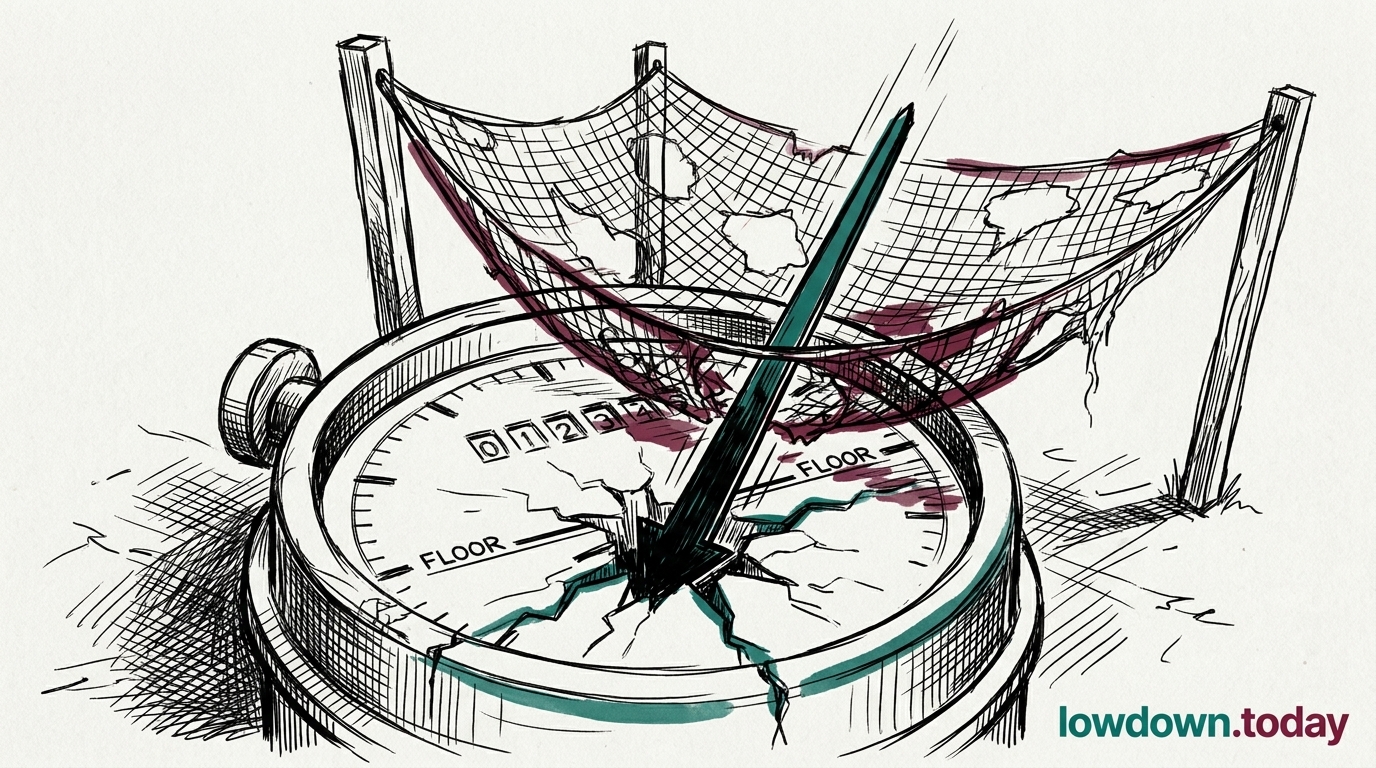
The EUR 50 level Lowdown called a ceiling is now a floor under test, nine days before the ban binds.

Dutch TTF settled EUR 50.83/MWh on Monday 8 June, up 4.82% on the day with an intraday print at EUR 51.2, the first clean close above EUR 50 since a US-Iran deal headline erased 8.1% in a single 26 May session 1. TTF is the Title Transfer Facility, the Dutch virtual hub that sets Europe's benchmark wholesale gas price and the reference leg for LNG arbitrage. The driver was a fresh re-pricing of Iran-Israel risk to Gulf LNG flows, not any change in European physical supply, and that distinction is the whole story for a prompt desk.

The front-month had tracked EUR 48.40 to 49.2 across 4 to 5 June before Monday's surge, so a single session moved the curve enough to reopen Bruegel's EUR 35bn refill-cost scenario from the EUR 26bn base case. TTF first broke EUR 50 on 18 May , then retraced as the diplomatic optimism that capped it returned . The level Lowdown has called a diplomatic ceiling across four updates has now flipped to a contested floor.

The re-rate matters because it lands nine days before a physical Russian pipeline step-down on 17 June, with no legal block confirmed. The curve is rebuilding a geopolitical premium it stripped out a fortnight ago, and it is doing so into a binary supply event rather than away from one. Exogenous risk-on meeting an endogenous supply cliff inside the same fortnight removes the mean-reversion comfort that a diplomatic de-escalation could cap the move.


Deep Analysis

In plain English

European gas is priced at a trading hub called TTF in the Netherlands, and that price affects bills across the continent. On Monday 8 June it crossed EUR 50 per megawatt-hour for the first time in almost two weeks. Traders pushed the price up because of Middle East tension, not a physical shortage. A lot of the gas Europe imports as liquefied natural gas (LNG, super-cooled gas shipped on tankers) travels from Qatar and the UAE through the Strait of Hormuz. Iran and Israel have been in conflict, and traders worry that worsening tension could disrupt those tanker routes. In late May a peace rumour pushed the price back down in one session. Now the price is climbing again, with a separate Russian pipeline supply cut arriving in nine days. Iran risk and Russian pipeline risk landing in the same fortnight keeps buyers bidding above EUR 50.

Deep Analysis
Root Causes

The EUR 50 break on 8 June has three separable causes.

First, the Iran-LNG route risk: the Strait of Hormuz carries Qatari and UAE cargoes that together represent more than 2 bcm/week of supply the European balance counted on post-March. Any credible escalation signal re-prices that dependency.

Second, the absence of a physical backstop: Hammerfest LNG is offline with a 10 July base-case return, and Troll A's compressor outage resolved only on 31 May. Norwegian send-out is no longer the unconstrained buffer it was in early 2025, which means Asia can pull flexible Atlantic cargoes east without a European counter-bid.

Third, the storage inventory deficit: at 22.9 percentage points below the five-year seasonal norm, European buyers are structurally short of comfortable reserve headroom, so geopolitical risk-off bids arrive into a physically thin market. The combination produces oversized moves per unit of news.

What could happen next?
  • Consequence

    Bruegel's EUR 35bn EU refill-cost scenario, rather than the EUR 26bn base case, becomes the operative planning figure if TTF holds above EUR 50 through July.

    Short term · Assessed
  • Risk

    A second diplomatic fade, similar to 26 May, would confirm EUR 50 as a contested rather than firm floor, reinforcing the pattern of headline-driven spikes that do not build into a new clearing level.

    Immediate · Assessed
  • Opportunity

    At EUR 50-plus, the summer-winter strip inversion narrows enough that commercial storage operators near continental LNG entry points face a viable booking window for the first time since January.

    Immediate · Assessed
First Reported In

Update #16 · TTF closes above EUR 50 on Iran risk re-rate

Trading Economics· 8 Jun 2026
Read original
Causes and effects
This Event
TTF closes above EUR 50 on Iran re-rate
The level Lowdown called a six-week diplomatic ceiling has flipped to a contested floor, nine days before the 17 June Russian pipeline step-down.
Different Perspectives
Equinor
Equinor
Equinor stacked a 13-16 June planned maintenance window on Hammerfest LNG directly atop the unresolved compressor fault running since 22 April, creating two simultaneous live stoppages at 4.3 mtpa capacity for the first time. The 10 July return target carries overrun risk: the same compressor class slipped 24 days in the 2025 maintenance cycle.
EDF and French nuclear-anchored power buyers
EDF's fleet repriced French July contracts roughly 10% in two days on cooling-water curtailment risk, flipping the FR-DE spread to France EUR 1.6 above Germany after a EUR 96.20 record in the other direction a week earlier. Industrial buyers long France against short Germany face EUR 97.7/MWh of spread swing in seven calendar days.
Hungary and Slovakia supply-security ministries
Hungary's Tisza government has reframed Russian gas dependency as a systemic risk, removing Budapest as a co-plaintiff in the CJEU challenge; MVM's 3.5 bcm long-term TurkStream contract remains exempt to September 2027, so Budapest's near-term supply is intact. Slovakia under Fico presses its QMV challenge alone and faces a 3-4 bcm/year short-term supply gap with no contracted LNG alternative.
LNG spot traders and cargo routers
At JKM-TTF of USD 5.26/MMBtu, every uncommitted Atlantic cargo loading in late June routes east; the arb sits roughly twice the OIES-assessed diversion threshold of USD 2.50-3.00/MMBtu after freight. European storage terminals are the losing bid in the cargo auction until TTF recovers or JKM eases.
European Commission / ACER
The Commission structured Regulation 2026/261 as a QMV trade measure to resist Article 194 unanimity challenges; the six-origin prior-authorisation waiver acknowledges that LNG capacity cannot substitute pipeline gas within the legislative window. ACER's cross-border enforcement powers activate in H2 2026, but jurisdiction over the Kipi entry point is legally contested.
German CCGT capacity planners
Capacity planners at Uniper and RWE face the StromVKG Wirtschaftsausschuss scrutiny as the decisive near-term fork: if the Greens' hydrogen-conversion amendment passes, the September 2026 auction becomes unbiddable on technology risk grounds and the capacity-payment fix delays into winter. Plants that have run at -EUR 44 spark spread for weeks cannot commercially sustain extended shut-in.



