Skip to content
Briefings are running a touch slower this week while we rebuild the foundations.See roadmap
European Energy Markets
4JUN

TTF breaks 38-session range to EUR 48.9

3 min read
10:45UTC

TTF rose 6% on 2 June to EUR 48.9/MWh, breaking the 38-session EUR 46-47 band, as Equinor issued no Troll A restart notice through 4 June and Iran diplomacy stayed stalled.

EconomicDeveloping
Key takeaway

TTF's breakout to EUR 48.9 confirms the 38-session range was consolidation, the EUR 50 ceiling intact.

TTF broke the EUR 46-47/MWh band it had held for roughly 38 sessions, rising about 6% on Tuesday 2 June to around EUR 48.9/MWh 1 and re-approaching the EUR 50 ceiling that capped the 18 May break at EUR 50.17 . The 25 May spike then hit EUR 51.82 intraday before a US-Iran deal headline erased 8.1% in a session , confirming EUR 50 as a diplomatic-premium ceiling. The 2 June move re-establishes that the structural premium is not fading: the 38-session hold was consolidation, not resolution.

Equinor drives the operative physical leg. It extended the Troll A compressor outage to 31 May , layering an additional cut onto the 26 May fault for a combined send-out loss near 50.8 mcm/day. The absence of a restart notice through 4 June, after the stated extension deadline, is itself inconsistent with a clean restart having cleared, and the rally through that date reflects the market pricing the ambiguity in.

The Iran diplomacy channel sets the ceiling. Each time a ceasefire headline materialises, TTF pulls 6-8% in a session; absent a headline, supply fundamentals re-establish the upward gradient. The asymmetry, a slow grind up against a sharp drop on diplomacy, is the trade expression of EUR 50 as a diplomatic option rather than a physical floor.

Stacked with carbon, the level sets the marginal German CCGT at a clean spark spread barely positive to negative in off-peak hours. The EUR 100-plus German power clear on 3 June was therefore a CCGT running at or below breakeven on a spread basis, dispatched because it was the marginal unit on the grid, not because the economics were compelling.


Deep Analysis

In plain English

European wholesale gas prices rose 6% on 2 June 2026, breaking out of the tight band they had held for almost two months. Two supply problems drove the move. Norway's Troll A gas platform missed its restart deadline with no new date given, and peace talks between the US and Iran stalled , leaving Hormuz-routed LNG shipments offline. Higher gas prices feed directly into the cost of running gas power stations, which is why German electricity prices stayed above EUR 100 through the same week.

Deep Analysis
Root Causes

Two simultaneous supply disruptions sustained the TTF at the top of its range and triggered the 2 June breakout. The Troll A compressor fault, discovered in an annual test on 21 May and extended to 31 May , combined with a further 16.2 mcm/day layered outage to produce a combined 50.8 mcm/day Norwegian send-out cut.

Equinor issued no restart UMM through 4 June after the stated extension date, a silence inconsistent with a clean restart and the direct cause of the market re-pricing that ambiguity.

The Hormuz diplomatic channel functions as the ceiling. Each Iranian ceasefire headline , the 26 May US-Iran deal report that pulled TTF 8.1% in a session , establishes EUR 50 as the ceiling where a diplomatic premium evaporates. Absent a headline, the physical supply gap re-establishes upward gradient.

The structural background is the TTF summer-winter strip inversion: the forward curve prices summer gas above winter, removing any commercial incentive to inject into storage and concentrating buying pressure in the prompt. The 38-session range was held by this equilibrium between physical tightness and diplomatic ceiling; the 2 June breakout reflects the Troll restart ambiguity tipping the balance toward the physical-supply story.

What could happen next?
  • Consequence

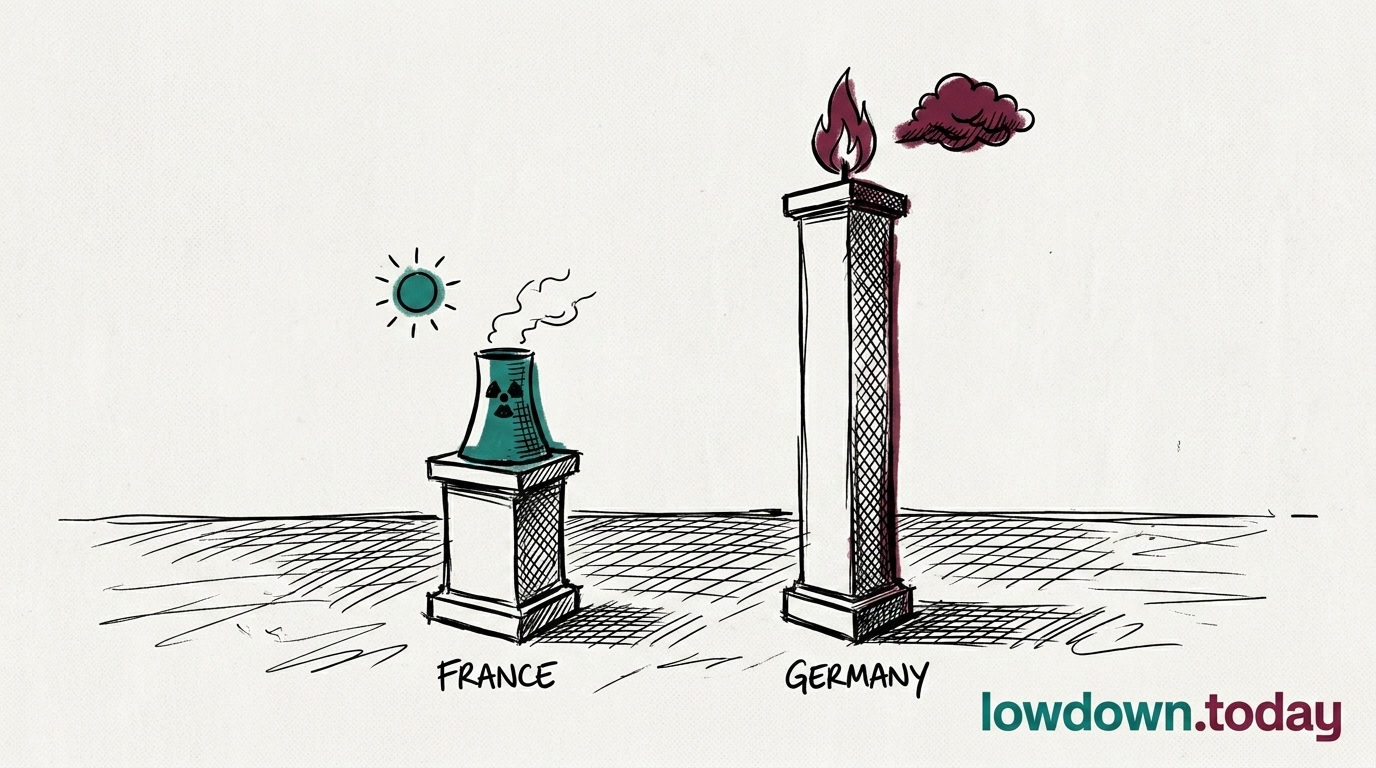
    TTF above EUR 48 sustains German CCGT clearing above EUR 100 for day-ahead power, maintaining the structural FR-DE spread and the intra-EU manufacturing cost gap.

    Immediate · Reported
  • Risk

    A confirmed Troll A restart or Iran ceasefire headline would pull TTF 6-8% in a single session, as demonstrated by the 26 May reversal, collapsing the spread and reducing German power costs.

    Short term · Assessed
  • Risk

    Repeated EUR 50 ceiling tests without resolution increase the probability the market re-rates the Hormuz risk as a durable supply loss rather than a temporary diplomatic variable, potentially establishing a new structural floor.

    Medium term · Suggested
First Reported In

Update #15 · France EUR 9, Germany EUR 103: heat splits

Trading Economics / Barchart composite· 4 Jun 2026
Read original
Different Perspectives
TTF traders / Amsterdam hub desks
TTF broke its 38-session EUR 46-47 band on 2 June to EUR 48.9 on stalled Iran diplomacy and an unconfirmed Troll A restart; Dutch EBN mandates carry storage trajectory while commercial injection books nothing. The 17 June pipeline expiry is the next binary level: Central European hub premium above EUR 2/MWh widens sharply on any physical step-down.
Red Electrica / Spanish grid operators
Spain logged 397 negative-price hours in Q1 2026, eight times the 48 hours of Q1 2025, documenting midday solar surplus now embedding structurally into Continental pricing. Spain is four to six quarters ahead of France and Germany on the solar-penetration curve, making it the clearest forward indicator of where Continental midday clearing is heading.
Equinor
Equinor
Equinor issued no Troll A restart notice through 4 June despite extending the combined outage to 31 May, keeping up to 51 mcm/day of Norwegian supply offline alongside Hammerfest LNG dark since 22 April. The company's silence follows its 2025 Hammerfest pattern, which ran 24 days past target, and each day without a notice sustains the TTF supply premium.
European Commission / GMTF
SWD(2026)147 found EU gas spot and derivatives markets functioning well on 2 June, recommending MiFID-REMIT legislative alignment rather than emergency intervention. The GMTF verdict addressed derivatives-market integrity, not the physical injection mechanism FNB Gas declared broken five days earlier: the Commission's immediate next step is a legislative proposal, not an emergency storage order.
FNB Gas / Bundesnetzagentur
FNB Gas declared the storage-refill mechanism broken on 27 May after zero bookings in January 2026 auctions, and German day-ahead cleared EUR 102.64 on 3 June on a CCGT stack set by TTF near EUR 49 plus EUA near EUR 78. Winter storage fill now depends on state mandates with no commercial self-correction.
EDF / French government
EDF held full-year nuclear guidance at 350-370 TWh after April output of 29.3 TWh, anchoring the surplus that collapsed French day-ahead to EUR 8.96 on 3 June and passed that price to VNU industrials. Flamanville-3's September overhaul removes 1.6 GW at heating-season onset, reversing the nuclear surplus that made VNU pricing competitive.
