Skip to content
You can now search across every topic, entity and event.What's new
European Energy Markets
15JUN

Modi raised dead sailors; Trump gave nil

3 min read
12:23UTC

At the G7 in France, Modi pressed Trump on three Indian seafarers killed by US Navy fire and on Hormuz trade damage; Trump offered no apology, investigation or relief.

EconomicDeveloping
Key takeaway

Modi pressed Trump on India's dead sailors and blocked trade; Trump offered nothing.

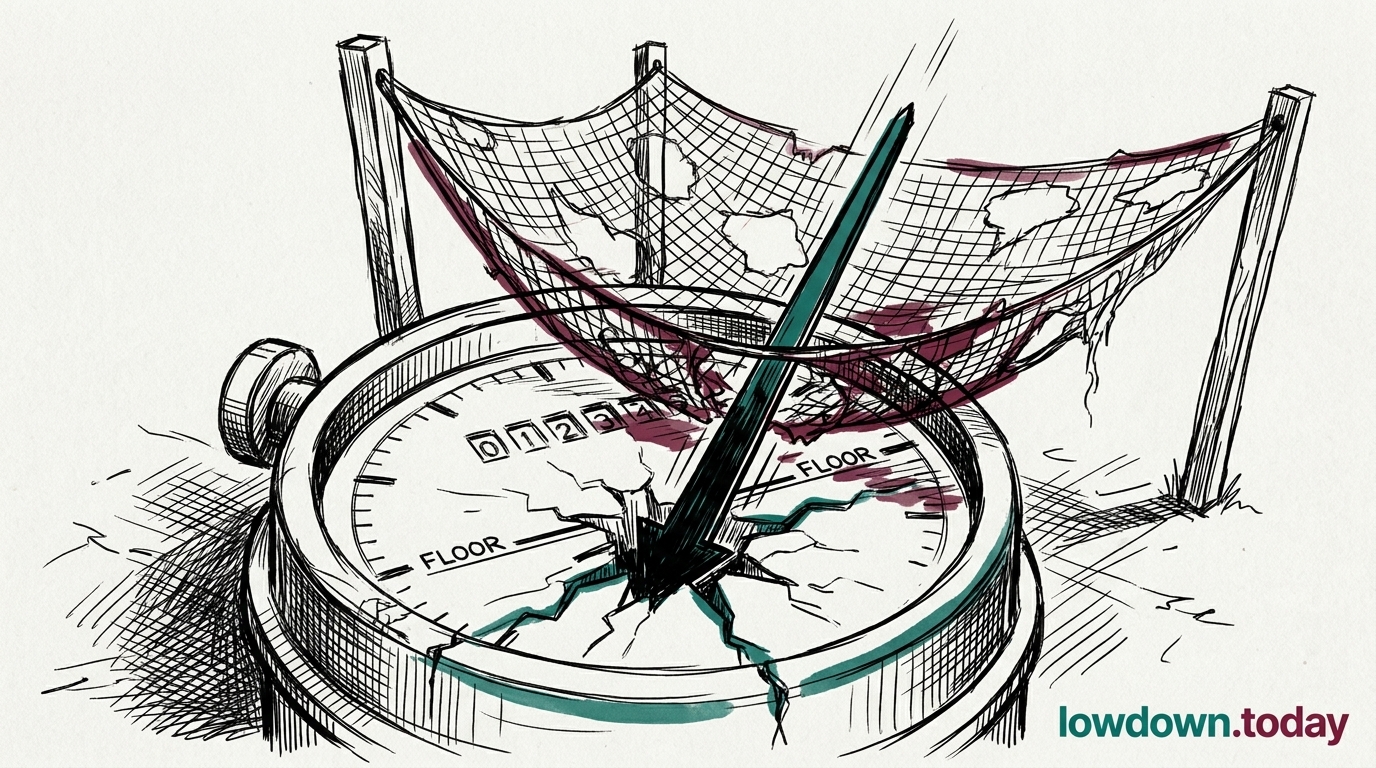
At the G7 summit in France on Wednesday 17 June, Narendra Modi raised with Donald Trump directly the killing of three Indian seafarers who died under US Navy fire in the Hormuz zone . India had already lodged two formal protests over the deaths . Modi also pressed the trade damage: 90 per cent of India's liquefied petroleum gas and 55 per cent of its crude transited Hormuz before the war, and he warned of a "trust deficit" between the two governments 1. The two men exchanged a restrained greeting, no embrace.

Trump answered none of it. He offered no apology for the sailors, announced no investigation or compensation, signed no tariff relief and made no concession on Iran-routed crude. For a president who had just signed a war to a close, the ledger at the table with the war's most aggrieved neutral party was empty.

The summit itself ended without a joint communique, the body's first such failure in recent memory, and Trump left early as the Iran deal moved . The split was over Iran: G7 members could not agree a common line on a deal whose own text remains unpublished. India sits outside the G7 but supplies the clearest measure of the blockade's cost, and Modi chose to carry that measure straight to the man who ordered the fleet that caused it. He got a handshake and no instrument in return.


Deep Analysis

In plain English

Three Indian sailors died when the US Navy fired on their ship in the Hormuz zone. At the G7 summit in France on 17 June, India's Prime Minister Modi raised this directly with Trump. Modi also pointed out that India imports 90 per cent of its cooking gas and 55 per cent of its crude oil through the strait the US has been blockading. Trump offered no apology, no promise of investigation, and no compensation. Modi's government had already filed two formal protests. The G7 itself ended without a joint communique, which is the summit's main output. India's bill went unpaid at the meeting where Modi came specifically to present it.

What could happen next?
  • Consequence

    Modi's public framing of a US-India trust deficit, without any US response, gives China and Russia a documented example to circulate in Global South forums that US military action in Hormuz carries no accountability to third countries.

  • Risk

    If the 19 June Geneva ceremony does not produce a timeline for Hormuz reopening, India may move toward bilateral LPG and crude contracts with Central Asian and Russian suppliers, accelerating de-dollarisation of its energy imports.

First Reported In

Update #130 · Trump signed the war over; it kept going

Washington Post· 17 Jun 2026
Read original
Different Perspectives
Spain's LNG terminal operators
Spain's 9,145 GWh terminal inventory is the largest single stock in the EU LNG network, an option value that can reroute cargoes wherever the winter strip pays best rather than a cavern gas obligation tied to a fixed date. That flexibility matters more as Germany's cavern shortfall pushes more of the winter security question onto import infrastructure.
European Commission
European Commission
Brussels holds the bloc to 90% on a flexible window while Germany, holding roughly a quarter of EU storage capacity, tracks toward missing its own lower 80% figure by 21 points. A national shortfall this size in the anchor market matters more to bloc security than the flexible timetable alone can absorb.
French power exporters and CRE
French day-ahead rose in step with Germany but by less, reopening a EUR 7-17 premium that makes northward export flows commercially attractive again after the EUR 43.09 discount evaporated in days. CRE separately authorised RTE and Enedis to buy flexibility locally, betting the coming winter's binding constraint is grid congestion rather than a shortage of firm capacity.
TTF trading desk
TTF trading desk
A visible national shortfall like Germany's 21-point gap is a directional signal, not noise, for a desk holding the summer-winter spread. TTF's flat EUR 58-60 range through this week's German price swings says the market has not yet chosen to reprice refill risk into the front of the curve.
German cavern and CCGT operators
German caverns kept buying prompt gas at TTF near EUR 58-60 through the inversion; the wind collapse to 2.4 GW then flipped the spark spread to plus EUR 29 and put turbines back in the same queue. Every day turbines win that bid, injection at a third of the 877 GWh/day pace needed falls further behind.
Slovakia
Slovakia
Slovakia says it dropped its hold-out on the 21st sanctions package only after Ursula von der Leyen personally signed written gas-price and supply guarantees. The Council of the European Union's own 17,238-character release on the package names neither Slovakia nor any guarantee, leaving Bratislava's account unconfirmed by the institutional record.



