Skip to content
You can now search across every topic, entity and event.What's new
European Energy Markets
15JUN

Brent at $94.79: markets price the gap

3 min read
12:23UTC

Lowdown Newsroom

EconomicDeveloping
Key takeaway

Brent has priced partial enforcement and two catalysts this week can move it either way.

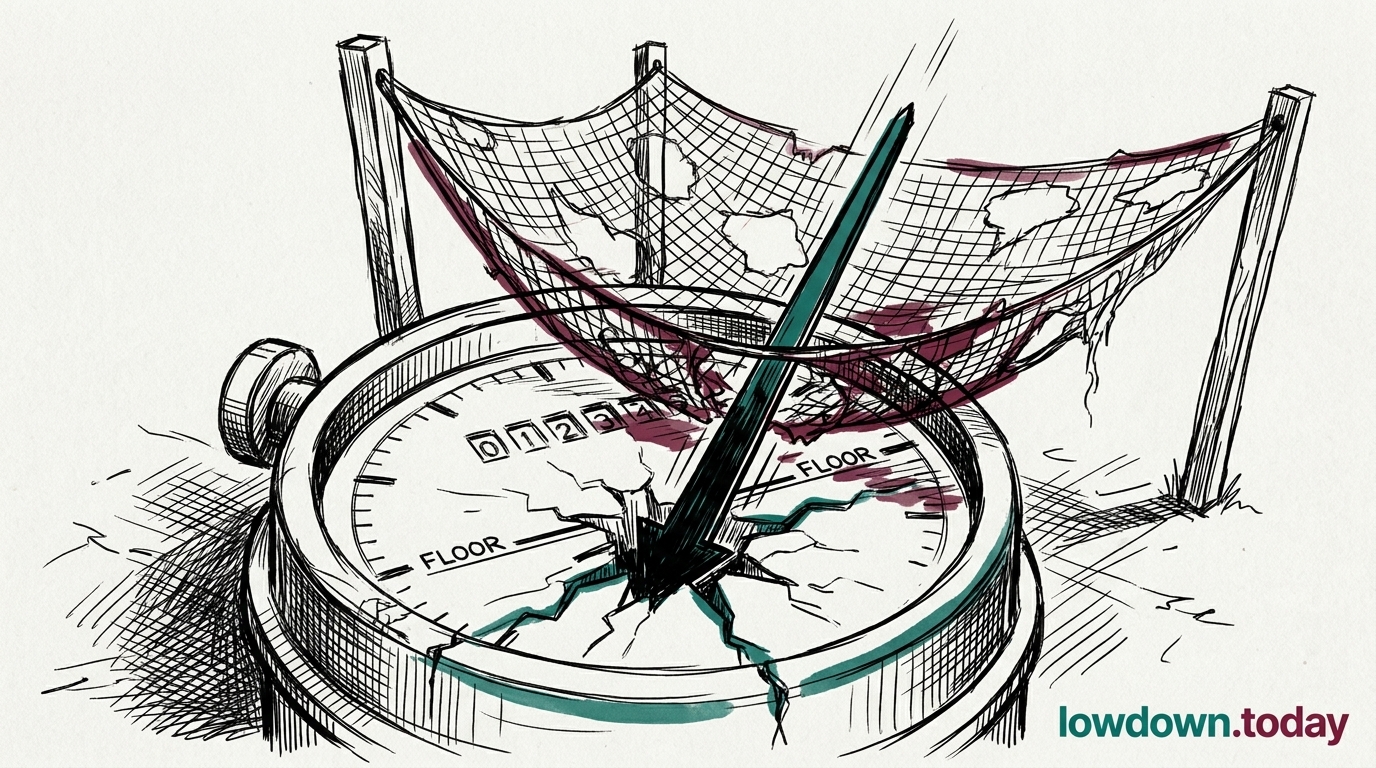
Brent Crude closed at $94.79 on Tuesday, down from the blockade-day peak in the previous session , still roughly two-fifths above the pre-war baseline. The move is consistent with traders watching the operational order rather than the admiral's lectern. Interdiction of Iranian-port traffic is priced in; the continuing carve-out for sanctioned non-Iranian-port tankers, documented when Windward tracked sanctioned dark-fleet vessels using scrapped ship identities , caps the upside by keeping partial supply flowing.

For drivers and consumers, that premium is what a partial blockade feels like at the pump. Brent has held in a narrow band this week because neither a full-closure path nor a resolution path is the base case. Two catalysts inside the coming week could shift the balance. The sanctions licence expiring mid-week, covered in the Senate vote cluster above, would tip enforcement risk sharply higher if Treasury lets it lapse without a successor; a spike back through Monday's peak is the likely response. A credible multilateral Hormuz framework published out of the Paris summit on Friday would tip the other way; a pullback towards the eighties becomes plausible.

Both catalysts arrive before the weekend. The dual-chokepoint scenario, a Houthi closure of Bab el-Mandeb on top of a continued Hormuz operation, is not priced at all. If it becomes a planning variable rather than a rhetorical threat, the repricing towards the deep triple-digit range would not be gradual.


Deep Analysis

In plain English

Brent crude; the main global price for oil; closed at about $95 on 14 April. That is 40 per cent above where it was before the Iran war started, but it has also come down from above $103 when the blockade was first announced. The price is stuck in the middle because markets are pricing a partial blockade: some ships are being stopped, some are getting through. Two things could move it significantly this week. On Sunday (19 April), a US government permit that legally allowed certain ships to deliver Iranian oil expires. If the US government does not renew it, about 325 tankers suddenly face legal problems with their cargoes; and oil prices could spike. But if France and the UK's conference on Friday produces a credible plan to reopen the strait after the war, prices could fall. The market is watching both events and has not yet committed to a direction.

Deep Analysis
Root Causes

Oil markets price the scenario they can model. The $94 band reflects a market that can see the CENTCOM operational order's carve-out (published, verifiable) but cannot see the GL-U renewal decision (unpublished, unannounced).

The 28 days of Treasury silence on Iran sanctions is the structurally anomalous element: OFAC routinely signals general licence renewals 10-15 days in advance; the absence of any signal four days before expiry is unusual enough to embed a non-renewal risk premium in Brent that has not yet fully resolved into price.

The deeper structural driver is that the blockade was announced without a sanctions architecture to match: GL-U was issued before the blockade, authorising the same oil the blockade aims to stop. The logical contradiction; a general licence enabling delivery of Iranian oil during a declared blockade; was never resolved in print, and Treasury's silence means it remains unresolved.

What could happen next?
  • Risk

    GL-U lapse without Treasury successor on 19 April triggers a $10-15 Brent spike as 325 tankers' legal cover evaporates, potentially reaching $104-109 by 20 April

    Immediate · 0.7
  • Opportunity

    A credible Macron-Starmer summit framework on 17 April provides the first post-war resolution pathway markets can price, likely pulling Brent toward $82-88 in a 60-day scenario

    Short term · 0.65
  • Risk

    Dual-chokepoint scenario; Houthi Bab el-Mandeb activation on top of partial Hormuz closure; remains entirely unpriced in the $94 band, implying catastrophic repricing to $130-150 if it materialises

    Medium term · 0.55
First Reported In

Update #69 · Cooper joins the instrument gap

Reuters Commodities· 15 Apr 2026
Read original
Different Perspectives
Spain's LNG terminal operators
Spain's 9,145 GWh terminal inventory is the largest single stock in the EU LNG network, an option value that can reroute cargoes wherever the winter strip pays best rather than a cavern gas obligation tied to a fixed date. That flexibility matters more as Germany's cavern shortfall pushes more of the winter security question onto import infrastructure.
European Commission
European Commission
Brussels holds the bloc to 90% on a flexible window while Germany, holding roughly a quarter of EU storage capacity, tracks toward missing its own lower 80% figure by 21 points. A national shortfall this size in the anchor market matters more to bloc security than the flexible timetable alone can absorb.
French power exporters and CRE
French day-ahead rose in step with Germany but by less, reopening a EUR 7-17 premium that makes northward export flows commercially attractive again after the EUR 43.09 discount evaporated in days. CRE separately authorised RTE and Enedis to buy flexibility locally, betting the coming winter's binding constraint is grid congestion rather than a shortage of firm capacity.
TTF trading desk
TTF trading desk
A visible national shortfall like Germany's 21-point gap is a directional signal, not noise, for a desk holding the summer-winter spread. TTF's flat EUR 58-60 range through this week's German price swings says the market has not yet chosen to reprice refill risk into the front of the curve.
German cavern and CCGT operators
German caverns kept buying prompt gas at TTF near EUR 58-60 through the inversion; the wind collapse to 2.4 GW then flipped the spark spread to plus EUR 29 and put turbines back in the same queue. Every day turbines win that bid, injection at a third of the 877 GWh/day pace needed falls further behind.
Slovakia
Slovakia
Slovakia says it dropped its hold-out on the 21st sanctions package only after Ursula von der Leyen personally signed written gas-price and supply guarantees. The Council of the European Union's own 17,238-character release on the package names neither Slovakia nor any guarantee, leaving Bratislava's account unconfirmed by the institutional record.



