Skip to content
Briefings are running a touch slower this week while we rebuild the foundations.See roadmap
European Energy Markets
4JUN

Serbia intercepted 4kg TurkStream bomb plot

3 min read
10:45UTC

Serbian authorities found plastic explosives metres from the Balkan Stream pipeline on 5 April; Hungary has since deployed the army.

EconomicDeveloping
Key takeaway

The last Russian pipeline leg survived a bomb attempt ten days before the LNG leg ends.

On 5 April 2026, Serbian authorities found two backpacks containing roughly 4 kg of plastic explosives, detonator caps and cord metres from the Balkan Stream pipeline near the village of Velebit in northern Serbia, a TurkStream offshoot carrying Russian gas through the Western Balkans 1. Hungary has since deployed its army to protect the Serbia-to-Slovakia segment, and Russia, Turkey, Serbia and Hungary have agreed a joint protection framework. Ukraine denied involvement; Serbian intelligence briefed that US-made explosives were recovered and pointed to a migrant with military training.

TurkStream carries roughly 15 bcm per year to Hungary, Slovakia, Czech Republic and Austria and is the sole remaining Russian pipeline route to central Europe since Ukraine transit ended. Against a shallow aggregate storage fill and the 25 April LNG ban closing the other Russian leg, a successful attack on the 5th would have removed both Russian supply routes in the same week. The intercept is the reason the system did not run that test.

The analytical read is not that Balkan Stream is safer today than it was on 4 April. Pipeline protection on a line that runs through four jurisdictions with varied standards cannot be hardened uniformly by one national deployment. The intercepted plot shows capability and intent against one segment; the route length means the vector count is larger than the vector just addressed.

TTF pricing is not carrying that tail. Implied vol on late-April TTF options is cheap relative to the physical state of the system: a Hormuz ceasefire expiry, a Russian LNG cutoff and an intercepted pipeline sabotage plot sitting inside the same ten-day window. The counter-view is that the plot was caught and protection has been hardened; that is correct for the specific vector, not for the category.


Deep Analysis

In plain English

TurkStream is a gas pipeline that runs from Russia through Turkey and then north through Serbia and Hungary, carrying gas to central European countries that no longer receive it through Ukraine. It is the last active Russian gas pipeline into Europe after the Ukraine transit route shut down in early 2025. On 5 April, Serbian police found 4 kilograms of plastic explosives hidden near the pipeline close to a village called Velebit. That is enough to damage the pipeline significantly. Nobody has admitted placing them. In response, Hungary sent its army to protect its section of the pipeline, and Russia, Turkey, Serbia, and Hungary agreed a joint protection arrangement. The four countries involved in protecting the pipeline are a mix of NATO members and non-NATO states, which makes the arrangement politically unusual.

Deep Analysis
Root Causes

TurkStream's vulnerability is structural. The pipeline was designed and built after 2017 as a specifically NATO-circumventing route: it enters European territory through Turkey (a NATO member but one with independent energy policy) and transits Serbia, which has EU candidate status but is not a member. The Serbian and Hungarian segments have no EU-level protection framework, relying entirely on bilateral host-country arrangements.

The absence of attribution for the explosives is itself a structural indicator. Ukraine denied involvement; no other actor claimed responsibility. The 4 kg of plastic explosive is below the threshold that would guarantee pipeline destruction but above what would be needed to trigger a protection-framework demand. The incident has the operational signature of a pressure tactic rather than a genuine interdiction attempt.

What could happen next?
  • Precedent

    Hungary's army deployment to protect Russian pipeline infrastructure creates the first instance of a NATO member providing ground-force security for Russian-origin energy assets in Europe since 2022.

  • Risk

    If the explosives originated from a state actor seeking to force Hungary and Slovakia into dependency on LNG alternatives (thus removing their political leverage within the EU), further interception attempts may follow to test the protection framework's deterrence.

First Reported In

Update #2 · TTF EUR 42 as Russian LNG ban enters range

Euronews· 15 Apr 2026
Read original
Different Perspectives
TTF traders / Amsterdam hub desks
TTF broke its 38-session EUR 46-47 band on 2 June to EUR 48.9 on stalled Iran diplomacy and an unconfirmed Troll A restart; Dutch EBN mandates carry storage trajectory while commercial injection books nothing. The 17 June pipeline expiry is the next binary level: Central European hub premium above EUR 2/MWh widens sharply on any physical step-down.
Red Electrica / Spanish grid operators
Spain logged 397 negative-price hours in Q1 2026, eight times the 48 hours of Q1 2025, documenting midday solar surplus now embedding structurally into Continental pricing. Spain is four to six quarters ahead of France and Germany on the solar-penetration curve, making it the clearest forward indicator of where Continental midday clearing is heading.
Equinor
Equinor
Equinor issued no Troll A restart notice through 4 June despite extending the combined outage to 31 May, keeping up to 51 mcm/day of Norwegian supply offline alongside Hammerfest LNG dark since 22 April. The company's silence follows its 2025 Hammerfest pattern, which ran 24 days past target, and each day without a notice sustains the TTF supply premium.
European Commission / GMTF
SWD(2026)147 found EU gas spot and derivatives markets functioning well on 2 June, recommending MiFID-REMIT legislative alignment rather than emergency intervention. The GMTF verdict addressed derivatives-market integrity, not the physical injection mechanism FNB Gas declared broken five days earlier: the Commission's immediate next step is a legislative proposal, not an emergency storage order.
FNB Gas / Bundesnetzagentur
FNB Gas declared the storage-refill mechanism broken on 27 May after zero bookings in January 2026 auctions, and German day-ahead cleared EUR 102.64 on 3 June on a CCGT stack set by TTF near EUR 49 plus EUA near EUR 78. Winter storage fill now depends on state mandates with no commercial self-correction.
EDF / French government
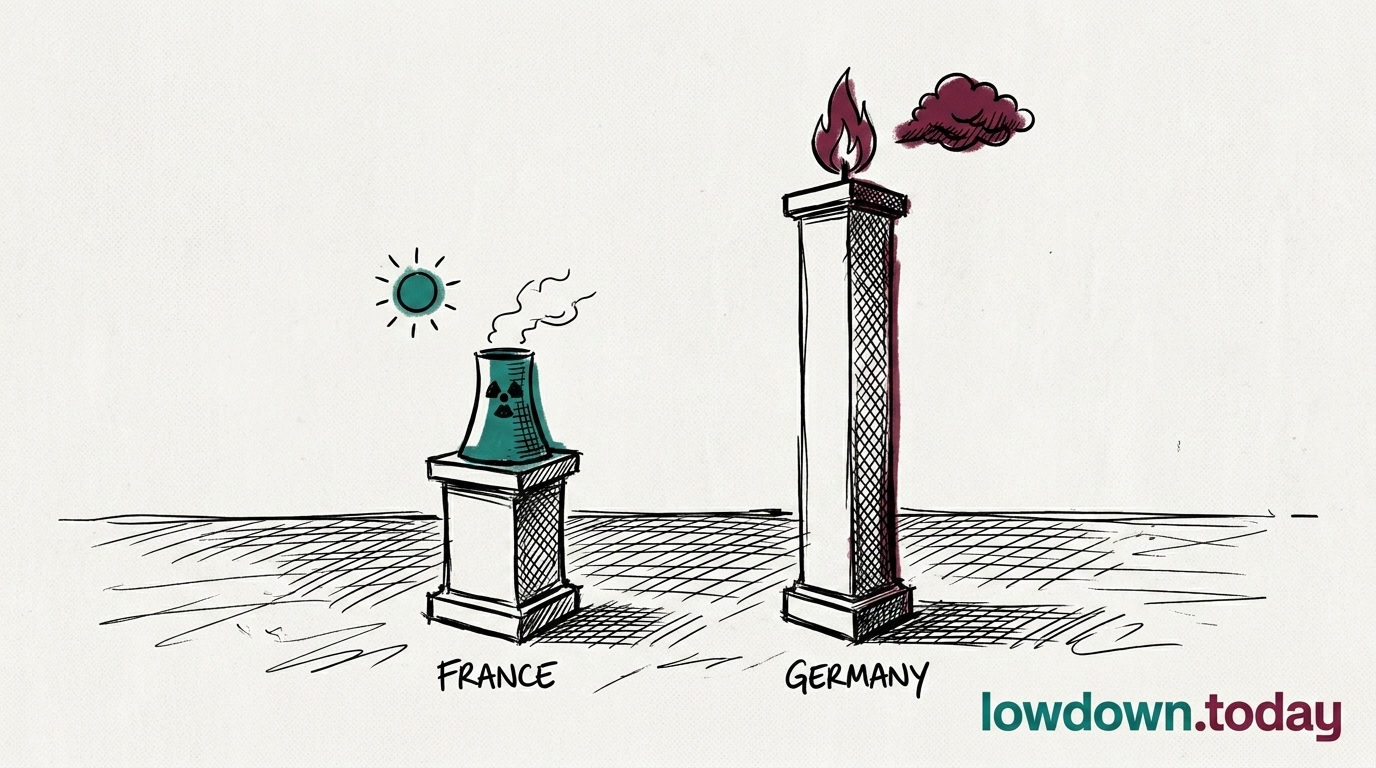
EDF held full-year nuclear guidance at 350-370 TWh after April output of 29.3 TWh, anchoring the surplus that collapsed French day-ahead to EUR 8.96 on 3 June and passed that price to VNU industrials. Flamanville-3's September overhaul removes 1.6 GW at heating-season onset, reversing the nuclear surplus that made VNU pricing competitive.
