Skip to content
Briefings are running a touch slower this week while we rebuild the foundations.See roadmap
European Energy Markets
4JUN

Final pre-conflict Qatari LNG tanker docks UK

2 min read
10:45UTC

The last Qatari LNG tanker loaded before the Hormuz closure docked in the UK on 10 April; 150 laden oil tankers remain trapped in the Gulf and the projected minimum delay before normal flows resume is 90 days.

EconomicDeveloping
Key takeaway

Europe's pre-conflict Qatari LNG supply bridge closed on 10 April; the 90-day clock is the primary forward parameter.

The final pre-conflict QatarEnergy LNG tanker docked at a UK terminal on 10 April 2026, closing the pre-conflict supply bridge 1. 150 laden oil tankers remain trapped in the Gulf; 277 LNG vessels have reached Europe since the war began, and a 90-day minimum delay is projected before normal Gulf flows resume 2.

QatarEnergy is the Qatari national energy company operating Ras Laffan Industrial City, the world's largest LNG export terminal and the origin of roughly 20% of global LNG supply in a normal year. From 11 April onward, every LNG molecule reaching a European terminal is Atlantic-sourced or from non-Hormuz origins. That is not a partial disruption to the European import picture; it is a regime change in cargo provenance.

The 90-day window anchors the operational calendar. It overlaps with Equinor's planned Hammerfest restart, meaning two of Europe's flexible supply offsets sit absent through the peak of the refill season. Any slippage on either schedule extends the overlap. EU LNG terminal inventory was already drawing 163kt in three days to 5,766kt on 13 April with no evident new cargo arrivals; terminal buffer now functions as the marginal supplier rather than incoming cargo.

The Atlantic-only regime has its own constraints. Flexible Atlantic cargoes route by JKM-TTF spread rather than by policy preference, and at prevailing TTF levels the spread does not favour a European bias. The marginal supply response to a European price signal is slower under an Atlantic-only regime. QatarEnergy declared force majeure after Ras Laffan was struck in the March disruption; subsequent resumption timing depends on the ceasefire window on 21-22 April and on infrastructure assessment that cannot begin until the security picture stabilises. For procurement desks, the 90-day clock is now the primary supply input and the reference parameter against which every other element of the 22-29 April stack has to be judged.


Deep Analysis

In plain English

Before the conflict closed the Strait of Hormuz, Qatar was shipping large quantities of gas in liquid form (LNG) to Europe and other customers worldwide. The last tanker loaded before the closure docked in the United Kingdom on 10 April. From that point, Europe can no longer receive gas from Qatar one of the world's largest gas exporters. Instead, Europe must rely entirely on gas from elsewhere: the United States, Norway, Algeria, and other countries not dependent on the Hormuz shipping route. Experts estimate it will take at least 90 days after the conflict ends before Qatar can get its gas flowing again meaning even a ceasefire tomorrow would not restore Qatari gas to European markets until mid-summer.

Deep Analysis
Root Causes

The 90-day minimum delay before normal Gulf flows can resume reflects a sequencing constraint specific to LNG export infrastructure. Before QatarEnergy can resume loading, Ras Laffan requires a physical safety assessment of the LNG storage tanks, jetty structures, and export pipelines a process that takes weeks even under favourable conditions.

Tanker scheduling then requires repositioning of vessels from alternative routes, reactivation of long-term charter agreements, and re-coordination with buyer terminals on berth availability. These logistics cannot be compressed below a physical minimum.

The 150 laden oil tankers still trapped in the Gulf are a secondary market signal: their cargo represents approximately 1.5-2 days of global oil consumption sitting inaccessible. Any ceasefire-induced release of those vessels will produce a temporary oil price drop and potentially a short-covering squeeze in gas futures, creating a mixed signal in the screens that experienced desks will have to disentangle from genuine supply improvement.

What could happen next?
  • Consequence

    Europe has entered an Atlantic-only LNG supply regime from 11 April, making every subsequent cargo's routing decision a function of JKM-TTF spreads rather than long-term contract commitments.

  • Risk

    The 90-day clock runs from resumption of Ras Laffan activity, not from the ceasefire date; any ceasefire delay extends the Atlantic-only regime proportionally into the second half of the injection season.

First Reported In

Update #3 · TTF holds six-week low as supply stack hardens

Euronews· 17 Apr 2026
Read original
Causes and effects
This Event
Final pre-conflict Qatari LNG tanker docks UK
From 11 April onward every LNG molecule reaching Europe is Atlantic-sourced or non-Hormuz, closing the pre-conflict supply bridge at the peak of the injection window.
Different Perspectives
TTF traders / Amsterdam hub desks
TTF broke its 38-session EUR 46-47 band on 2 June to EUR 48.9 on stalled Iran diplomacy and an unconfirmed Troll A restart; Dutch EBN mandates carry storage trajectory while commercial injection books nothing. The 17 June pipeline expiry is the next binary level: Central European hub premium above EUR 2/MWh widens sharply on any physical step-down.
Red Electrica / Spanish grid operators
Spain logged 397 negative-price hours in Q1 2026, eight times the 48 hours of Q1 2025, documenting midday solar surplus now embedding structurally into Continental pricing. Spain is four to six quarters ahead of France and Germany on the solar-penetration curve, making it the clearest forward indicator of where Continental midday clearing is heading.
Equinor
Equinor
Equinor issued no Troll A restart notice through 4 June despite extending the combined outage to 31 May, keeping up to 51 mcm/day of Norwegian supply offline alongside Hammerfest LNG dark since 22 April. The company's silence follows its 2025 Hammerfest pattern, which ran 24 days past target, and each day without a notice sustains the TTF supply premium.
European Commission / GMTF
SWD(2026)147 found EU gas spot and derivatives markets functioning well on 2 June, recommending MiFID-REMIT legislative alignment rather than emergency intervention. The GMTF verdict addressed derivatives-market integrity, not the physical injection mechanism FNB Gas declared broken five days earlier: the Commission's immediate next step is a legislative proposal, not an emergency storage order.
FNB Gas / Bundesnetzagentur
FNB Gas declared the storage-refill mechanism broken on 27 May after zero bookings in January 2026 auctions, and German day-ahead cleared EUR 102.64 on 3 June on a CCGT stack set by TTF near EUR 49 plus EUA near EUR 78. Winter storage fill now depends on state mandates with no commercial self-correction.
EDF / French government
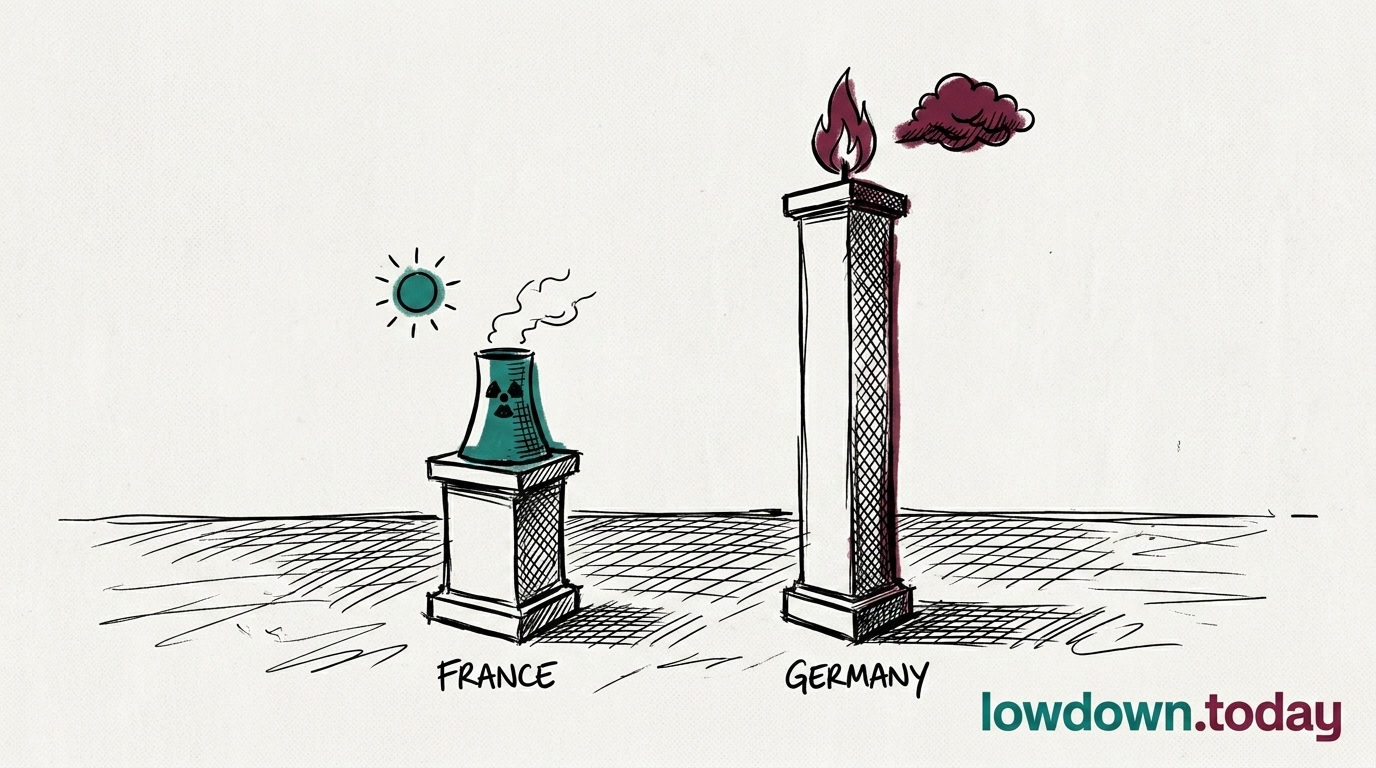
EDF held full-year nuclear guidance at 350-370 TWh after April output of 29.3 TWh, anchoring the surplus that collapsed French day-ahead to EUR 8.96 on 3 June and passed that price to VNU industrials. Flamanville-3's September overhaul removes 1.6 GW at heating-season onset, reversing the nuclear surplus that made VNU pricing competitive.
