Skip to content
Briefings are running a touch slower this week while we rebuild the foundations.See roadmap
European Energy Markets
4JUN

EU LNG terminals drew 163kt in three days

2 min read
10:45UTC

Terminal stocks funded the marginal molecule into pipeline storage as Atlantic cargoes kept missing the basin.

EconomicDeveloping
Key takeaway

Terminal stocks are now the marginal supplier; the buffer is finite and shrinking.

Gas Infrastructure Europe's ALSI (Aggregated LNG Storage Inventory, the terminal-stocks companion to AGSI+) showed aggregate EU terminal inventory falling from 5,929 thousand tonnes on 10 April to 5,766 thousand tonnes on 13 April, a draw of 163 kt over three days 1. Daily send-out averaged 4,348 GWh, with no evident new cargo arrivals landing in the window.

Around a dozen Atlantic LNG cargoes had already diverted to Asia since early March , compressing the JKM-TTF spread to near parity and removing the arbitrage that would ordinarily pull reload cargoes back into European terminals. QatarEnergy's Ras Laffan force majeure takes out the other direction of flexible supply. With Atlantic inflow thin and Qatari inflow blocked, terminal buffer is the only variable left, and it is being drawn at roughly 50 kt per day to keep pipeline send-out steady.

That dynamic has a short runway. ALSI carries finite stock, and drawing it during peak reload season means Europe enters May with a thinner LNG cushion against any late-April supply shock. With the Russian LNG cutoff arriving on 25 April and no replacement supply publicly named, the buffer question becomes a May question rather than a June one.


Deep Analysis

In plain English

LNG, liquefied natural gas, arrives at European ports as a super-cooled liquid in specialised tankers. It is stored at coastal terminals before being sent inland through pipelines as regular gas. Think of the terminals as the first link in the chain between ships arriving from Qatar, the US, or Nigeria, and the heating systems of European homes. Between 10 and 13 April, EU terminals collectively drew down their stocks by 163,000 tonnes in three days, and no new tankers appear to have docked to refill them. That is because LNG ships have been diverting from Europe to Asia, where buyers are paying slightly more. European terminals were funding their pipeline obligations by drawing on reserves, not new deliveries.

What could happen next?
  • Risk

    The Russian LNG ban on 25 April removes a portion of the terminal replenishment flow while injection season demand for send-out rises, accelerating the terminal drawdown rate beyond the current 54 kt/day.

First Reported In

Update #2 · TTF EUR 42 as Russian LNG ban enters range

Gas Infrastructure Europe· 15 Apr 2026
Read original
Causes and effects
Different Perspectives
TTF traders / Amsterdam hub desks
TTF broke its 38-session EUR 46-47 band on 2 June to EUR 48.9 on stalled Iran diplomacy and an unconfirmed Troll A restart; Dutch EBN mandates carry storage trajectory while commercial injection books nothing. The 17 June pipeline expiry is the next binary level: Central European hub premium above EUR 2/MWh widens sharply on any physical step-down.
Red Electrica / Spanish grid operators
Spain logged 397 negative-price hours in Q1 2026, eight times the 48 hours of Q1 2025, documenting midday solar surplus now embedding structurally into Continental pricing. Spain is four to six quarters ahead of France and Germany on the solar-penetration curve, making it the clearest forward indicator of where Continental midday clearing is heading.
Equinor
Equinor
Equinor issued no Troll A restart notice through 4 June despite extending the combined outage to 31 May, keeping up to 51 mcm/day of Norwegian supply offline alongside Hammerfest LNG dark since 22 April. The company's silence follows its 2025 Hammerfest pattern, which ran 24 days past target, and each day without a notice sustains the TTF supply premium.
European Commission / GMTF
SWD(2026)147 found EU gas spot and derivatives markets functioning well on 2 June, recommending MiFID-REMIT legislative alignment rather than emergency intervention. The GMTF verdict addressed derivatives-market integrity, not the physical injection mechanism FNB Gas declared broken five days earlier: the Commission's immediate next step is a legislative proposal, not an emergency storage order.
FNB Gas / Bundesnetzagentur
FNB Gas declared the storage-refill mechanism broken on 27 May after zero bookings in January 2026 auctions, and German day-ahead cleared EUR 102.64 on 3 June on a CCGT stack set by TTF near EUR 49 plus EUA near EUR 78. Winter storage fill now depends on state mandates with no commercial self-correction.
EDF / French government
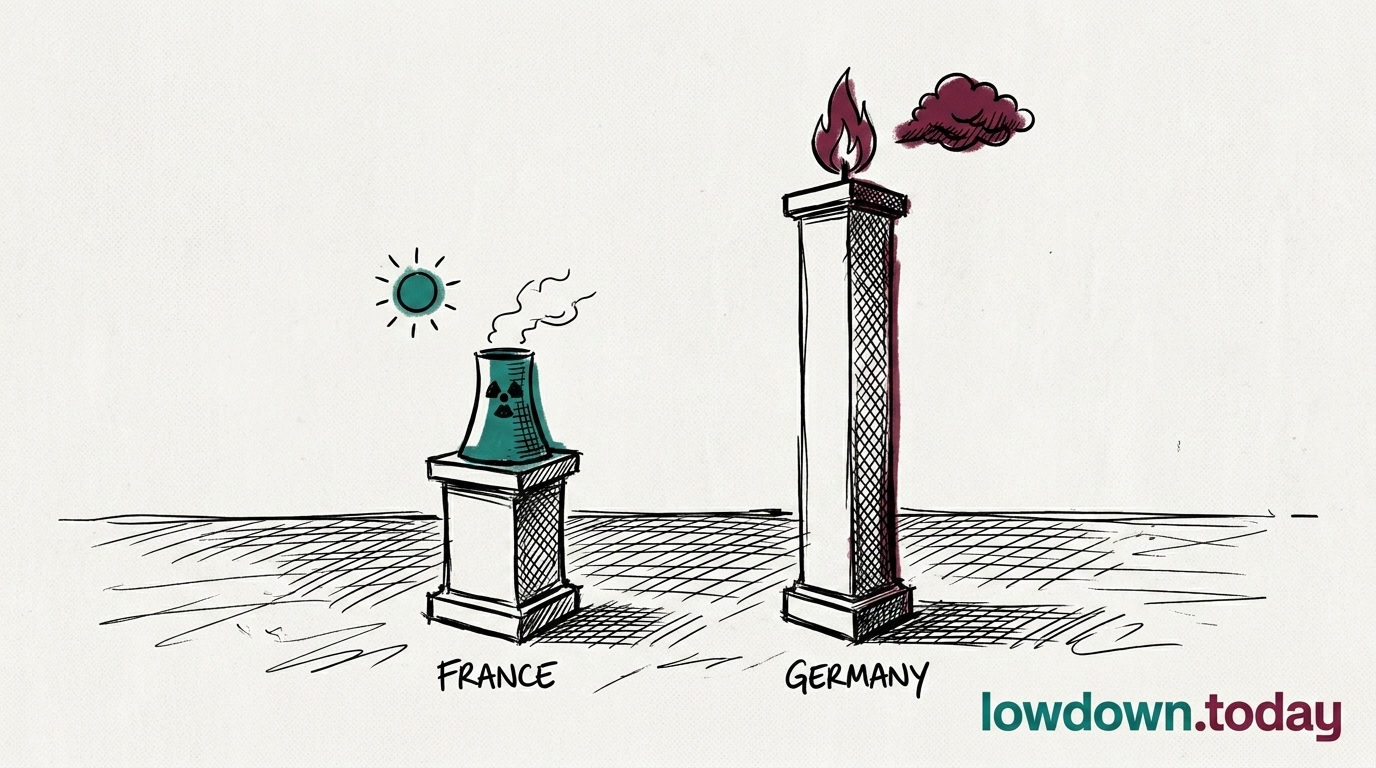
EDF held full-year nuclear guidance at 350-370 TWh after April output of 29.3 TWh, anchoring the surplus that collapsed French day-ahead to EUR 8.96 on 3 June and passed that price to VNU industrials. Flamanville-3's September overhaul removes 1.6 GW at heating-season onset, reversing the nuclear surplus that made VNU pricing competitive.
