Skip to content
Briefings are running a touch slower this week while we rebuild the foundations.See roadmap
European Energy Markets
4JUN

Spain logs 397 negative-price hours in Q1

3 min read
10:45UTC

Spain recorded 397 hours of negative day-ahead power prices in Q1 2026, eight times the 48 hours of Q1 2025, with the clean-spark squeeze now spreading north into the Continental midday stack.

EconomicDeveloping
Key takeaway

Spain's 397 negative-price hours confirm Iberian solar penetration is structural, now spreading north into the Continental midday stack.

Euronews reported that Spain logged 397 hours of negative day-ahead power prices in Q1 2026, eight times the 48 hours of Q1 2025 1. The 8x jump is not a heatwave artefact: it is a first-quarter reading from a window with no exceptional heat, the structural maturation of Spanish solar into a grid where baseload and midday demand have not adjusted fast enough to absorb the output. The CNMC blackout proceedings running in parallel underline that Iberian grid management already faces stress beyond price dynamics. For gas-fired operators the consequence is direct: midday clean spark spreads in Spain are now deeply negative, so CCGTs cannot clear on their own economics and must lean on capacity mechanisms or simply not run, while the overnight and morning windows still hold positive spark spread.

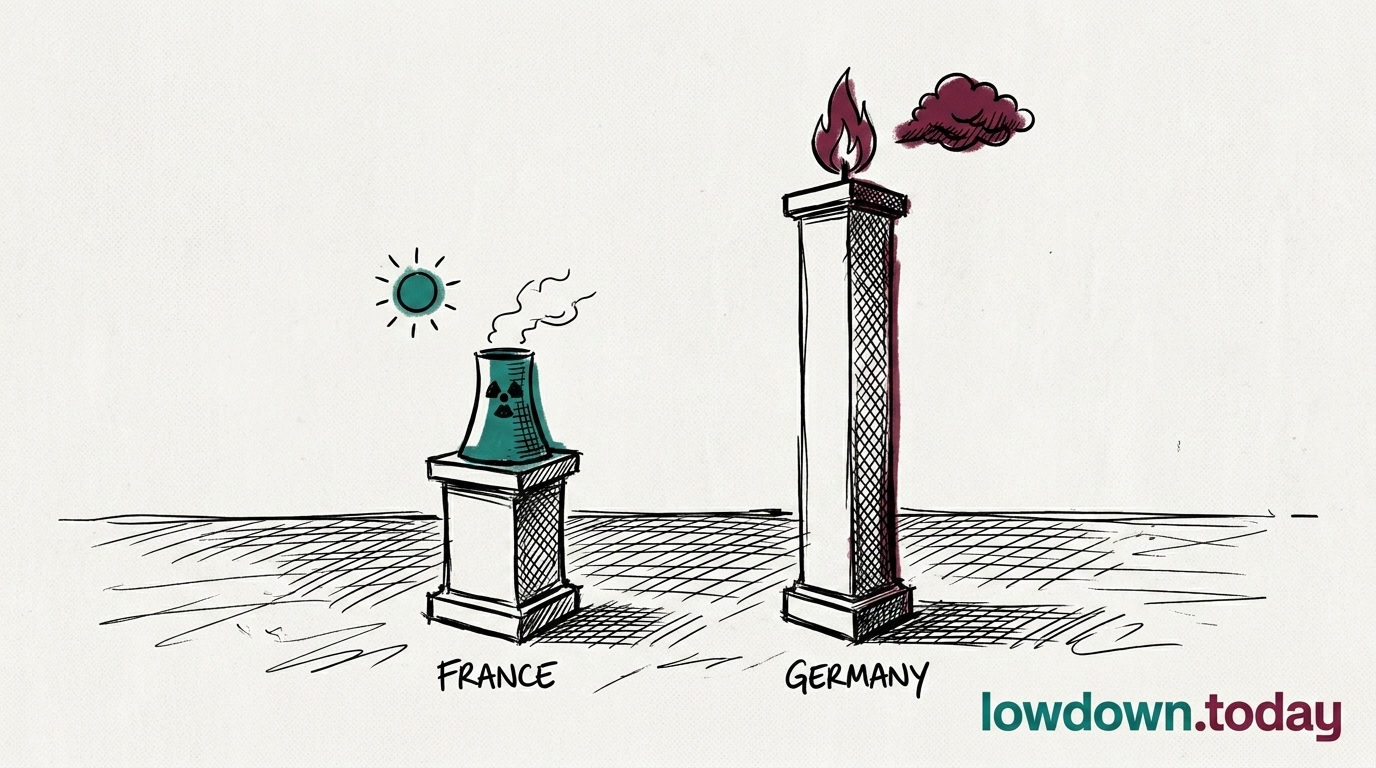
France's 3 June collapse into single digits gives the northward spread its sharper forward edge. That print is the first time the same mechanism has reached a market large enough to set the FR-DE spread record , and the Italy-Spain compression events of early May trace the same arc. As Germany adds solar under the Energiewende trajectory, the dynamic eventually reaches its grid too, collapsing the gas-set marginal unit during peak solar hours and compressing the FR-DE spread from the German side rather than the French. For Iberian desks the Q1 data recalibrates the negative-price premium in day-ahead options; for Continental desks it is a leading indicator the French print has just confirmed as present, not theoretical.


Deep Analysis

In plain English

Spain's electricity price went negative for 397 hours in the first three months of 2026, meaning suppliers had to pay buyers to take power rather than receive payment. This happened because solar panels generated far more electricity than Spain needed during midday hours , eight times more frequently than in the same period of 2025. When supply cannot be switched off and demand cannot absorb it, prices go below zero. The same pattern is now appearing in France and other northern European countries as solar capacity grows, with France recording its own extreme low of EUR 8.96 per megawatt-hour on 3 June 2026.

What could happen next?
  • Consequence

    Spanish gas-fired operators faced structurally uneconomic midday clean spark spreads for 18% of Q1 hours, accelerating dependence on capacity mechanism payments as a business-model backstop.

    Short term · Reported
  • Risk

    As solar penetration spreads north into France and Germany, Continental CCGT economics will face the same midday compression that Spanish operators encountered at scale in Q1 2026, undermining the investment case for new gas capacity across the EU.

    Medium term · Assessed
  • Opportunity

    Negative price hours create a structural commercial case for battery storage and demand-response aggregators in Spain; operators who can capture and discharge negative-price surplus during peak windows will capture the value that gas plants cannot.

    Medium term · Suggested
First Reported In

Update #15 · France EUR 9, Germany EUR 103: heat splits

Euronews· 4 Jun 2026
Read original
Causes and effects
This Event
Spain logs 397 negative-price hours in Q1
Spain's negative-price proliferation is the leading indicator of a solar-penetration squeeze spreading north: the midday surplus that collapsed French day-ahead into single digits on 3 June is the Continental expression of a phenomenon Spain hit at scale a quarter earlier.
Different Perspectives
TTF traders / Amsterdam hub desks
TTF broke its 38-session EUR 46-47 band on 2 June to EUR 48.9 on stalled Iran diplomacy and an unconfirmed Troll A restart; Dutch EBN mandates carry storage trajectory while commercial injection books nothing. The 17 June pipeline expiry is the next binary level: Central European hub premium above EUR 2/MWh widens sharply on any physical step-down.
Red Electrica / Spanish grid operators
Spain logged 397 negative-price hours in Q1 2026, eight times the 48 hours of Q1 2025, documenting midday solar surplus now embedding structurally into Continental pricing. Spain is four to six quarters ahead of France and Germany on the solar-penetration curve, making it the clearest forward indicator of where Continental midday clearing is heading.
Equinor
Equinor
Equinor issued no Troll A restart notice through 4 June despite extending the combined outage to 31 May, keeping up to 51 mcm/day of Norwegian supply offline alongside Hammerfest LNG dark since 22 April. The company's silence follows its 2025 Hammerfest pattern, which ran 24 days past target, and each day without a notice sustains the TTF supply premium.
European Commission / GMTF
SWD(2026)147 found EU gas spot and derivatives markets functioning well on 2 June, recommending MiFID-REMIT legislative alignment rather than emergency intervention. The GMTF verdict addressed derivatives-market integrity, not the physical injection mechanism FNB Gas declared broken five days earlier: the Commission's immediate next step is a legislative proposal, not an emergency storage order.
FNB Gas / Bundesnetzagentur
FNB Gas declared the storage-refill mechanism broken on 27 May after zero bookings in January 2026 auctions, and German day-ahead cleared EUR 102.64 on 3 June on a CCGT stack set by TTF near EUR 49 plus EUA near EUR 78. Winter storage fill now depends on state mandates with no commercial self-correction.
EDF / French government
EDF held full-year nuclear guidance at 350-370 TWh after April output of 29.3 TWh, anchoring the surplus that collapsed French day-ahead to EUR 8.96 on 3 June and passed that price to VNU industrials. Flamanville-3's September overhaul removes 1.6 GW at heating-season onset, reversing the nuclear surplus that made VNU pricing competitive.
