Flamanville-3
France's only EPR reactor; declared commercial 5 May 2026, one-year overhaul from September removes 1.6 GW.
Last refreshed: 26 June 2026 · Appears in 1 active topic
Is the Flamanville-3 overhaul a one-year plan or a multi-year first-of-class risk?
Timeline for Flamanville-3
Named as forward context for France's autumn nuclear capacity
European Energy Markets: Mentioned in: France holds cheaper leg, heat unwindsFrench reactors curtail on river heat
European Energy MarketsMentioned in: FR-DE day-ahead resets to Germany dearer
European Energy MarketsMentioned in: France-Germany spread sets €96.20 record
European Energy MarketsFrance €9, Germany €103: record spread
European Energy MarketsBackground
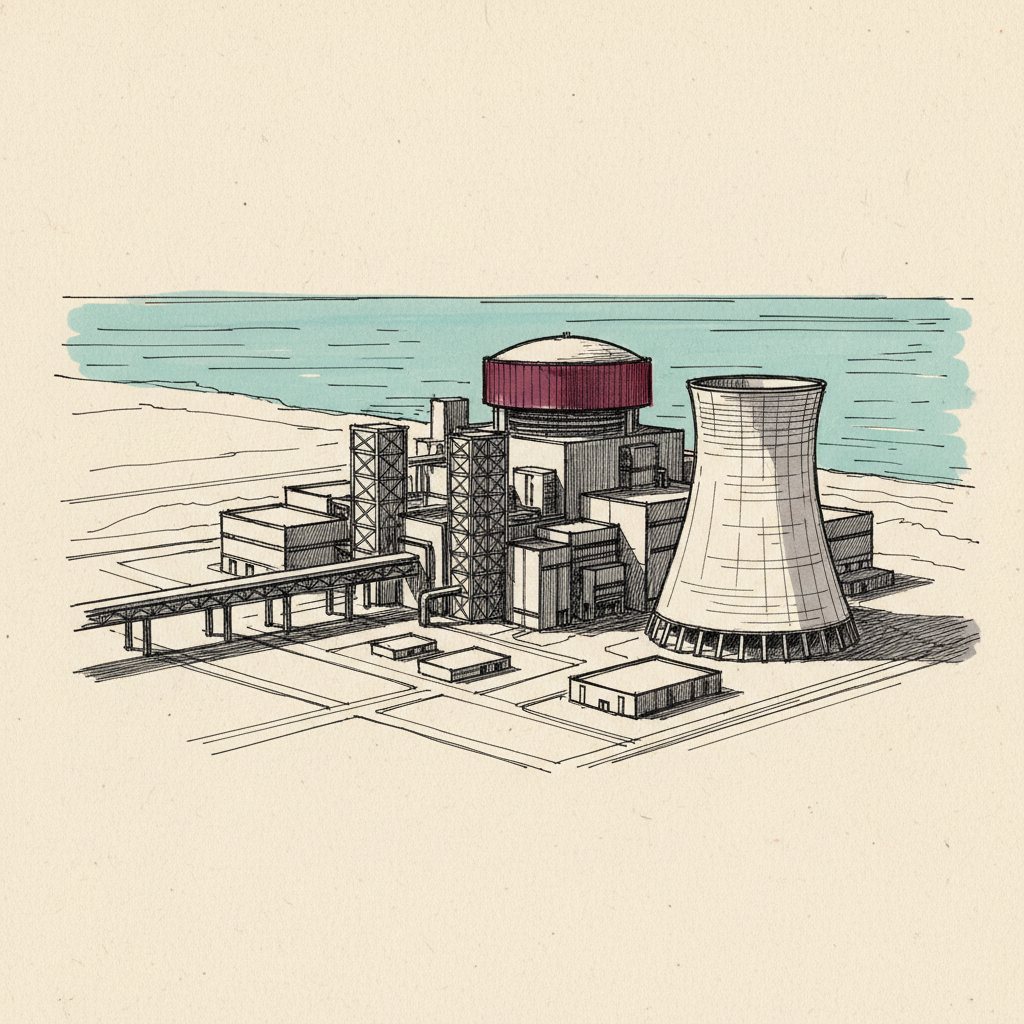
Flamanville-3 is France's first third-generation EPR pressurised water reactor, located at the Flamanville nuclear site in Normandy on the English Channel coast. After years of construction delays and cost overruns, it was connected to the grid in late 2024. The reactor has a design capacity of 1,650 MW and is operated by EDF. A major planned overhaul is scheduled to begin in September 2026 and is expected to last approximately one year, effectively removing the reactor from EDF's production base through most of the 2026-27 refill season.
Flamanville-3 was originally scheduled for completion in 2012 at a cost of €3.3 billion. The final cost exceeded €13 billion and completion was delayed by more than a decade, becoming a cautionary case study in nuclear project management cited by critics of new-build programmes across Europe and beyond.
Despite its operational challenges, the EPR design forms the basis of France's planned new-build programme: EDF has received government approval for up to six new EPR2 reactors (a refined design), with Penly as the first site. Flamanville-3's operational experience feeds directly into EPR2 engineering and regulatory approvals, making the current overhaul strategically as well as operationally significant for French energy policy.
EDF declared Flamanville-3 in commercial operation on 5 May 2026, formally ending the commissioning stage that began with first criticality on 12 December 2024. The reactor is contributing to the French nuclear surplus: on 3 June 2026 a midday solar surge into an already-nuclear-long grid collapsed French day-ahead to €8.96/MWh while Germany cleared at €102.64/MWh, a series-record FR-DE spread of €93.68/MWh. From September 2026, Flamanville-3 enters a one-year major overhaul, removing approximately 1.6 GW from France's nuclear fleet at the start of the heating season. This is the first maintenance cycle of this class for any EPR reactor; EDF has guided approximately one year but the absence of a prior EPR overhaul makes the one-year estimate a floor rather than a ceiling. The overhaul's risk profile was re-rated on 22-23 June 2026, when river-cooling curtailments forced Golfech and Nogent to reduce output, demonstrating that the French fleet is hydrology-fragile in summer heat. Flamanville-3's September departure therefore lands on a fleet already shown vulnerable to high river temperatures, not a clean single-asset outage: any summer 2027 heatwave during an extended overhaul would compound the supply shortfall across multiple sites simultaneously.
When is Flamanville 3 going offline in 2026?
How much did Flamanville 3 cost to build?
What is an EPR nuclear reactor?
When is Flamanville-3 going offline for overhaul?
How much did Flamanville-3 cost to build?
Why is Flamanville-3 different from other French nuclear reactors?
When did Flamanville-3 nuclear reactor start operating commercially?
What is the EPR reactor and why did Flamanville take so long to build?
How does the Flamanville-3 overhaul affect European electricity prices?
What is France's plan to build more nuclear reactors?
When did Flamanville-3 start operating commercially?
How long is the Flamanville-3 maintenance shutdown?
What is the EPR reactor at Flamanville and why did it cost so much?
Why do French nuclear reactors cut output in summer heat?

