Skip to content
Briefings are running a touch slower this week while we rebuild the foundations.See roadmap
European Energy Markets
18MAY

France-Germany May power spread doubles record

4 min read
11:11UTC

France May-26 baseload settled at EUR 21.80/MWh on 28 April against Germany at EUR 77.55/MWh, a EUR 55.75 spread that more than doubles Kpler's January 2025 record on the same calendar product.

EconomicAssessed
Key takeaway

The spread closes when Flamanville-3 starts its overhaul in September; until then interconnector capacity caps any earlier compression.

France May-26 baseload power settled at EUR 21.80/MWh on Tuesday 28 April, against Germany May-26 baseload at EUR 77.55/MWh 1. The EUR 55.75/MWh spread is more than double Kpler's January 2025 record of EUR 27.50 on the same calendar product, the highest forward gap between the two grids that the market has recorded.

EDF's March nuclear output ran at the highest level since 2019 and is still suppressing French forward Continental power into Q2. Germany's May-26 baseload is clearing on a gas-dominated merit order anchored to TTF at around EUR 44/MWh; France's is clearing on a fleet of pressurised water reactors running near nameplate. The Italy-France day-ahead spread hit EUR 153/MWh on 26 April on the same Continental nuclear-surplus dynamic at the cash level. Forward markets have absorbed the May-26 print over a week of trading without significant compression.

France-Germany cross-border physical interconnector capacity runs at roughly 4.8 GW under day-ahead market coupling, the structural bottleneck the headline does not show. Even at full nominal allocation, the cable cannot transfer enough French nuclear surplus to clear into German prices without merit-order shifts in Germany itself. The arbitrage cannot fully clear inside the physical network, so the financial spread persists. For French-sited industrial offtakers, that translates into roughly EUR 56,000 of monthly hedge advantage per MW of load against southern-Germany peers, with knock-on effects on cross-border manufacturing competitiveness in chemicals and metals through Q2-Q3.

The window has a defined close. Flamanville-3, EDF's newest reactor, enters its twelve-month overhaul in September 2026 , removing roughly 1.6 GW of French nuclear at the heating-season cusp. Forward strips that lean on French nuclear past Q3 are pricing through the September calendar, so the spread compression should land before the heating-season buyers do. RTE and CRE auction signals on cross-border interconnector allocation through May become the test of whether regulatory remedy is in scope before the physical fleet shift forces it.


Deep Analysis

In plain English

Wholesale electricity for May 2026 costs around EUR 22 per megawatt-hour in France and EUR 78 in Germany. France has cheap power because its nuclear plants are running flat-out, producing far more electricity than France needs. Germany relies heavily on gas-fired power plants; at EUR 44/MWh TTF, that pushes German clearing prices well above EUR 70/MWh. The cable connections between the two countries can't carry enough cheap French electricity east to bring German prices down. This gap is good news for French factories, which pay far less for electricity than their German competitors. It closes in September, when France's newest nuclear reactor goes into a planned overhaul for a year, and France will have less electricity to export.

What could happen next?
  • Consequence

    German-sited chemicals and metals producers face monthly hedge-cost disadvantages of tens of millions of euros versus French peers through Q2-Q3 2026, amplifying industrial competitiveness pressure ahead of autumn EU energy policy review.

  • Risk

    Forward sellers of French power for the period after September 2026 are pricing a 1.6 GW nuclear buffer that Flamanville-3's overhaul removes; if autumn demand is cold, French forward prices may reprice sharply upward as the overhaul start nears.

First Reported In

Update #6 · REMIT II live; storage instrument absent

Prestige Business Solutions· 29 Apr 2026
Read original
Different Perspectives
US LNG exporter (Sabine Pass / Corpus Christi)
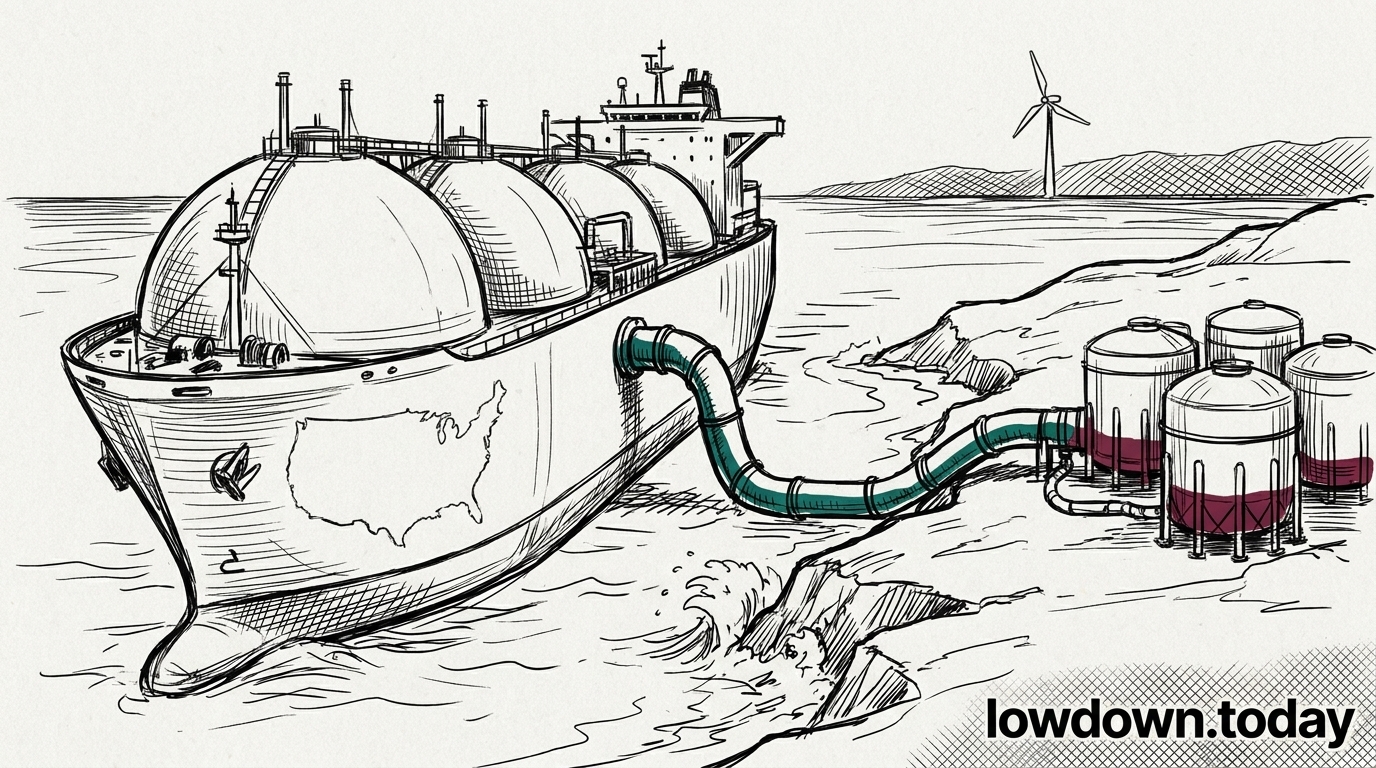
The 58% EU import share confirmed by ACER, heading toward 65% in 2026, represents a structural long-term offtake position that European terminal operators are now willing to underwrite against the German 2031 gas-demand floor. Ribera's warning lands inside a commercial relationship that is expanding, not contracting.
Teresa Ribera, European Commission EVP
Ribera warned Europe should 'avoid replacing one energy dependency with another', framing the ACER 58% US LNG figure as a supply-security risk in the same week TTF broke EUR 50. Her institution has spent EUR 117 billion on US LNG since 2022.
Yara International (ammonia producer)
Front-month TTF at EUR 50+ touches the demand-destruction threshold at which ammonia output curtailments have historically been triggered. Yara faces the same lock-or-ride binary as financial desks, but the downside is production loss rather than mark-to-market exposure.
Katherina Reiche, German Economy Minister
Reiche confirmed the 12 GW hydrogen-ready gas tender is formally agreed with the EU Commission, with first auctions in 2026 and all units operational by 2031. The confirmation closes three years of SPD environment-ministry obstruction and anchors German gas demand through the early 2030s.
European gas trader (Amsterdam desk)
The EUR 50 break is a watershed signal, not a squeeze: the forward curve at EUR 55.21 twelve months out implies the market has repriced structural winter risk, not a positioning overshoot. The lock-or-ride decision on winter hedges closes in June when injection-pace data for May lands.
Hungarian and Slovak gas buyers and regulators
Hungary cleared EUR 123.23/MWh on 12 May, EUR 54 above Spain's same-day clearing and the largest single-market premium of the briefing series, as ACER named it among seven NRAs in TurkStream derogation opinions with the 5 August EC ruling pending. A denial of derogation removes the only available pipeline substitute for Russian LNG banned since 25 April.
