Skip to content
Briefings are running a touch slower this week while we rebuild the foundations.See roadmap
European Energy Markets
18MAY

Flamanville-3 commercial, 1.6 GW overhaul in September

3 min read
11:11UTC

EDF declared Flamanville-3 in commercial operation on Tuesday 5 May, formally closing the commissioning stage that began with first criticality in December 2024. A one-year overhaul from September removes 1.6 GW at heating-season start.

EconomicDeveloping
Key takeaway

EDF's Flamanville-3 enters service then exits in September, removing 1.6 GW as heating demand returns.

EDF declared Flamanville-3 in commercial operation on Tuesday 5 May, formally ending the commissioning stage that began with first criticality on 12 December 2024. April nuclear output reached 29.3 TWh (+2.2 TWh year-on-year); cumulative 2026 output through April hit 133.2 TWh (+3.1 TWh YoY); EDF held its full-year guidance band at 350-370 TWh .

The reactor enters a one-year major overhaul from September 2026, removing approximately 1.6 GW at heating-season start. The France-Germany day-ahead spread, which reached EUR 55.75/MWh on 28 April and compressed to EUR 37.47 on 7 May , is sensitive to small French capacity shifts; a 1.6 GW removal widens that spread by the same arithmetic at the front of Q4 demand. ASN, France's nuclear safety regulator, has historically extended first-of-class EPR overhauls beyond initial schedules, making the one-year estimate a floor rather than a ceiling for outage duration. Positions leaning on the French nuclear cushion through Q4 are pricing spring numbers against an autumn calendar.


Deep Analysis

In plain English

France runs most of its electricity from nuclear power plants. The country's newest reactor, Flamanville-3, officially started generating for the grid this month after years of delays. The catch is that it goes offline again from September for a year of safety inspections, right when households start turning up their heating. Less French nuclear power in autumn means higher electricity prices across France and the countries it normally exports to.

Deep Analysis
Root Causes

Flamanville-3's 16-year construction overrun, driven by first-of-class manufacturing defects at the Creusot Forge foundry and weld remediation at Areva, created a compressed commissioning and first-overhaul schedule that places the reactor's first major inspection at the worst possible seasonal moment.

France's regulatory framework under ASN mandates that EPR first-of-class major overhauls include extended inspection of pressuriser welds and steam-generator tubing not required for subsequent decennial outages, structurally extending the outage duration beyond EDF's initial estimate.

What could happen next?
  • Meaning

    The France-Germany day-ahead spread, which compressed to EUR 37/MWh in early May from EUR 55/MWh in late April, is likely to widen again in September as the overhaul removes capacity at heating-season start.

    Short term · Assessed
  • Meaning

    EDF's 350-370 TWh full-year guidance already embeds the Flamanville-3 overhaul; the risk is an ASN-mandated extension of the outage duration beyond EDF's schedule, which would push the impact into Q1 2027.

    Short term · Assessed
  • Meaning

    Continental cross-border power flows that rely on French nuclear export capacity through Q4 will need alternative sourcing, likely Norwegian hydro or German gas-fired generation, both of which carry their own supply constraints this season.

    Short term · Assessed
First Reported In

Update #10 · TTF breaks EUR 50; US LNG hits 58% of imports

EDF· 18 May 2026
Read original
Different Perspectives
US LNG exporter (Sabine Pass / Corpus Christi)
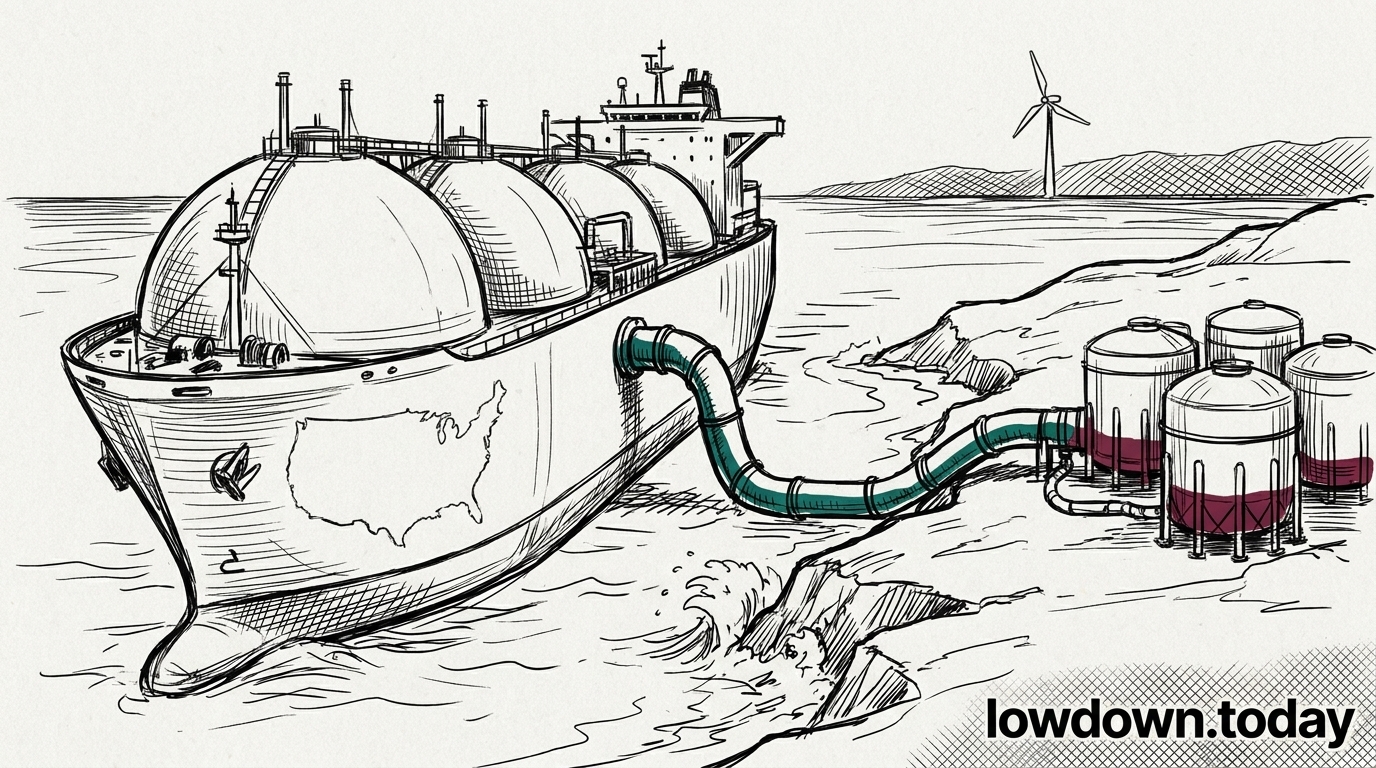
The 58% EU import share confirmed by ACER, heading toward 65% in 2026, represents a structural long-term offtake position that European terminal operators are now willing to underwrite against the German 2031 gas-demand floor. Ribera's warning lands inside a commercial relationship that is expanding, not contracting.
Teresa Ribera, European Commission EVP
Ribera warned Europe should 'avoid replacing one energy dependency with another', framing the ACER 58% US LNG figure as a supply-security risk in the same week TTF broke EUR 50. Her institution has spent EUR 117 billion on US LNG since 2022.
Yara International (ammonia producer)
Front-month TTF at EUR 50+ touches the demand-destruction threshold at which ammonia output curtailments have historically been triggered. Yara faces the same lock-or-ride binary as financial desks, but the downside is production loss rather than mark-to-market exposure.
Katherina Reiche, German Economy Minister
Reiche confirmed the 12 GW hydrogen-ready gas tender is formally agreed with the EU Commission, with first auctions in 2026 and all units operational by 2031. The confirmation closes three years of SPD environment-ministry obstruction and anchors German gas demand through the early 2030s.
European gas trader (Amsterdam desk)
The EUR 50 break is a watershed signal, not a squeeze: the forward curve at EUR 55.21 twelve months out implies the market has repriced structural winter risk, not a positioning overshoot. The lock-or-ride decision on winter hedges closes in June when injection-pace data for May lands.
Hungarian and Slovak gas buyers and regulators
Hungary cleared EUR 123.23/MWh on 12 May, EUR 54 above Spain's same-day clearing and the largest single-market premium of the briefing series, as ACER named it among seven NRAs in TurkStream derogation opinions with the 5 August EC ruling pending. A denial of derogation removes the only available pipeline substitute for Russian LNG banned since 25 April.
