Skip to content
Briefings are running a touch slower this week while we rebuild the foundations.See roadmap
European Energy Markets
18MAY

France swings 88% as FR-DE spread halves

4 min read
11:11UTC

France day-ahead power averaged EUR 37.00/MWh on Monday 11 May, then surged 88% to EUR 69.63/MWh on Tuesday 12 May, while Germany cleared EUR 93.31/MWh down 22% on the day, compressing the FR-DE spread to EUR 23.68 from EUR 37.47 on 7 May.

EconomicDeveloping
Key takeaway

Convergence between France and Germany hides growing dispersion at the edges of the bloc.

France day-ahead power averaged EUR 37.00/MWh on Monday 11 May, then cleared EUR 69.63/MWh on Tuesday 12 May, an 88% intraday move 1. Germany settled at EUR 93.31/MWh the same day, down 22% on the day. The FR-DE spread compressed to EUR 23.68 from EUR 37.47 on 7 May , reversing much of the doubling from EUR 55.75 on 28 April . ENTSO-E, the European transmission system operator network, published the day-ahead data via euenergy.live.

The pattern reflects a high-renewable Monday compressing French and German prices in parallel, then thermal-set prices returning on Tuesday as wind output fell back. EDF's nuclear fleet provided the baseload that suppressed French Monday clearing to EUR 37; once thermal generation re-entered the merit order, the EUR 32.63 gap to Tuesday opened in a single session. Forward positions taken on the EUR 98 snapshot of 7 May now need to price daily swings above EUR 30 rather than a static level. Forward desks now trade the EUR 30+ dispersion rather than the headline level.

Hungary cleared EUR 123.23/MWh on 12 May, EUR 54 above Spain's same-day EUR 69.23, the largest single-market premium in the briefing series. ACER named Hungary and Slovakia among seven national regulatory authorities in its 6 May TurkStream-entry derogation opinions ; the European Commission has not ruled, and the 5 August deadline is the live decision window. Hungary's EUR 54 premium compounds the political case for the derogation while the parallel CJEU challenge runs without a ruling date.

France-Germany has compressed; the edges, Hungary above and Spain below, have widened. Cross-border interconnector revenue for Coreso participants softens as the headline French-German arbitrage narrows, while forward positions on the EUR 37+ snapshot of 7 May face mark-to-market pressure. Flamanville-3's September overhaul, removing approximately 1.6 GW of EPR nuclear baseload, will amplify both level and variance into Q4, compressing the buffer that kept France below Germany through most of Q2.


Deep Analysis

In plain English

Electricity prices in Europe are set every day in auctions, and the price in each country varies depending on how much electricity is being generated from wind, solar, and nuclear power versus gas-fired plants. On Monday 11 May, France had cheap electricity at EUR 37 per megawatt-hour because its nuclear plants were running fully and renewable output was high. On Tuesday, wind dropped and gas plants had to pick up the slack at much higher cost, sending the price to EUR 70. Germany had the opposite pattern: high on Monday, lower on Tuesday. Hungary paid EUR 123 per megawatt-hour, the most expensive in this briefing series, because it lacks cheap connections to France or Spain's renewables and relies more on gas piped in from Russia via a pipeline called TurkStream.

Deep Analysis
Root Causes

European day-ahead power prices have become structurally bimodal since the post-2022 transition. High-renewable sessions (strong wind and solar output, typically Monday-Tuesday) drive continental clearing toward EUR 0-40 in France and EUR 1-10 in Germany.

On thermal-set sessions, gas peakers at EUR 47 TTF set the marginal cost at EUR 80-140. The EUR 30+ intraday variance traders now price across France and Germany is a direct product of renewable penetration plus a high gas-price floor, not a transient anomaly.

Hungary's structural EUR 54 premium over Spain reflects both limited cross-border interconnection and TurkStream dependency. Hungary has no direct connection to cheap French nuclear or Spanish solar via high-capacity interconnectors; its grid balances on gas, priced at Continental spot rates without the Norwegian pipeline-gas discount that Western European markets access.

The ACER TurkStream derogation opinions of 6 May and the Commission's 5 August deadline mean Hungary's gas supply security remains in regulatory limbo through the summer pricing window.

What could happen next?
  • Risk

    Flamanville-3's September 2026 overhaul removes 1.6 GW of French baseload exactly when the storage deficit (currently tracking to 73%) tightens the winter gas supply picture; the two events compound in Q4 2026.

    Medium term · 0.85
  • Consequence

    Hungary's EUR 54 premium over Spain reinforces the economic case for TurkStream derogations; the Commission's 5 August ruling will move Hungarian forward contract pricing in either direction.

    Short term · 0.79
  • Opportunity

    The narrowing FR-DE spread reduces cross-border arbitrage revenue but improves price convergence for consumers in both markets; if Flamanville-3's overhaul is delayed, the compression could persist through Q3.

    Short term · 0.62
First Reported In

Update #9 · Storage 35% met, 80% trajectory still missed

euenergy.live· 12 May 2026
Read original
Different Perspectives
US LNG exporter (Sabine Pass / Corpus Christi)
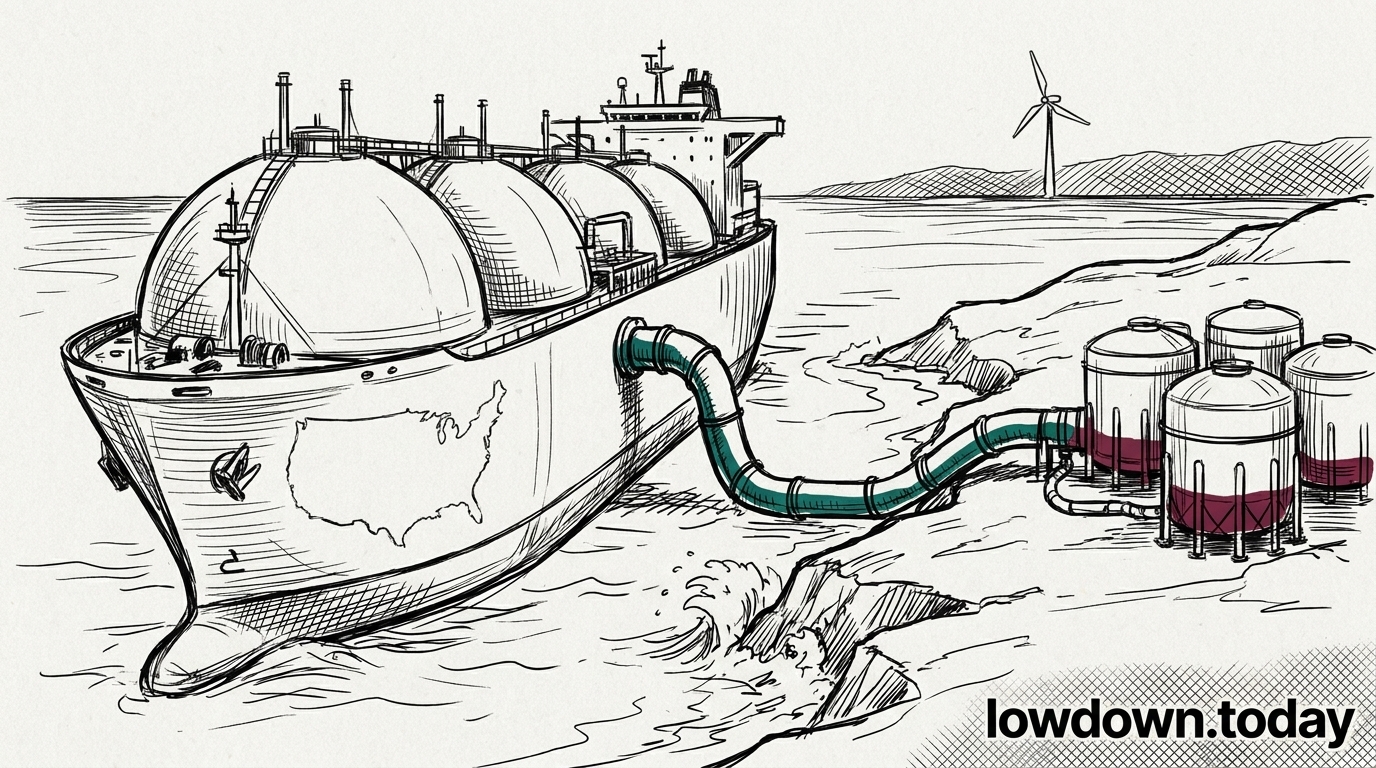
The 58% EU import share confirmed by ACER, heading toward 65% in 2026, represents a structural long-term offtake position that European terminal operators are now willing to underwrite against the German 2031 gas-demand floor. Ribera's warning lands inside a commercial relationship that is expanding, not contracting.
Teresa Ribera, European Commission EVP
Ribera warned Europe should 'avoid replacing one energy dependency with another', framing the ACER 58% US LNG figure as a supply-security risk in the same week TTF broke EUR 50. Her institution has spent EUR 117 billion on US LNG since 2022.
Yara International (ammonia producer)
Front-month TTF at EUR 50+ touches the demand-destruction threshold at which ammonia output curtailments have historically been triggered. Yara faces the same lock-or-ride binary as financial desks, but the downside is production loss rather than mark-to-market exposure.
Katherina Reiche, German Economy Minister
Reiche confirmed the 12 GW hydrogen-ready gas tender is formally agreed with the EU Commission, with first auctions in 2026 and all units operational by 2031. The confirmation closes three years of SPD environment-ministry obstruction and anchors German gas demand through the early 2030s.
European gas trader (Amsterdam desk)
The EUR 50 break is a watershed signal, not a squeeze: the forward curve at EUR 55.21 twelve months out implies the market has repriced structural winter risk, not a positioning overshoot. The lock-or-ride decision on winter hedges closes in June when injection-pace data for May lands.
Hungarian and Slovak gas buyers and regulators
Hungary cleared EUR 123.23/MWh on 12 May, EUR 54 above Spain's same-day clearing and the largest single-market premium of the briefing series, as ACER named it among seven NRAs in TurkStream derogation opinions with the 5 August EC ruling pending. A denial of derogation removes the only available pipeline substitute for Russian LNG banned since 25 April.
