Skip to content
Briefings are running a touch slower this week while we rebuild the foundations.See roadmap
European Energy Markets
18MAY

EDF March output highest since 2019

2 min read
11:11UTC

French nuclear is on track for 350-370 TWh this year and ran EUR 45 under Germany in Wednesday's day-ahead.

EconomicDeveloping
Key takeaway

French nuclear is the regional buffer until September, then one reactor less for a year.

EDF's French nuclear fleet posted its highest monthly output since 2019 in March 2026 and is on track for 350-370 TWh full-year against a CRE-estimated average sale price of EUR 65.90/MWh under the new VNU mechanism 1. The fleet's output translated directly into wholesale prices on 15 April : France landed well beneath the German print and close to Spanish levels on the same session.

The operational effect is that French nuclear surplus is behaving like a southern-European supply asset rather than a domestic baseload. On a low-wind Iberian print the Franco-Iberian interconnector is the arbitrage; on a gas-set German print the north-south flow absorbs the German power premium. Both directions depend on the fleet holding availability through the heavy-maintenance window that typically begins in autumn.

Flamanville-3, France's newest reactor at roughly 1.6 GW, enters a one-year major overhaul from September 2026. That is one unit off the fleet through winter and into the next spring. The shortfall is material relative to the roughly 350-370 TWh target, and it is timed against the autumn-winter window when European storage is either high or exposed. If Germany's April injection fails to recover , the Flamanville-3 overhaul compounds a thin supply stack in the quarter when the stack matters most.

For utilities and industrial offtakers the picture through Q2 is a Franco-Iberian arbitrage while the fleet runs, followed by a material reduction in the regional buffer from September. Positions that lean on French surplus persisting through Q4 2026 need to price the Flamanville-3 calendar, not the March headline.


Deep Analysis

In plain English

France generates about 70% of its electricity from nuclear power stations, more than any other major economy. After several years of problems when safety inspectors found cracks in reactor components and forced many plants offline for repairs, French nuclear output has recovered strongly in early 2026. In March 2026, EDF (the French state utility that owns the nuclear fleet) achieved its highest monthly output since 2019. This matters beyond France because French power stations export surplus electricity to neighbouring countries, helping to keep prices lower in Germany, Spain, and Italy. However, there is a catch: Flamanville-3, France's newest and most powerful reactor, is scheduled for a major one-year overhaul starting September 2026. During that overhaul, France will lose a significant amount of generating capacity, which could raise power prices across the region heading into the following winter.

Deep Analysis
Root Causes

French nuclear's 2019-2022 output collapse had a specific engineering cause: stress corrosion cracking (SCC) found in the primary circuit elbows of PWR reactors, which required simultaneous inspections and repairs across the fleet.

EDF and the French nuclear safety authority ASN eventually developed a standardised repair protocol, allowing the fleet to restart systematically from 2023. The 2026 recovery to seven-year-high output is therefore not a permanent new normal but the completion of a multi-year repair cycle.

Flamanville-3's September 2026 overhaul is the European Pressurised Reactor (EPR), France's first new nuclear unit since 1999 and the first EPR to enter commercial operation anywhere in the world after extensive delays. Major overhauls on first-of-class reactors carry higher schedule risk than fleet maintenance because the repair tooling and procedures have not been standardised.

What could happen next?
  • Risk

    Flamanville-3's one-year overhaul from September 2026 removes the newest and highest-capacity reactor from the fleet precisely as winter 2026-27 demand rises, reducing France's export surplus and increasing Germany and Italy's gas-fired generation hours.

First Reported In

Update #2 · TTF EUR 42 as Russian LNG ban enters range

euenergy.live (ENTSO-E feed)· 15 Apr 2026
Read original
Different Perspectives
US LNG exporter (Sabine Pass / Corpus Christi)
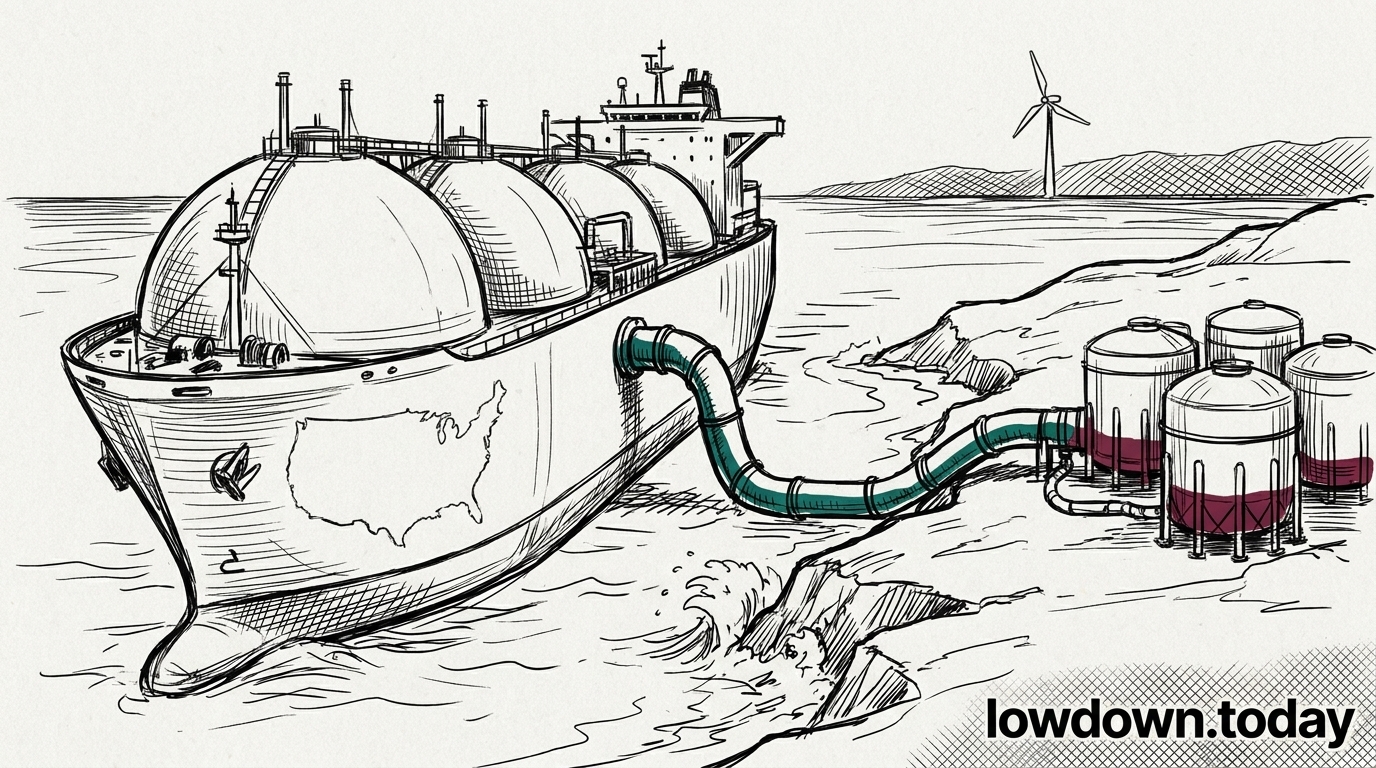
The 58% EU import share confirmed by ACER, heading toward 65% in 2026, represents a structural long-term offtake position that European terminal operators are now willing to underwrite against the German 2031 gas-demand floor. Ribera's warning lands inside a commercial relationship that is expanding, not contracting.
Teresa Ribera, European Commission EVP
Ribera warned Europe should 'avoid replacing one energy dependency with another', framing the ACER 58% US LNG figure as a supply-security risk in the same week TTF broke EUR 50. Her institution has spent EUR 117 billion on US LNG since 2022.
Yara International (ammonia producer)
Front-month TTF at EUR 50+ touches the demand-destruction threshold at which ammonia output curtailments have historically been triggered. Yara faces the same lock-or-ride binary as financial desks, but the downside is production loss rather than mark-to-market exposure.
Katherina Reiche, German Economy Minister
Reiche confirmed the 12 GW hydrogen-ready gas tender is formally agreed with the EU Commission, with first auctions in 2026 and all units operational by 2031. The confirmation closes three years of SPD environment-ministry obstruction and anchors German gas demand through the early 2030s.
European gas trader (Amsterdam desk)
The EUR 50 break is a watershed signal, not a squeeze: the forward curve at EUR 55.21 twelve months out implies the market has repriced structural winter risk, not a positioning overshoot. The lock-or-ride decision on winter hedges closes in June when injection-pace data for May lands.
Hungarian and Slovak gas buyers and regulators
Hungary cleared EUR 123.23/MWh on 12 May, EUR 54 above Spain's same-day clearing and the largest single-market premium of the briefing series, as ACER named it among seven NRAs in TurkStream derogation opinions with the 5 August EC ruling pending. A denial of derogation removes the only available pipeline substitute for Russian LNG banned since 25 April.
