Skip to content
You can now search across every topic, entity and event.What's new
Drones: Industry & Defence
21MAY

Ukraine shares drone-defence playbook

3 min read
11:11UTC

No military has shot down more Iranian-design drones in combat than Ukraine's. Kyiv is now packaging that operational knowledge for non-NATO states facing the same threat.

TechnologyDeveloping
Key takeaway

Ukraine is packaging combat-proven drone-intercept expertise into a new defence diplomacy currency.

Ukraine announced on 2 March that it will offer drone-interception expertise to non-NATO states facing Iranian-pattern unmanned aerial threats 1. The package covers radar signatures, optimal interception angles, and electronic warfare countermeasures — all derived from combat, not simulation.

No military has more experience defeating Iranian-design drones. Ukrainian air defences have engaged thousands of Shahed-136 variants and their Russian-manufactured copies since Iran began supplying them in autumn 2022. That operational dataset — which interception method works at which altitude, which electronic signatures precede which attack profile, where the guidance systems are most vulnerable — has no equivalent in NATO training programmes, because no NATO member has faced this threat at scale.

The intended recipients are states outside the Western alliance structure facing drone proliferation without integrated air-defence networks. Saudi Arabia and the UAE have confronted Houthi drone attacks since 2019; several sub-Saharan African states face armed drone use by non-state actors. For these governments, Ukraine's combat-tested knowledge has immediate practical value that a NATO membership aspiration does not.

The diplomatic content matters as much as the defence content. Kyiv draws a direct line between Russia's war and Iran's global proliferation network, reframing its own defence as a contribution to international security rather than a regional expense. As European support displaces American funding and Trump presses Zelenskyy for a rapid settlement, Ukraine's ability to present itself as a defence partner rather than an aid recipient strengthens its negotiating hand. The announcement also complicates any diplomatic effort to separate the Iran file from the Russia file: if Ukrainian expertise is actively protecting third countries from Iranian drones, the two conflicts are operationally linked whether negotiators wish them to be or not.


Deep Analysis

In plain English

Ukraine has shot down more Iranian-design drones than any other military in history. That experience — knowing exactly how Shahed drones fly, what radar signatures they emit, which angles are most vulnerable to interception, and which electronic warfare frequencies disrupt their guidance — is genuinely valuable knowledge that no training manual or simulation can replicate. Countries in Africa, the Middle East, and South Asia facing Iranian-supplied drones from proxy groups currently have no equivalent combat-experienced partner to turn to. Ukraine is now offering to share that knowledge. It costs Ukraine nothing to produce — the knowledge is generated daily by ongoing combat operations — but it earns Kyiv political goodwill, potential revenue, and relationships with countries that will matter during post-war reconstruction and at the UN.

Deep Analysis
Synthesis

Unlike hardware exports, knowledge transfer creates ongoing dependency relationships: recipient nations will need Ukrainian expertise to update their counter-drone capabilities as Iranian drone designs evolve, making the relationship self-renewing. Ukraine is not merely selling a one-time service — it is positioning itself as an indispensable node in a latent counter-Iranian-drone coalition that cuts across NATO and non-NATO lines, a diplomatic network that could prove more durable than formal alliance memberships.

Root Causes

Ukraine's initiative reflects a structural calculation about post-war positioning. As US direct support has contracted, Kyiv requires alternative diplomatic relationships that do not depend on NATO membership or Western political cycles. Expertise export is the only asset Ukraine can offer at scale without depleting its own capabilities — unlike weapons transfers, sharing interception knowledge does not reduce Ukraine's own defence capacity. It also creates a basis for reciprocal political support in UN votes and reconstruction financing discussions.

What could happen next?
  • Opportunity

    Ukraine can build a latent political coalition among non-NATO states facing Iranian drone proliferation, generating UN voting support and reconstruction investment relationships independent of Western alliance structures.

    Medium term · Assessed
  • Consequence

    Iran may interpret Ukraine's expertise export as a direct threat to its regional drone-proxy influence and accelerate technology transfers to Russia or to proxy groups to stay ahead of interception knowledge.

    Short term · Suggested
  • Precedent

    Ukraine establishes that a nation under full-scale attack can simultaneously function as a defence knowledge exporter, reshaping assumptions about wartime diplomatic capacity for future conflicts.

    Long term · Assessed
  • Opportunity

    Ukrainian defence firms gain commercial entry points into non-NATO markets currently dominated by Israeli, French, and US systems, with combat-proven credentials as the primary differentiator.

    Medium term · Suggested
First Reported In

Update #1 · Ukraine best month as Russia triples drones

Al Jazeera· 3 Mar 2026
Read original
Different Perspectives
Procurement sceptics
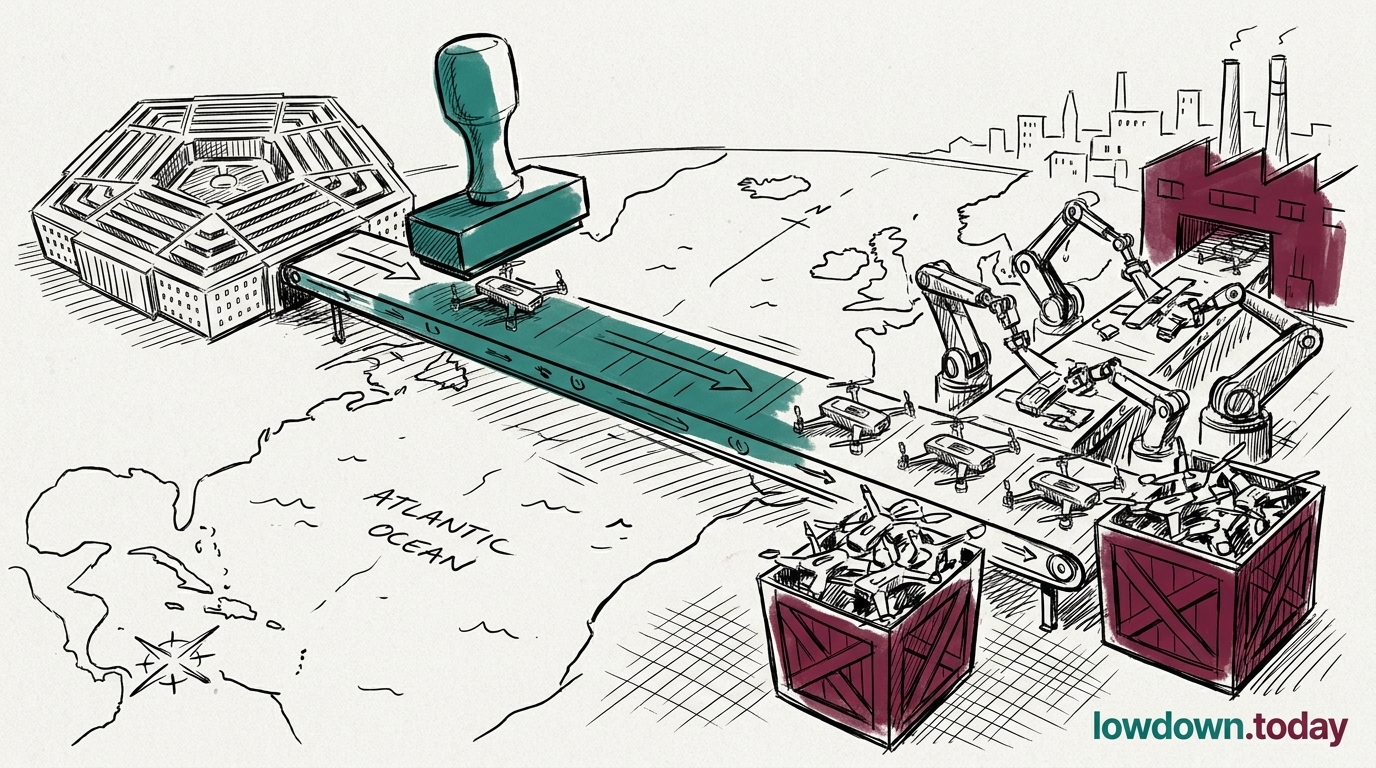
Two identically sized IDIQs to different primes within seven weeks, and a five-nation pact where one partner moves weeks ahead of the rest, could just as easily read as an industrial base still improvising vendor mix as a deliberate hedging doctrine. Neither ceiling appears sized against a validated requirement yet.
Chinese component suppliers
FCC and Pentagon-level restrictions on Chinese-origin airframes and motors have progressively excluded DJI-linked suppliers from federal counter-drone catalogues, narrowing the field JIATF-401 and Gauntlet II can buy from to a short list of certified domestic bidders. Beijing reads the exclusions as protectionism dressed as security policy.
Quantum Systems
Quantum Systems
Blackstone, Airbus, Advent and Noteus reportedly priced the Munich drone maker at $8 billion, more than double its prior mark, on the strength of 19,000 Ukraine missions rather than confirmed revenue. It is betting production capacity, not current sales, is what buyout capital is now paying for.
United Kingdom
United Kingdom
Britain released the first LEAP effector money three weeks after its defence secretary quit over the size of the drone budget, splitting £3.16 million across three small firms rather than one contractor. It expects the other four LEAP partners to follow its pace, not set their own.
JIATF-401
JIATF-401
The task force handed AeroVironment a $500 million counter-drone ceiling identical to Perennial Autonomy's from seven weeks earlier, while its own Gauntlet II red team prepares to attack the drones the winners of that sprint will build. It expects to keep several qualified suppliers warm rather than certify one.
DroneShield
DroneShield
DroneShield appointed retired Rear Admiral Lee Goddard as an independent director from 1 July, its second board move since founder Oleg Vornik's April exit. The ASIC probe into November's disclosures and share sales stays open, so the admiral steadies the story without closing the file.



