Skip to content
Briefings are running a touch slower this week while we rebuild the foundations.See roadmap
Drones: Industry & Defence
21MAY

Healey commits £752M for 120,000 Ukraine drones in Berlin

3 min read
11:11UTC

UK Defence Secretary John Healey named Tekever, Windracers and Malloy as primary suppliers at the 34th UDCG on 15 April.

TechnologyDeveloping
Key takeaway

The £752M Berlin package names the £4bn doubling's first suppliers; contract concentration is hidden behind SME framing.

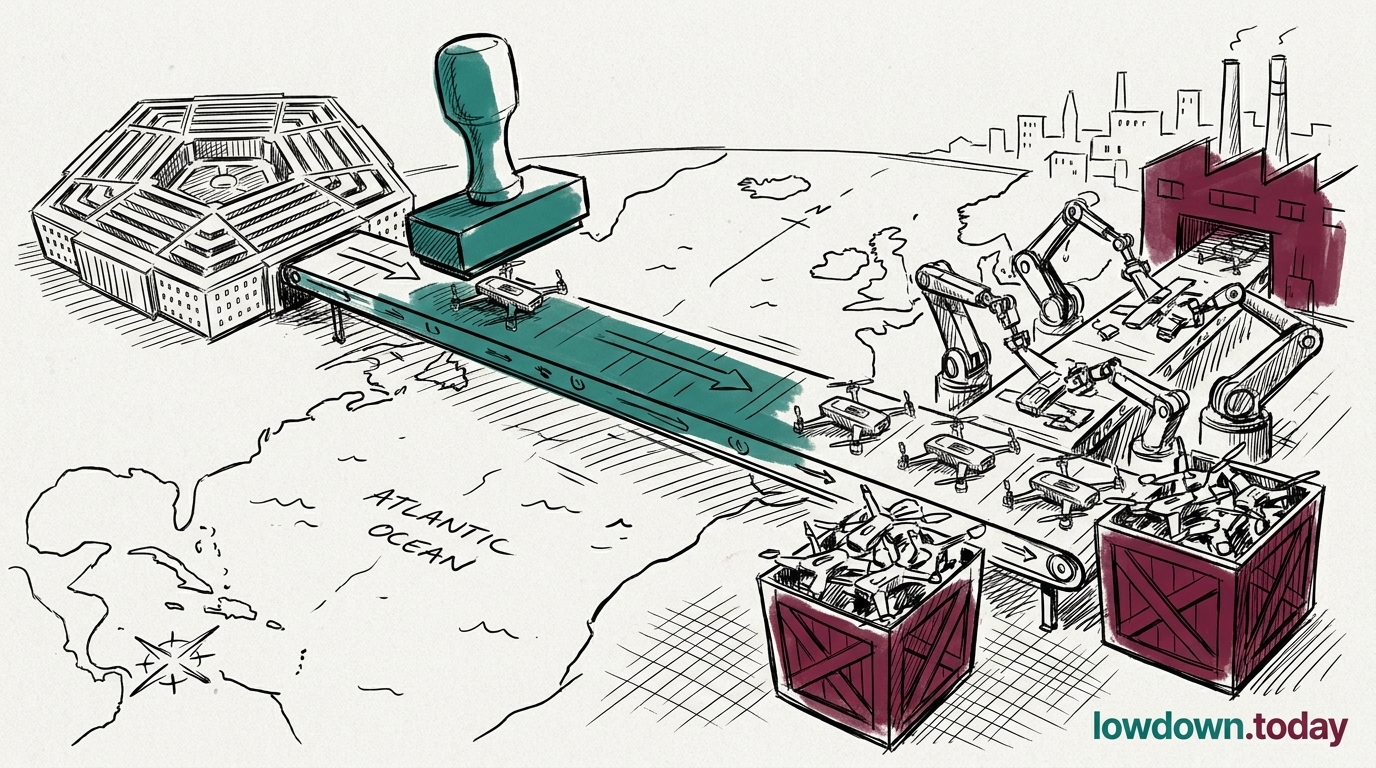
John Healey announced a £752 million Ukraine drone package at the 34th Ukraine Defence Contact Group in Berlin on 15 April, committing 120,000 unmanned systems with deliveries already underway. Healey named Tekever, Windracers and Malloy Aeronautics as the three primary suppliers. Healey also used the meeting to trail a wider UK military support envelope for Ukraine this year and a £390 million UK-Ukraine industrial strand alongside it.

The £4 billion autonomous-systems doubling has now produced its first signed work in the form of the Berlin package. Until now the headline number was abstract; in Berlin it acquired named counterparties, unit volumes, and a delivery clock. The £752M package also sits alongside the Skyhammer interceptor buy from Cambridge Aerospace announced the same week , sketching a British procurement posture that blends mass attritable systems with dedicated counter-drone kinetics for the first time.

What the MOD did not publish matters almost as much as what it did. There is no per-supplier breakdown of the £752M, no volume split across the three firms, and no disclosure of whether the deliveries count against the £4bn total or sit alongside it. Tekever, Windracers and Malloy Aeronautics have very different scales, ownership structures and product categories, and grouping them under a single SME-flavoured press line obscures a contract distribution that is almost certainly lopsided. UK Ministry of Defence sources confirmed to FlightGlobal that the package value is £752 million (approximately $1 billion), but left the internal share undisclosed.

Kyiv needs throughput above all else. The UK drone industrial base faces a different question, namely who under the SME banner is actually receiving multi-hundred-million-pound work.

Deep Analysis

In plain English

The UK government has promised to send 120,000 drones to Ukraine, worth £752 million. To put that in context: £752 million is roughly the annual budget of a medium-sized NHS hospital trust. Drones have become one of the most important weapons in the Ukraine war. Small cheap drones spot enemy positions or carry small bombs; medium drones deliver supplies or carry larger payloads. Front-line consumption in Ukraine runs so fast that Ukrainian units typically lose hundreds of drones per week across the front. Britain named three companies that will supply the drones. Two of them turn out to be much larger than the government implied: one, called Tekever, already held £270 million in existing British defence contracts, and another, Malloy Aeronautics, is owned by BAE Systems, one of the world's biggest defence companies.

Deep Analysis
Root Causes

Three structural drivers brought the Berlin package to this scale at this moment.

First, the £4 billion autonomous-systems doubling created an underspend problem by mid-2026: funds were committed in principle but contracts were not yet signed, creating Parliamentary scrutiny pressure on the MoD to show concrete spending.

Second, the 34th UDCG meeting was preceded by US proposals to reduce its own bilateral aid commitments, creating space for European allies to fill with visible announcements. The Berlin forum gave the UK both an audience and a political incentive to lead.

Third, Ukraine's operational attrition rate in FPV and ISR drones had accelerated through Q1 2026, with front-line consumption outpacing resupply. Healey's team needed a package that could claim immediate delivery credit, which is why the announcement led with "deliveries already underway" rather than contract signing.

What could happen next?
  • Consequence

    Tekever's Swindon factory, opening summer 2026, becomes a critical-path dependency for British delivery commitments; any delay in factory commissioning puts the '120,000 units' headline at risk.

    Short term · 0.75
  • Precedent

    Naming suppliers publicly in bilateral defence packages creates a template that other UDCG members may follow, increasing transparency but also increasing adversary targeting intelligence.

    Medium term · 0.65
  • Risk

    If Malloy's BAE Systems ownership receives public scrutiny during Parliamentary questions, ministers face having to defend the SME framing retroactively, which may trigger a review of the £4bn autonomous-systems narrative more broadly.

    Short term · 0.7
First Reported In

Update #6 · Britain's £752M Ukraine drone package

UK Ministry of Defence / gov.uk· 18 Apr 2026
Read original
Causes and effects
This Event
Healey commits £752M for 120,000 Ukraine drones in Berlin
Britain has finally converted its £4 billion autonomous-systems pledge (ID:2304) into named contracts, and it has done so in public, in Berlin, with deliveries already underway. The package reframes the UK's Ukraine support as industrial policy: named British suppliers, named volumes, and a political anchor inside the Ukraine Defence Contact Group. For the drone-industry beat, this is the first hard data point on how the £4bn doubling will actually be spent, which firms benefit, and which do not. Every subsequent award will be judged against these three names and this headline figure.
Different Perspectives
Institutional investors and defence-sector equity markets
Perennial's IDIQ gives revenue-visibility that earlier Schmidt ventures lacked; Northrop's dual award places a heritage prime on the attritable-payload standard-setting layer analysts had reserved for startups. Rheinmetall at €650 per share, up from €500 in January, prices auto-grade drone conversion as margin-accretive; DroneShield's ASIC probe introduces a governance-discount variable proxy advisers will apply at the 29 May AGM.
Korean defence-industrial sector (LIG Nex1, Hanwha Aerospace)
LIG Nex1's $2.2 billion Cheongung-III win and the KUS-FS service introduction together close Seoul's sovereign layered air-defence stack; both firms face multi-year backlog revisions on the Korea Exchange. The unresolved sensor-to-shooter integration risk between Hanwha's LAMD sensors and LIG Nex1's Cheongung-III engagement layer sits publicly unaddressed ahead of the 2029 fielding date.
Ukrainian export regulator (SSEC)
Ukraine's wartime export ban blocks Gulf sales of combat-proven interceptors at $2,100 to $2,500 per unit while Perennial Autonomy, built on Ukrainian combat data, wins a $500 million US IDIQ. Perennial's Merops, credited with 4,000-plus Russian drone kills in Ukraine, can now reach NATO allies via Munich; a direct Ukrainian sale to those same buyers remains legally blocked.
DJI and Autel Robotics
Autel's Ralls Corp filing attacks the classified-evidence foundation of its Covered List designation; DJI's parallel Ninth Circuit case has quantified $1.56 billion in 2026 regulatory losses. Both companies are now betting the D.C. Circuit will extend due-process protections to FCC product certification, a constitutional route that does not require contesting the intelligence allegations directly.
US Pentagon defence-industrial-base policy
JIATF-401's IDIQ names Perennial the benchmark holder while Anduril's $20 billion Lattice vehicle and Northrop's Drone Dominance payload role run in parallel lanes; the DoD bet is that named holders at each tier cut order-to-delivery cycles. The Section 232 clock 54 days overdue signals the administration treats FCC and FAR exclusions as sufficient to manage Chinese market access.
European defence procurement community
Germany's three-tier award demonstrates that EU member states can fund loitering-munition production at scale without single-supplier dependency, and Perennial's Munich line gives procurement offices a domestic-source justification for Merops orders outside US Foreign Military Sales channels. The Bundeswehr's split across Helsing, Stark and Rheinmetall has become the reference architecture other European buyers are mapping their own industrial bases against.
