Skip to content
Briefings are running a touch slower this week while we rebuild the foundations.See roadmap
Drones: Industry & Defence
13APR

UK buys Skyhammer from unproven startup

2 min read
13:26UTC

Defence Secretary Healey announced procurement of Skyhammer counter-drone interceptors from Cambridge Aerospace, a British startup with no prior production record, with first deliveries expected May.

TechnologyDeveloping
Key takeaway

UK procurement urgency is compressing startup-to-delivery timelines from years to weeks.

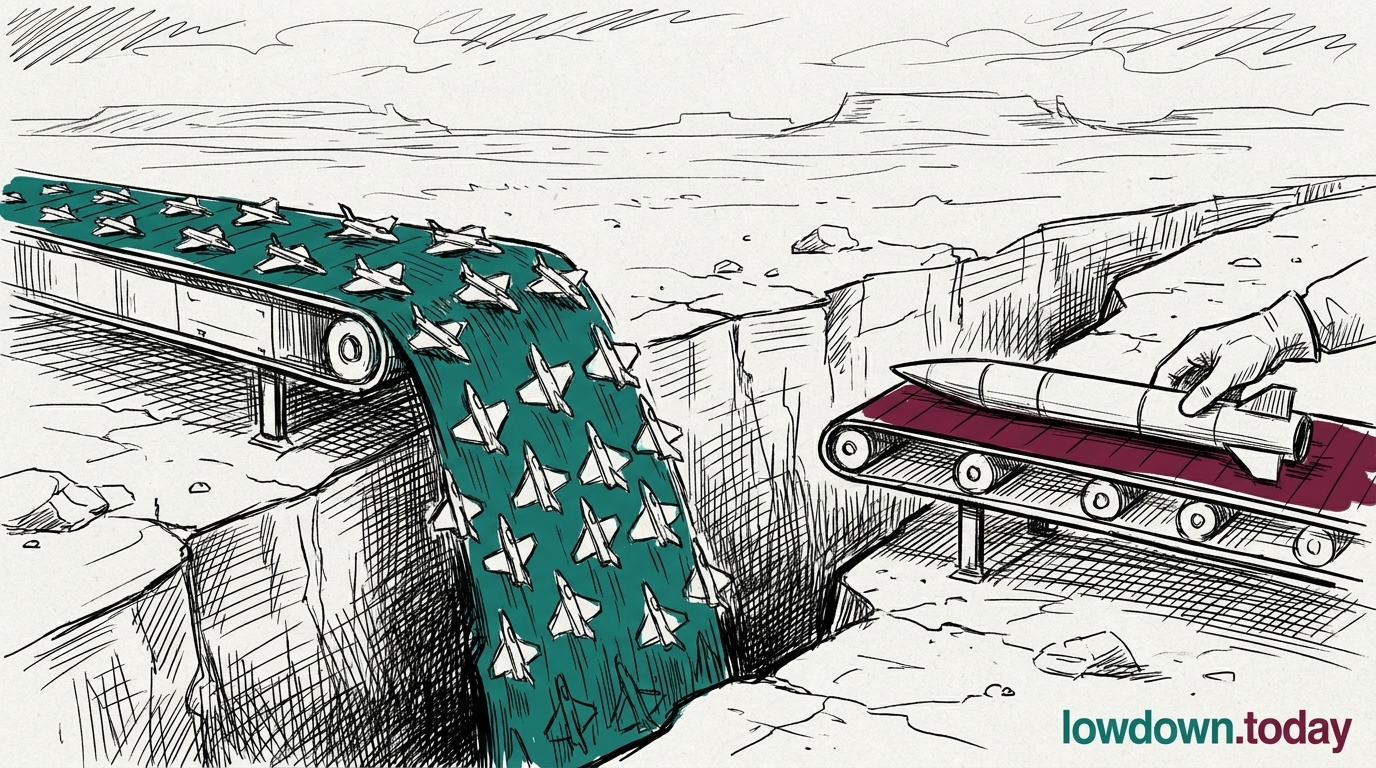
Defence Secretary John Healey announced on 10 April the procurement of Skyhammer interceptor missiles from Cambridge Aerospace, a British startup. The subsonic turbojet interceptor has a 30km range and an active X-band radar seeker designed to counter Shahed-class drones. First deliveries are expected as early as May.

Cambridge Aerospace has no prior production track record at scale. The May delivery expectation represents extraordinary risk tolerance by the Ministry of Defence, a signal of how urgently Gulf attrition rates have compressed procurement timelines. The cumulative UAE intercept data has turned counter-drone acquisition from a future requirement into an immediate operational demand.

Skyhammer addresses the threat Britain can detect: radar-visible, subsonic attack drones of the Shahed class. It does not address the fibre-optic gap that UKDI acknowledged the same week (see Event 6). The UK is buying kinetic solutions for threats it can see while simultaneously admitting it cannot see an entire class of drone already in the operational theatre.

For Cambridge Aerospace, the contract is transformative. A startup that delivers to MOD production schedules becomes a credible Tier 1 supplier overnight. The UKDI rapid investment tranche is distributing £140 million across British SMEs; Skyhammer is now the highest-profile programme in that pipeline. The company's entire commercial trajectory depends on the May delivery schedule.

Deep Analysis

In plain English

The UK government has ordered counter-drone missiles from Cambridge Aerospace, a British startup that has never produced missiles at scale before. First deliveries are expected in May, which is weeks away from the announcement. Skyhammer is a missile with a range of 30km designed specifically to shoot down Shahed-type drones, the kind Iran is firing at Gulf states. It locks onto the drone using radar and intercepts it. The challenge is that Cambridge Aerospace has to go from announcement to delivering working missiles to the military in a matter of weeks. That is the drone industry equivalent of being asked to finish your dissertation tomorrow.

What could happen next?
  • Precedent

    A startup-to-MoD delivery timeline of weeks, if achieved, permanently changes the procurement model for British SMEs; every future competitive tendering process will be measured against the Cambridge Aerospace benchmark.

  • Risk

    Single-source dependency on an unproven startup for a critical counter-drone capability means that any production failure at Cambridge Aerospace leaves the UK with no alternative in the near term.

First Reported In

Update #5 · Gulf drone war rewrites procurement

UK Defence Journal· 13 Apr 2026
Read original
Different Perspectives
Chinese drone manufacturers (DJI, Autel)
Autel's Ralls Corp Fifth Amendment filing and DJI's Ninth Circuit quantification of USD 1.56 billion in 2026 losses are parallel constitutional attacks on a classified-evidence exclusion mechanism; neither company can contest the intelligence allegations directly, so both are betting on due-process doctrine to reopen the FCC authorisation route.
Ukraine (SSEC export regulator)
Baltic states bought Lithuanian Merops and Swedish LVKV 90 stopgaps while Ukraine's cheapest combat-proven interceptors at USD 2,100 to USD 2,500 per unit remain legally blocked under EU conflict-aggravation rules; Perennial Autonomy, built on Ukrainian combat data, can now sell via Munich while direct Ukrainian sales to the same buyers remain prohibited.
Helsing
Helsing
HX-2 combat-proven status, a EUR 1.46 billion German framework, an $18 billion valuation, and the OHB space JV together constitute the first credible European counterweight to Anduril's US stack. The critical test is whether European procurement offices can maintain sovereign AI discipline under operational urgency, or default to the US integration speed that drove the Netherlands Lattice decision.
Anduril Industries
Anduril Industries
A USD 61 billion valuation on USD 2.2 billion revenue prices in the assumption that Lattice becomes the default Western counter-drone software layer. The Netherlands adoption and Project NYX inclusion suggest the architecture bet is converting; the S-1 filing window opens when quarterly growth sustains the 27x multiple.
European Union
European Union
The EUR 115 million AGILE programme was designed before Baltic states began emergency national purchases worth ten times the total EU budget; calling for coordination on 26 May after each country had signed contracts is not a procurement policy, it is a statement of concern with no enforcement teeth.
UK Ministry of Defence
Britain has committed GBP 752 million to Ukraine drones, GBP 115 million to Hormuz, APKWS to Gulf combat, and three concurrent procurement programmes, all driven by the same operational pressure. Project NYX and Corvus together set the British Army's drone architecture through 2036; the autumn down-select will reveal whether Washington or London holds the architectural preference.
