Skip to content
Briefings are running a touch slower this week while we rebuild the foundations.See roadmap
Drones: Industry & Defence
13APR

Iran breaks Gulf ceasefire within hours

3 min read
13:26UTC

Iran launched 94 drones and 30 missiles at Gulf states hours after an 8 April ceasefire announcement; Trump declared a naval blockade of the Strait of Hormuz on 12 April.

TechnologyDeveloping
Key takeaway

Hormuz blockade opens a maritime drone requirement that did not exist a fortnight ago.

Iran launched 94 drones and 30 missiles at Gulf states within hours of the 8 April ceasefire announcement brokered by Pakistan. JD Vance confirmed on 12 April that talks had collapsed after a single day of negotiations. President Trump declared a naval blockade of the Strait of Hormuz the same day.

The speed of the violation signals deliberate strategy rather than failed communication. The Soufan Center assessed on 6 April that Iran retains roughly 50% of its arsenal and is rationing launch rates to sustain a long-duration campaign. At 50 to 100 Shaheds per day from dispersed civilian workshops, Iran is producing faster than the West can intercept. The CSIS-documented campaign since 28 February now includes the first confirmed post-ceasefire wave, confirming that the diplomatic track has closed.

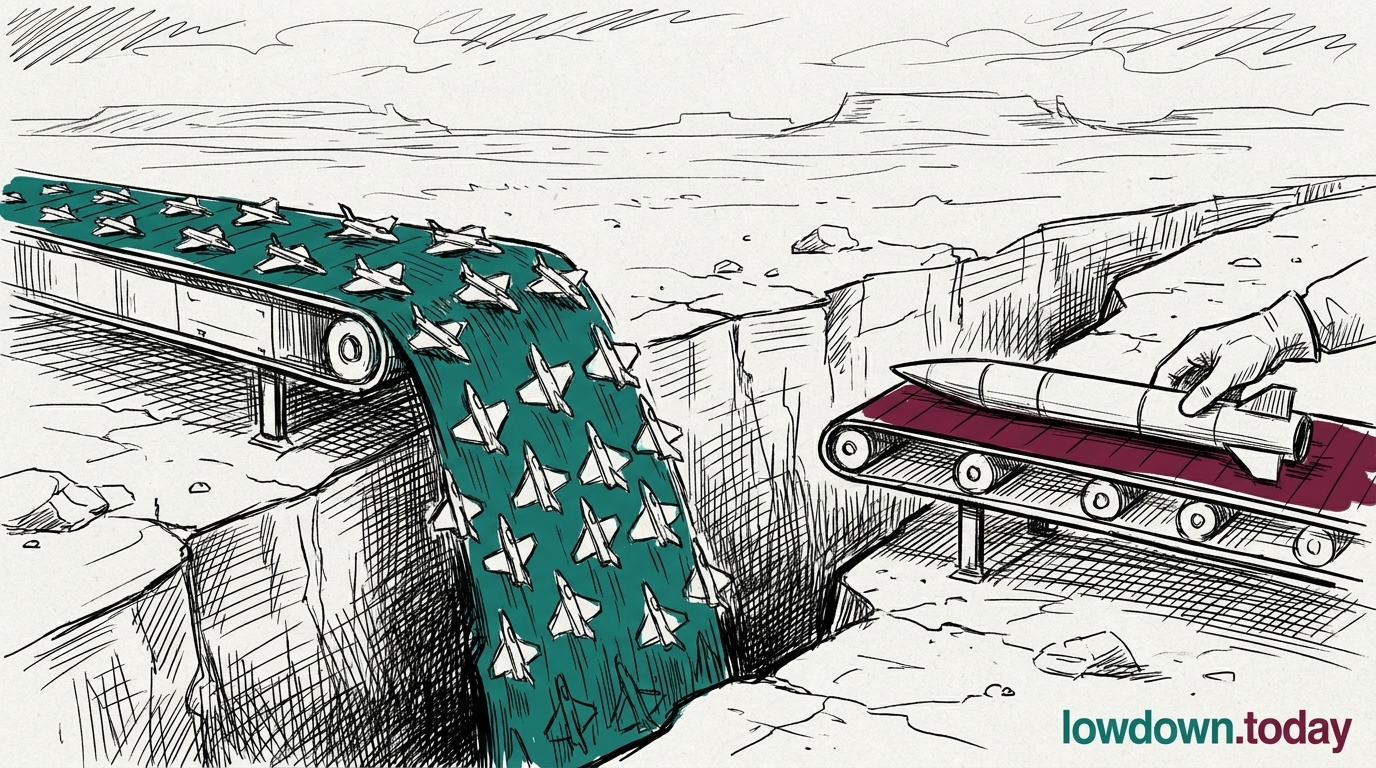
The Hormuz blockade opens a maritime drone theatre with no operational precedent. Naval drone interdiction at blockade scale requires autonomous platforms, communications architectures, and rules of engagement that do not yet exist in any navy's inventory. The original drone Dominance order for 30,000 attack drones was scoped for land-based operations; the maritime requirement adds a second demand signal on top of an already strained production base.

For the drone industry, the combined effect is structural: procurement timelines that were measured in fiscal years are now measured in weeks, and every major contract decision in this update traces back to what is happening in the Gulf.

Deep Analysis

In plain English

Iran agreed to a ceasefire on 8 April but within hours launched nearly 100 drones and 30 missiles at Gulf countries anyway. The ceasefire lasted less than a day. President Trump responded by declaring a naval blockade of the Strait of Hormuz, a narrow waterway between Iran and Oman through which roughly one-fifth of the world's oil passes. Blocking it even partially would push up petrol prices worldwide. For the drone industry, this matters because it adds a completely new requirement: drones that can operate at sea. Land-based drone doctrine does not transfer to maritime blockade enforcement. No navy currently has the equipment ready for that.

Deep Analysis
Root Causes

Iran's post-ceasefire launch is not a failure of communication but a product of the IRGC's structural autonomy from civilian government. Mojtaba Khamenei, appointed under IRGC pressure, cannot order a stand-down that the Guard does not endorse without threatening his own position in an institution that placed him there.

The Hormuz blockade reflects a US strategic choice to escalate horizontally rather than vertically: rather than striking Iranian territory directly, which carries nuclear escalation risk, the administration is closing the economic chokepoint that matters most to China and India. The signal is calibrated to impose costs beyond the immediate theatre.

What could happen next?
  • Risk

    Naval drone interdiction at blockade scale requires autonomous platforms no navy currently possesses; the gap between declared policy and operational capability creates a six-to-twelve month window of vulnerability.

    Short term · 0.78
  • Consequence

    China and India, whose energy imports depend on Hormuz passage, face pressure to either broker a resolution or develop alternative supply arrangements, reshaping their diplomatic positioning toward Iran.

    Medium term · 0.72
  • Opportunity

    Maritime counter-drone procurement will open as a new funding category across US, UK, and allied navies within 90 days, creating an addressable market that did not exist before 12 April.

    Short term · 0.81
First Reported In

Update #5 · Gulf drone war rewrites procurement

Al Jazeera· 13 Apr 2026
Read original
Different Perspectives
Chinese drone manufacturers (DJI, Autel)
Autel's Ralls Corp Fifth Amendment filing and DJI's Ninth Circuit quantification of USD 1.56 billion in 2026 losses are parallel constitutional attacks on a classified-evidence exclusion mechanism; neither company can contest the intelligence allegations directly, so both are betting on due-process doctrine to reopen the FCC authorisation route.
Ukraine (SSEC export regulator)
Baltic states bought Lithuanian Merops and Swedish LVKV 90 stopgaps while Ukraine's cheapest combat-proven interceptors at USD 2,100 to USD 2,500 per unit remain legally blocked under EU conflict-aggravation rules; Perennial Autonomy, built on Ukrainian combat data, can now sell via Munich while direct Ukrainian sales to the same buyers remain prohibited.
Helsing
Helsing
HX-2 combat-proven status, a EUR 1.46 billion German framework, an $18 billion valuation, and the OHB space JV together constitute the first credible European counterweight to Anduril's US stack. The critical test is whether European procurement offices can maintain sovereign AI discipline under operational urgency, or default to the US integration speed that drove the Netherlands Lattice decision.
Anduril Industries
Anduril Industries
A USD 61 billion valuation on USD 2.2 billion revenue prices in the assumption that Lattice becomes the default Western counter-drone software layer. The Netherlands adoption and Project NYX inclusion suggest the architecture bet is converting; the S-1 filing window opens when quarterly growth sustains the 27x multiple.
European Union
European Union
The EUR 115 million AGILE programme was designed before Baltic states began emergency national purchases worth ten times the total EU budget; calling for coordination on 26 May after each country had signed contracts is not a procurement policy, it is a statement of concern with no enforcement teeth.
UK Ministry of Defence
Britain has committed GBP 752 million to Ukraine drones, GBP 115 million to Hormuz, APKWS to Gulf combat, and three concurrent procurement programmes, all driven by the same operational pressure. Project NYX and Corvus together set the British Army's drone architecture through 2036; the autumn down-select will reveal whether Washington or London holds the architectural preference.
